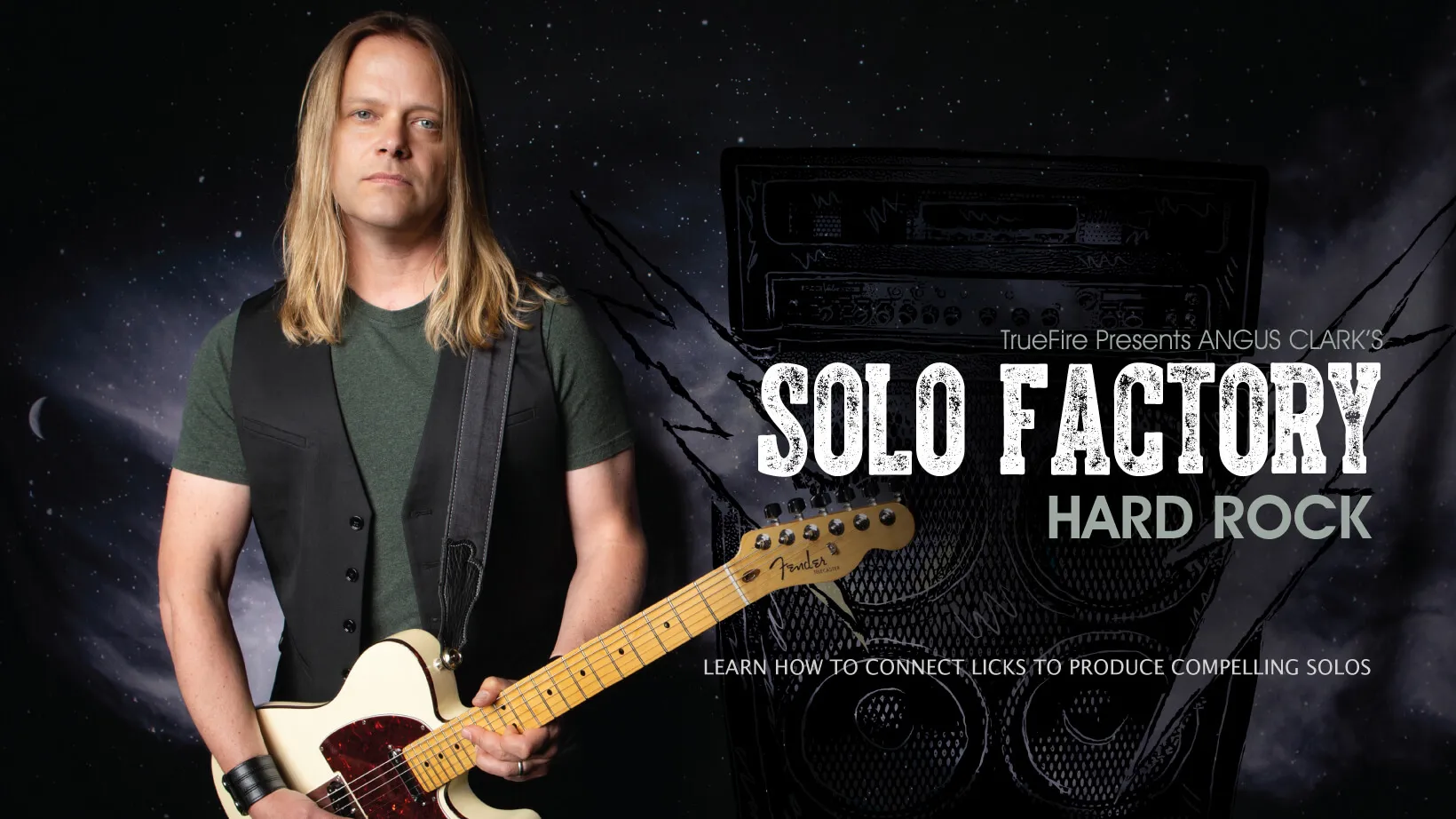
Solo Factory: Hard Rock

Learn How To Construct Compelling Hard Rock Solos

Marty FriedmanTommy EmmanuelSteve VaiEric GalesEric Johnson

Get this course and 1,000+ more with All Access

Try 14 days free. Cancel any time.

Purchase Individual Course for $14.99
Solo Factory: Hard Rock

About this course

Learning the language of music and improvisation is like learning any new language. You start by articulating sounds (notes), which sounds you use to form words and sentences (licks and phrases), and which sentences you string together into stories (solos). The tricky part is connecting those licks and phrases into compelling and interesting solos.

Angus Clark’s Hard Rock edition of Solo Factory reveals a variety of creative and effective ways to seamlessly connect your vocabulary of licks and craft full-length, exciting solos.

”Every guitarist develops their own vocabulary of licks and phrases easily enough. But, connecting those licks and phrases into a compelling solo can be fairly challenging. In this Solo Factory, we’ll discuss solo architecture and work on an essential vocabulary of licks, separated into four thematic categories.  We’ll cover melodic licks, builder licks that facilitate register changes, a handful of my own go-to “money” licks, and of course, we’ll cover a few blazing, over-the-top licks you’ll melt faces with.

We’ll then work through a series of 8 solo performance studies across 4 distinct hard rock tracks demonstrating how you can build more impactful solos by mixing, modifying, and connecting the licks from the first section. “


In the first section of the course, Angus will teach you 5 ‘melodic’ licks, 4 ‘building’ licks, 6 ‘money’ licks, and 9 ‘over-the-top’ licks. In the second section of the course, Angus demonstrates how to craft solos with that vocabulary of licks over a variety of hard rock feels and tempos. You’ll play your way through 9 soloing performance studies.

Angus will explain and demonstrate all of the key concepts and approaches along the way.  You’ll get standard notation and tabs for all of the performance studies. Plus, Angus includes all of the rhythm tracks for you to work with on your own. In addition, you’ll be able to loop or slow down any of the videos so that you can work with the lessons at your own pace.

Grab your guitar and let’s rock hard with Angus Clark!

What you'll learn

  • Navigate the challenging transition between arpeggio positions
  • Apply chord extensions like minor 7th in soloing context
  • Create an ensemble-oriented solo that locks with the rhythm section
  • Construct a high-energy solo without relying heavily on scale runs
  • Build solo energy using tremolo picking and octave bends
Release date: 10/01/2018 • 2h 20m runtime
Start Course
Sample lessons
Symphonic Half Steps
Melodic Lick 4
Accelerating Ascent
Accelerating Ascent
Building Lick 4
Repeaters
Repeaters
Money Lick 6
More Sixteenths
More Sixteenths
Over The Top Lick 5

What's included

52 lessons • 32 charts • 28 Jam Tracks

Solo Factory: Hard Rock
Welcome to the Solo Factory for Hard Rock! This course is designed to bridge the gap between learning licks and crafting solos. I remember struggling with how to really apply everything I was learning on the guitar into a real playing context. It seemed all I got was ambiguous advice like "tell a story", or "compose a song within a song", or "focus on your phrasing". Meanwhile, all I'm thinking is: "Show me the secrets!" Well, here they are.

We'll show you a vocabulary of licks, and categorize them into their different functions within a solo. Then we'll show you how to plug them into a couple of different solo structures that are based on some of the most iconic solos of all time. I'll demonstrate how the factory works with playing examples from real records that I've made over the last couple of years.

It's all here including the tab and the jam tracks, so let's get started!
SECTION 1: Solo Architecture
The Solo Factory format at TrueFire was originally designed for blues players, where there are strict forms and chord progressions so you can kind of mix and match the chord licks into solos. For rock, things are a bit more unpredictable, so we had to take a different approach. The approach in this course is based on a few core assumptions, and they are:
  1. Hard rock solos are primarily composed.
  2. Hard rock phrasing is primarily from downbeat to downbeat.
  3. Hard rock solos are usually in a single key or mode.
The licks are categorized into different types so that they can be combined based on a "solo architecture". This is where we decide how the energy in the solo is going to ebb and flow, and by what means. The energy can be built using fundamental such as speed (slow vs. fast), register (high vs. low), quality (consonance vs. dissonance).

In the discussion here, we look at the design of three hard rock solos that broke the radio: "Crazy Train" by Randy Rhoads, "Nothing But A Good Time" by CC DeVille, and "The Unforgiven" by Kirk Hammett. I don't play through any of these solos here, as most of us can sing them in our heads, so I'll just summarize the structures of these solos instead:

CRAZY TRAIN
Beginning: High energy created by SPEED.
Middle: Hook created with MELODICISM and REPEATER licks.
End: High energy created with SPEED and REGISTER (end with a high note).

NOTHIN BUT A GOOD TIME
Beginning: Hook created with HIGH REGISTER (highest note on the guitar).
Middle: Energy shifted by switching from Pentatonic to Diatonic, and SHIFTING REGISTER.
End: High Energy created with SPEED and REGISTER.

THE UNFORGIVEN
Beginning: DIGGING IN, with a double stop bend and low register blues licks at the top.
Middle: TRANSITION LICK to shift registers, REPEATER arpeggio lick to build tension.
End: HIGH REGISTER and ORCHESTRATED MELODIC passage.

All three solos are composed, all three solos feature phrases that primarily work from downbeat to downbeat, all three solos have an architecture that features a strong entrance, some development, and a high energy climax.
Melodic Licks
Melodicism: what does this really mean? According to the dictionary, it means "a focus on the development of a melody" - which is a terrible definition in that it uses the word to define the word, so we'll have to do better than that. A melody is in turn defined (on Wikipedia) as "a linear succession of musical tones that the listener perceives as a single entity." And that gets to the heart of it I think. If you really want some rules about what makes a recognizable melody successful in Western music, you might read up on the rules governing the construction of a "Cantus Firmus" in species counterpoint. I highly recommend it. Various rules like: All note to note progressions are melodic consonances, range of no more than a 10th, a single climax (high note) that appears only once in the melody, mostly stepwise motions, etc. and so on.

An easier way to do it is to steal from the vocal melody of the song you're playing. Or steal from Bach, or steal from the hymnal. Just a little bit goes a long way. It makes you slow down and focus your playing. The following examples all feature elements that should steer you in the direction of melody, and once you have it in your ear, you should be able to find it again.
Slinky Half Steps
The half step bend is your friend. Get to know it. Think of Neal Schon's guitar solo in "Don't Stop Believing", or anything by the amazing Marty Friedman, who trademarked the use of approaching chord tones by the chromatic half-step bend. This example features a simple motion from F major to A minor.
Majestic
Scalar material can easily become melodic material if you're nailing chord tones and you create a sequence. This lick is an example of using a "motive" and then developing it by playing a similar motive at a different pitch level.
Bach
These two licks conform to the Cantus Firmus rules in that they both start and end on the tonic. They're primarily scalar and/or sequential, and whenever there is a leap it's a consonant interval and it's followed by scalar material in the opposite direction from the leap.

So, you could construct stuff like this from the rules, or you could do what I did and just spend a year reading through the Bach Sonatas and Partitas for the Violin. It's a great way to hone your reading chops while getting some of these shapes and lines under your fingers so you have the muscle memory for it. It's sure to find its way into your playing. And then you'll be coming up with licks that sound like Randy's solo from "Goodbye To Romance" all the time!
Symphonic Half Steps
This is an example of how a simple diatonic chord progression offers you plenty of information to help you be melodic. If you simply anchor all of your downbeats to chord tones, you can just connect the dots, and blam-o! You've got a melody. Easy peasy.

+ 45 more lessons

Start Course

Reviews

12 results

alessandroramos

Verified buyer

06/10/26

Review in 3 Words

This is GOLD!

Domdege

Verified buyer

11/19/25

Solo Factory

I have most if not all of Angus Clark’s courses . They are absolutely amazing just so fun. Just completed Solo Factory (Hard Rock). I’m telling you if you take your time and work through the course he will having doing things you would not think possible. My playing is on a different level from learning from him .

Aleksandar

01/27/23

phenomenally insightful

The way Angus choses topics, explain them and execute them left me speechless. If you need ideas how to most effectively use your time in practice, yet knowing exactly what you are doing and why - this is the one. You also have the bonus of listening to a real professional and top musician. Fantastic!

celio

Verified buyer

10/21/21

Well written,balanced solos that you can draw inspiration from rapidly

A truly well written course with musical and very well balanced musical solos that are challenging but not impossible for intermediate players .This is more than licks, it's really great solos to learn for every guitarist .You can copy the energy,the way they are built for your own solos quite rapidly.

Skipper1

Verified buyer

09/11/21

Solo, anyone?

World class player! Here’s your chance to learn awesome licks and improve your soloing skills! Angus rocks!

Stop searching. Start improving with All Access.

Try 14 days free. Cancel any time.