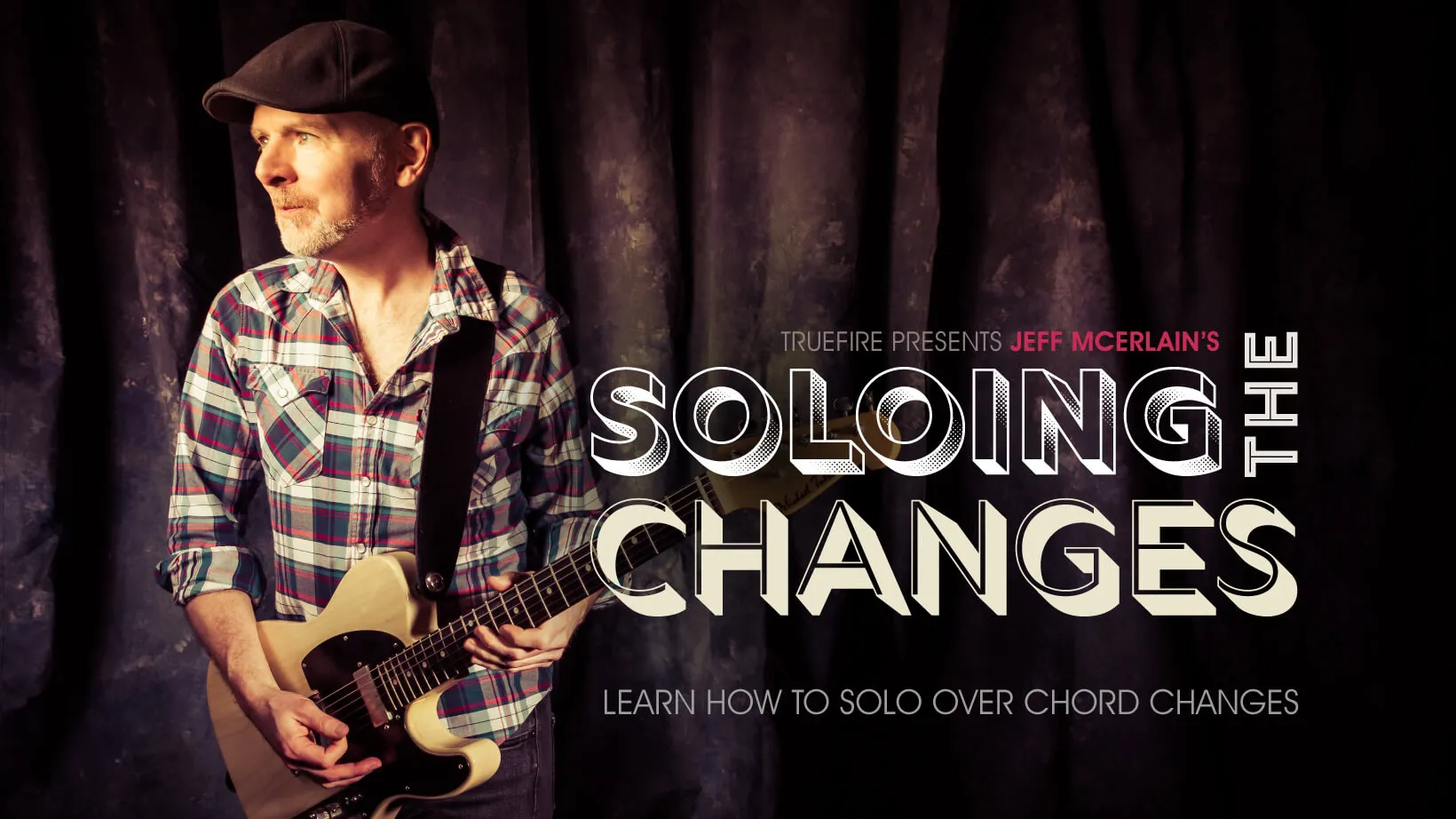
Soloing the Changes

Learn How To Solo Over Chord Changes

Marty FriedmanTommy EmmanuelSteve VaiEric GalesEric Johnson

Get this course and 1,000+ more with All Access

Try 14 days free. Cancel any time.

Purchase Individual Course for $14.99
Soloing the Changes

About this course

Most guitar players learn how to solo and improvise with the pentatonic scale. All 5 of those notes are relatively safe to play and that’s a great place to start. But after a while, those solos start sounding a little bland and disconnected from the chord changes they’re playing over.

Learning how to ‘play the changes’ is a rite of passage that guitar players must pass through to take their playing to the next level. Targeting chord tones as you solo over changes is the central focus of Jeff McErlain’s Soloing the Changes.

”We’ll work on “soloing the changes” using 10 backing tracks featuring the chord progressions and feels used in many popular rock songs. For example we’ll tackle a patented Pink Floyd style progression, a vamp similar to the outro of Frampton’s Do You Feel Like We Do, a solo that highlights the flat six dominant seven chord, and how to play over an unusual five major seven chord on a progression similar to Jeff Beck’s ‘Cause We’ve Ended as Lovers.

We’ll also check out a great way to solo over the ubiquitous one six four five chord progression, changes in the style of Bell Bottom Blues, a progression in the style of John Mayer’s Waiting on the World Change, a progression in the style of the Beatles’ While My Guitar Gently Weeps, a four major to four minor line that highlights the unique changes of a progression along the lines of It Hurts Me To, and finally we’ll get a bit quirky on a chord progression in the style of St. James Infirmary.”

"As Jeff suggests, this course really does take you to the next level. Sweet note after sweet note Jeff takes you through ten great tunes while offering up well-chosen insights that will contribute to making you a much better player. Another great set of lessons from the talented Jeff McErlain." - David Parker, TrueFire Student
"The lessons in this course can be applied universally over many genres of music. Excellent, Excellent work here Jeff." - Cletus Flynn, TrueFire Student
For each of the 10 soloing studies, Jeff will first solo over the track and then provide a detailed breakdown of the solo emphasizing how the lines and target notes in the solo relates to the chord changes.

Jeff will explain and demonstrate all of the key concepts and approaches along the way.  You’ll get standard notation and tabs for the key examples and performance studies. Plus, Jeff includes all of the rhythm tracks for you to work with on your own. In addition, you’ll be able to loop or slow down any of the performances so that you can work with the materials at your own pace.

Grab your guitar and let's solo the changes with Jeff McErlain!

Jeff McErlain's Preferred Gear

Below is a list of Jeff McErlain's preferred gear including guitars, amps, pedals, accessories, and more. What you see in Jeff's lessons may or may not be this actual gear, but if you are trying to capture Jeff's sound and tone, the gear listed below is recommended by Jeff and it's a great place to start!

Guitars

Amps

Pedals

Accessories & More

What you'll learn

  • Navigate a chord progression using chord tones instead of just pentatonic scales
  • Navigate major to minor chord movements in blues context
  • Solo over chord changes by outlining chord tones
  • Use chromatic approach notes effectively
  • Make chord changes audible in unaccompanied solos
Release date: 04/27/2018 • 1h 42m runtime
Start Course
Sample lessons
Gilmourish
Gilmourish
Overview
Gilmourish
Gilmourish
Performance
Gilmourish
Gilmourish
Breakdown
Man, That Hurts
Man, That Hurts
Overview

What's included

32 lessons • 10 charts • 10 Jam Tracks

Soloing the Changes
Hi, I'm Jeff McErlain and welcome to Soloing the Changes. I'm very excited to bring this course to you! This is exactly how I think about soloing all over any chord progression. I've chosen a number of popular songs and chord progressions from the blues and rock world. I'll take you through soloing over the chord changes and finding the special and unique notes for each tune. These are progressions that I find people often miss what I see as great opportunists to dig into the song. As you'll see, I'll use the pentatonic scale as a starting point, something we are all familiar with, then see how we can expand upon that. I'm not thinking scales here, I'm thinking chord tones and making the changes.

I'll perform every solo and then I'll break it down for you note for note highlighting the essential chord tones as we go. Everything is tabbed and notated and you’ll have the backing tracks to work with on your own. You can also loop and slow down any of the tabbed performances so that you can work with the materials at your own pace. So, let's dig in!
Gilmourish
David Gilmour is one of the masters of the perfect guitar solo. I see his solos as two different types and "Comfortably Numb" is a perfect example of what I mean. The first solo is extremely melodic and an integral part of the song. If you play the song, you must play that solo. It's like the vocal melody - it's not the song without it. The end solo is more bluesy with an improvised looser feel. To be clear, Gilmour composes all his solos.
Gilmourish
My framework here is minor B pentatonic, B-D-E-F#-A. I'd recommend just jamming over the progression and have fun. By its nature, it'll sound Pink Floyd-ish. Experiment with the blues scale as well.

In the Bm pentatonic scale alone we have some cool bend options you should definitely give some serious time to. Between the root and b3 is a minor 3rd (1 1/2 steps), B to D. The other minor 3rd is between the 5th and b7, F# to A. These two bends are often overlooked when using the pentatonic scale, but not by Gilmour.
Gilmourish
As we can see, and the point of this course, is how to outline the changes. The chord progression is in Bm (Aeolian) B-C#-D-E-F#-G-A. So, if you look you can see the minor pentatonic scale is just a minor scale without the half steps. The half steps can be problematic on certain chords and that's why the pentatonic scale is so ubiquitous, it's kinda hard to hit a bad note! But as we see here, those omitted notes can add a whole other dimension to the solo.
I Feel Ya
I'm showing my age here, I but I remember my sister listening to Peter Frampton's Frampton Comes Alive endlessly when I was a kid. She had a crush on him, as did most teenage girls at the time. I didn't play guitar yet, but I wanted to, and he made a big impression on me. It's still a great record and well worth a listen. Peter was also in a great band prior to that, Humble Pie. In the Pie stuff you can hear him developing into the solo artist he became. Comes Alive is still one of the best-selling live albums of all time!
I Feel Ya
What we have going on here is called modal interchange. The song changes keys actually, but it's easier to see it as changing modes although it is the same thing. The chord progression is D-F-C-D basically. Let's spell those out: D=DF#A, F= FAC, C= CEG. Already your Spidey senses should be tingling about that F# and F notes. One key cannot contain both, so we have changed keys.

We can also see it as changing modes from D Dorian (DEFGABC) to D Mixolydian (DEF#GABC). Pretty cool and pretty common, in the best way. It's a simple concept, but I know it's not that easy to think about modes and keys if it's new to you, so here's the trick... Just think about changing the one note you need to change, F to F#. There, you've changed modes.
I Feel Ya
Of course, there's more to think about than just changing modes or the one note to really dig in to making the changes. Each chord is made up of specific notes that form that chord - these are chord tones. The chord tones are always a safe bet to choose when soloing and the point of this course. Even if I'm not changing keys, I'm thinking about chord tones. As guitar players, we're usually thinking pentatonic, and as a result hit the root of the pentatonic scale a lot. By starting easy, and in this case being sure to hit the F or the F# at the right time, we can start to break out of that habit.

+ 25 more lessons

Start Course

Reviews

25 results

Starglazer

Verified buyer

11/18/25

Good Tittle.

Jeff explains well has a great approach to the course and plays everything well. Thanks.
kbeaumont1959

Verified buyer

10/27/24

Looks good so far

I just started the course going through the first two songs. But I am enjoying it so far.

nosamt

Verified buyer

01/21/22

Excellent teacher and content

AndreFontijn

Verified buyer

08/22/21

Understandable and splendid build up. Take your time with this.

zoopit

Verified buyer

07/15/21

I've lost count on how many courses I have from Jeff Mcerlain. This one proves to be another gem. Jeff has such a causal way of teaching and his style frankly suites every level of player. This course gets into the nuances of soloing that I've been wanted to delve into. Looking forward to another rewarding experience.

Stop searching. Start improving with All Access.

Try 14 days free. Cancel any time.