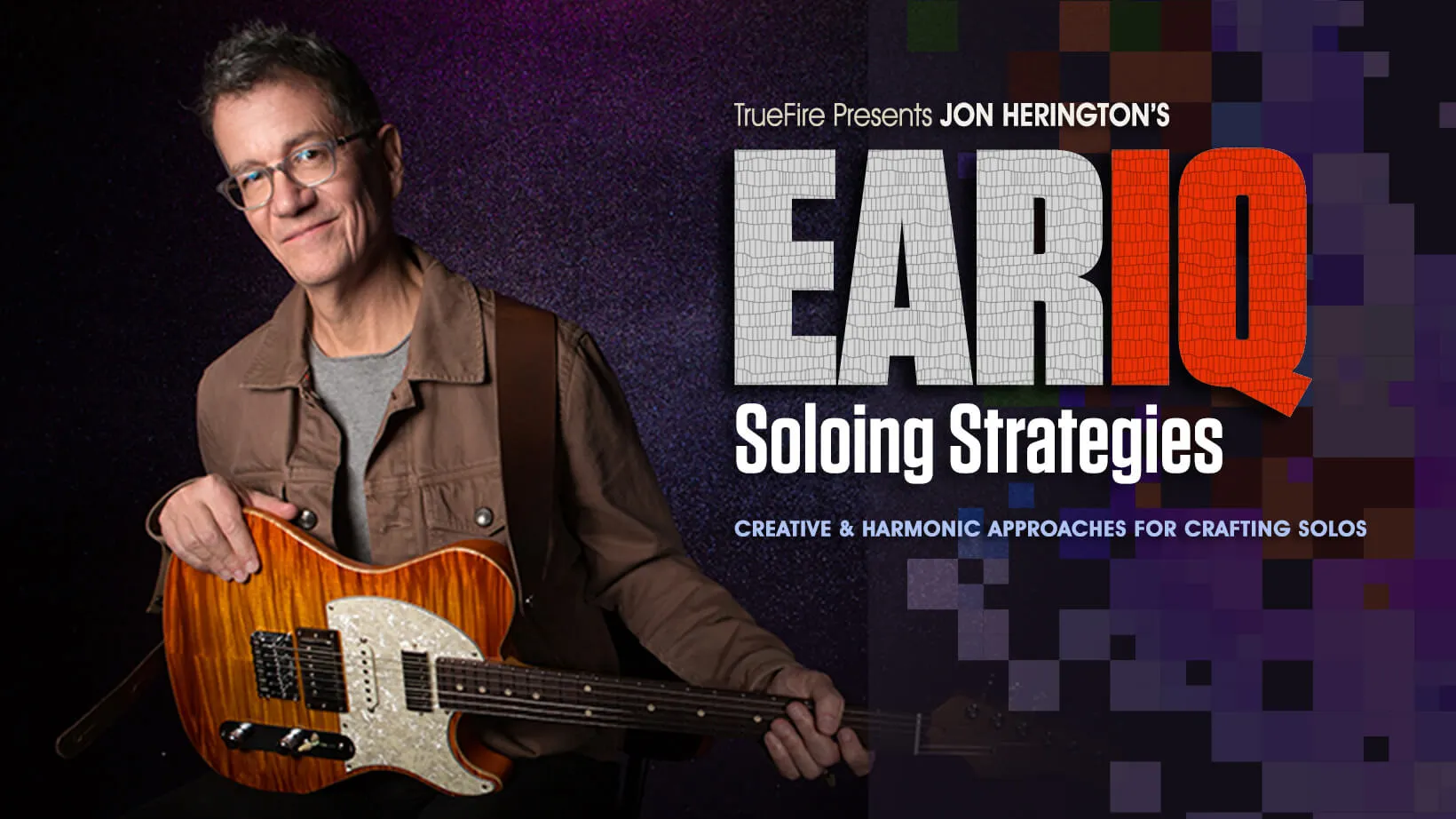

Ear IQ: Soloing Strategies

Interactive Masterclass Covering 10 Creative & Harmonic Approaches for Crafting Solos

Marty FriedmanTommy EmmanuelSteve VaiEric GalesEric Johnson

Get this course and 1,000+ more with All Access

Try 14 days free. Cancel any time.

Purchase Individual Course for $14.99
Ear IQ: Soloing Strategies

About this course

Have you ever played a solo and been less than happy with the result? Maybe your solo doesn’t feel like it fits the song, maybe it’s too predictable, maybe you’re not engaging the audience. Easy fix!

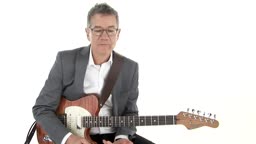
Jon Herington’s Soloing Strategies edition of Ear IQ will impart ten true proven approaches for crafting engaging, memorable solos for any style, any tune. Jon is the veteran touring and recording guitarist for the iconic band Steely Dan, and the lead singer, guitarist, and songwriter for the New York City-based Jon Herington Band.

”Over the years, I’ve discovered there’s A LOT you can do to dramatically improve the way you build a guitar solo. In this course, I’ll open your ears wide to 10 soloing strategies that I’ve personally found to be most effective. We'll take an in-depth look at 10 of my solos, and focus on the particular strategy for each one. I’ll also provide tips for working all of the strategies into your solos and improvisations.”
"Jon Herington is a real TrueFire virtuoso. He is an equally fantastic instructor. I'm hanging onto every word and demonstration in this video series. Cheers!" - Don Compton, TrueFire Student
For each of the ten soloing strategies, Jon will first explain the strategy and analyze a track that he will apply the soloing strategy over. Jon will then solo over the track and provide a detailed breakdown of solo emphasizing the how the strategy was applied.
"I am so excited to see this coming to TrueFire! Like many others, I loved his Ear IQ course and think this is going to be as good or better :-D" - Kenneth Gonzalez
Jon will explain and demonstrate all of the key concepts and approaches along the way. You’ll get standard notation, tabs, and diagrams for the key examples and performance studies. Plus, Jon includes all of the rhythm tracks for you to work with on your own. Also, you’ll be able to loop or slow down any of the performances so that you can work with the materials at your own pace.

Grab your guitar, put your ears on, and let’s get strategic with Jon Herington!

What you'll learn

  • Target chord tones (thirds, fifths, sevenths) for melodic soloing
  • Solo effectively over a repeating chord progression in 3/4 time
  • Create melodic solos by singing ideas first before playing them
  • Use left-hand-only articulation for smoother, more vocal phrasing
  • Incorporate breathing space and pauses into solo phrasing
Release date: 04/09/2018 • 2h 59m runtime
Start Course
Sample lessons
Strategy 5: Engage Your Audience
Overview
Strategy 5: Engage Your Audience
Track Analysis & Approach
Strategy 5: Engage Your Audience
Performance
Strategy 5: Engage Your Audience
Breakdown

What's included

42 lessons • 10 charts • 10 Jam Tracks

Ear IQ: Soloing Strategies
Hi, I'm Jon Herington, and welcome to Ear IQ: Soloing Strategies. In the first edition of Ear IQ, I presented a simple and straightforward approach to learning how to play on chord changes that move into different keys. It's something a lot of students have asked me about, and it felt like an important and natural first course. For this second course, the people at TrueFire and I decided it would be a good idea to focus on my own lead guitar playing style. So, I wanted to feature 10 of my favorite recorded lead guitar solos, collected from various records and live performances I've done in the last several years. I'll be talking a bit about how to apply the material in my first course with these solos, also making sure to get these sounds and these strategies into your head and under your fingers.

We're going to take an in-depth look at these solos, analyze some of the chord changes and the notes I chose to play on them, and I'll try to give you some insight into how I think musically when I'm soloing on a tune. We'll look at character, style, shape, repetition, variation, flash, and more, and I'll discuss the choices of sound and technique that I made. I'll also talk about the various ways I work on the whole continuum of improvisation on the one end and composition on the other. We'll look at solos that were completely improvised, solos that were composed, and solos that were a kind of hybrid of the two.

But the whole idea here is to get your ears working. If you open your ears wide to all these strategies and think about them when you're listening to other people solo and especially when you're soloing yourself, you'll be on the right track to seriously raise your Soloing IQ. Ready? Grab your guitar, and let's get going!
Strategy 1: Consider Character
Whenever I sit down to record a solo on a tune, the first thing I do is listen with the idea of zeroing in on the overall character of the song. I do a sort of a general assessment of the style (is it some kind of rock, blues, jazz, country, folk, roller disco, or some mix of them, etc.), and try to get an idea of the attitude of the song by listening to the lyrics if there are any (is it earnest, funny, ironic, angry, etc.). Once I have a sense of the world I'm going to add something to, I start to imagine an approach to the sound I want to make. A lot of times I'll get some direction about sound and style if I'm hired by someone to play, but a lot of the time I'm free to make those choices myself. But this idea of getting the right character is really critical to me - I like to look for the answer to the question: what is the music asking me to play?

Though I'm as happy as anybody to try to bring something personal to any music I play on if there's room for it, it's not my priority. I find it much more satisfying to try to help make the music do what it's doing just that much better if I can - if I do this, each new song becomes a real adventure, and never an automatic exercise.

The first tune we're going to look at is a Donald Fagen tune loaded with character called "H Gang". Let's dive in.
Strategy 1: Consider Character
Let's take a look at "H Gang". As with a lot of Donald's writing, you can be lulled into a false sense of security as a soloist by the way a section will start very simply. But almost always there's a sharp harmonic curve up ahead - and though it's a really short solo section, this tune is no exception. So, we have 2 bars of Dmi9, 2 bars of Ami7, 2 more bars of Dmi9 - pretty simple so far - all one key, and pretty easy to negotiate. Then in the 7th bar, we get a C9 chord - so we get the Bb now instead of the B natural in the original key - and then we get a split bar of Fmi6 and Ebdim7, which get your ears working. The solo section ends on the next bar of F6/9 which begins a vamp that existed before, and we're all done.
Strategy 1: Consider Character
Here I'll perform my solo over "H Gang". Because of the way Donald likes to work, this solo was completely improvised. We did numerous takes, but all complete takes, and never punched anything in or fixed anything. It's not my most natural way to work in the studio, but the keeper take had a striking start and an unusual melodic twist at the end which felt a bit quirky - maybe even a little humorous, somehow - but fresh, and I think that's what drew Donald to choose this out of many, many takes I played.
Strategy 1: Consider Character
Now, let me say something about the character of the song that seems important. A lot of this will happen intuitively and unconsciously, but whether it's conscious or not, the song determines a lot about how I decide to play on it. This tune has a kind of slick, pop vibe, but it sounds a little suspicious to me. What I mean is that it has a surface simplicity and ease and restraint about it, but it does some unusual things that you don't often hear in a pop song, like unusual chord changes and sly little deviations from more standard section lengths. But it feels so perky and innocent that you can miss some of that sophistication. Now this kind of sneaky doubleness is Steely Dan's stock in trade, of course - you hear this kind of thing on all their records a lot of the time. Very slick and sly.

So after hearing the song and getting to know the harmony, I chose an approach that I thought would reflect the character of the track - the wah gave it a kind of quirky vocal quality which fit the song somehow, and I decided to not use too much overdrive on the amp, since the song, though it has a kind of drive to it, seems sort of clean and slick, too. I tried to play with an even attack - not too soft and not too hard - so it would match the steadiness of the track that way. I also tried not to play too much - no rhythmic subdivision greater than a triplet - since I felt that the solo should sort of float on top of the track and not be too aggressive. On a track like this that seems so strong and steady on its own, a solo can be quite simple - the solo doesn't have to carry the day on a groove like this, it just has to fit naturally over the track.

I started with the trills on the open E string, which is striking, but because it's all a left hand technique, it somehow still seems to float or be light enough. We're in A minor here, and my note choices in the first five bars are all firmly in the key, and very familiar to most guitarists used to playing in the fifth position in this key. But in the 5th bar, the ascending bends kind of emphasize the key change that arrives with the C9 chord. You might notice that I used a note that is out of the key when I was climbing up to the high A - I think that helps signal that something's up in the song at that point. And something is up, and we get the bar with the most unusual chords next. I'm sure I was just winging it there, but I like the way the notes play around the final E note, sort of teasing from both above then below before they resolve on the downbeat of the F chord.

So that's our first solo. How are you doing so far? As Donald Fagen often asks me, "Is anything okay?" Let's move on to solo number two.
Strategy 2: Work the Style
Sometimes the single most important thing to address when coming up with a solo is the style. Often a job is even presented as centered around a style. I'll get asked, "Can you play a Rockabilly solo?", or someone will say, "Play this like Wes Montgomery", or, "I need a Stevie Ray sound", etc. This is similar to character, of course, but it's definitely a factor that I've had to deal with and I still do that even when I'm making my own records, since style is such a powerful thing. It also can make life easier for you, since if you identify the style of playing a song requires, it helps you make choices that are likely to be the right ones for that song. Of course, you have to be somewhat familiar with that style for this to work. But even just a passing familiarity with a style can direct you to places you might not ordinarily go, and they're likely to be a good fit for the song.

The second solo we're going to look at is from one of my own recordings, and it's called "Thirteen Feet of Rain". Let's take a look at the track.
Strategy 2: Work the Style
What strikes me here is the sort of plaintive quality of the music. It has a kind of Americana vibe, a bit of a folky character. The lyrics are about longing for lost love after a great flood, and they have a folky, Americana quality, too. So, when it came time to play a guitar solo on this song I naturally gravitated toward a fairly clean, almost country style sound - a Telecaster on the treble pickup - a single coil sound. Just making that choice of style was enough to get the ideas flowing, because there are so many very particular sonic elements and so many particular guitar playing techniques that are unique to the country style.

+ 35 more lessons

Start Course

Reviews

12 results

olivierhage

Verified buyer

10/30/25

A very good course that helps you think about your solos
AshTelecaster

Verified buyer

04/26/23

Excellent video.

Jon Herington takes an unconventional approach to teaching guitar in that he starts with high level concepts then demonstrates how to employ those strategies to produce solo's that are well composed and impactful. Like an author writing a book rather than just playing riffs. If you are looking for a list of outside scales and runs, this isn't it. It's more about letting the music dictate what is needed.

mikehilson

Verified buyer

06/10/22

I am a gigantic Jon Herington fan! This is an excellent lesson filled with Jon teaching you some of his greatest solos. Thanks to the ability to slow down the video I can play along with this master musician! Highest rating!

Keith

08/29/21

Masterful

A fab course on solo mindfulness, from a fab player! What I like to do with these is load the jam tracks into a DAW & do a few solo takes, before checking out Jon's solo, and his well detailed breakdown of the processes he uses, invaluable information, thanks!

Uschmed

Verified buyer

06/06/21

Eart IQ: Soloing Strategies

A great course by one of the most versatile guitarists I know. That's what I really like about TrueFire. You can get input and advice from various "Masters" and insight into the way they work and play. Then you can incorporate all this into your own playing and, — if you are lucky and not too old — come up with something of your own. Again I wish TrueFire had existed when I was 16!

Stop searching. Start improving with All Access.

Try 14 days free. Cancel any time.