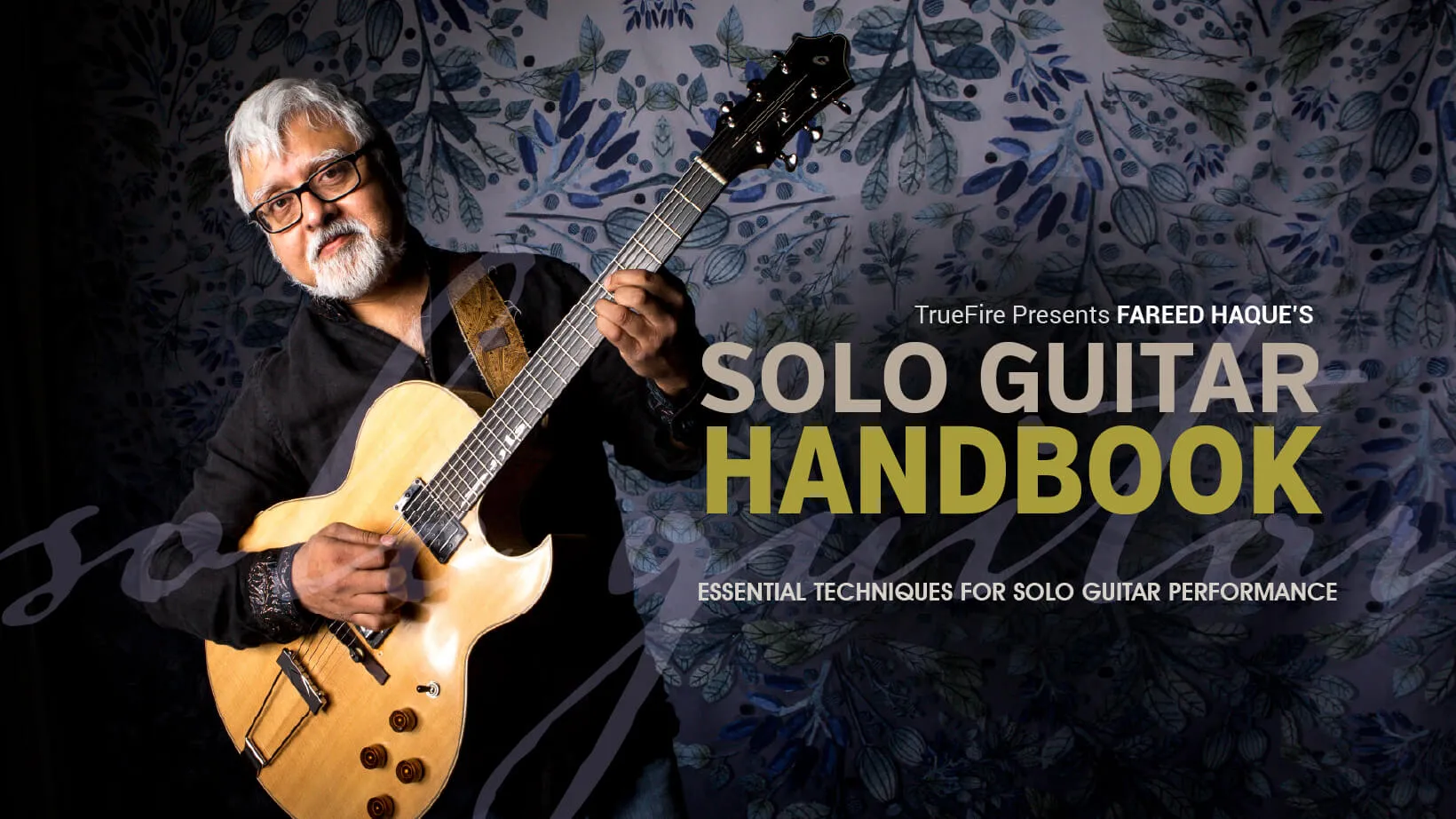
Playing solo guitar arrangements on the gig, or even just for family and friends is something every guitarist aspires to be able to do. Most players think you have to learn how to play bass lines, rhythm, and melody simultaneously like a fingerstyle or classical guitarist does. But there’s another very effective approach that any player can master and that’s what Fareed Haque’s Solo Guitar Handbook is all about.
”I’ll show you a very simple, logical system for creating solo guitar arrangements which you can play with a pick, or with your fingers. You can use this system to craft folk, blues, pop, and even jazz solo guitar arrangements for any of your favorite tunes.
I don't really like calling this approach to solo guitar a "system", it's really just what you do to learn a song on any instrument. I'm just organizing it a bit, so we don't skip any steps. Maybe we can call it a natural process, not really a "system". Learn the melody, learn the basic chords, put 'em together. Build fancy chords and chord progressions from the simple ones, add an intro, outro runs, and fills, and there you are!”
Fareed organized The Solo Guitar Handbook into four sections. In the first section, Fareed presents three Solo Arrangement Basics: Learn the Melody in Multiple Keys, Learn the Basic Chords, and How to Put the Melody and Chords Together
The second section features Fareed's Principles of Chord Arrangement: Sub a Third Above or Below, Lead to Any Chord with Its Dominant, Any Chord Can Be Dominant, Any Minor or Dom Can Be a ii V, Any Dom Can Become a ii V, Sub or Lead with a Tritone, Tritone Subs, and Chord Embellishments.
In the third section, Fareed presents a series of lessons focused on Sweetening the Arrangement: Intros: How to Begin, Adding Fills & Runs, Adding an Ending, and a full arrangement of Amazing Grace.
In the fourth and final section, Fareed guides you through a series of lessons to craft a complete Solo Arrangement for Whispering: Learning the Melody & Basic Chords, Whispering: Basic Arrangement, Applying the Chord Arrangement Principles, Whispering: Jazz Harmony Arrangement, Sweetening Ideas for the Tune, and then finally a full arrangement of Whispering.
Fareed will explain and demonstrate all of the key concepts and approaches along the way. You’ll get standard notation and tabs for all of the key examples and performance studies. You’ll be able to loop or slow down any of the videos so that you can work with the lessons at your own pace.
Grab your guitar and let’s perform some solo guitar with Fareed Haque!
What you'll learn
Navigate the basic chord progression of 'Whispering'
Combine melody and chords in a simple arrangement
Apply jazz vocabulary to fill empty spaces in arrangements
Identify spaces in arrangements where fills can be added
Hello all and welcome to the Solo Guitar Handbook. It's my hope that through this and other "nuts and bolts" types of courses, we can begin to view the guitar as a practical and flexible instrument, much as the piano has been for the past few hundred years. Pretty much any function that the piano can fill the guitar can fill too. But, we need to look at the guitar in a practical flexible manner for these insights to happen.
For too long, guitar has been taught as a visual instrument, tabbed out, block diagramed out, with lead sheets, real books, How to Learn Guitar Without Practicing, How to Learn Guitar While You Sleep, Learn the Guitar with Just Two Pills a Day...come on, ya'll! Music is music. Learn chords, learn melody, develop your ear. I guarantee that actually learning music, instead of spending your life looking for a shortcut, will get you where you want to go.
I don't really like even calling this approach to solo guitar a "system", it's really just what you do to learn a song on any instrument. I'm just organizing it a bit, so we don't skip any steps. Maybe we can call it a natural process, not really a "system". Learn the melody, learn the basic chords, put 'em together. Build fancy chords and chord progressions from the simple ones, add an intro, outro runs, and fills, and there you are!
Learning the melody is the one step that most musicians don't do enough, and frankly, it's probably the most important step. Know the melody and then everything else can follow from there. Transposing is crucial as it shows you what is the same and what is essential about the melody and what is not. Learning the lyrics is essential in that it shows you how to phrase the melody and where the accents/important beats are. Once you really know the melody, the next steps all become easier. I Promise.
So go ahead and play the melody in C and E as in the examples, and try it in a few different octaves to really get the melody in your ears and fingers. Hey, and while you're at it, you'll be doing that weird thing called ear training. Obvious. Ears are like muscles. If you don't use 'em, they don't develop.
A little bit about "Amazing Grace" [from Wikipedia]:
"Amazing Grace" is a Christian hymn published in 1779, with words written by the English poet and Anglican clergyman John Newton (1725–1807). Jonathan Aitken, a Newton biographer, estimates that it is performed about 10 million times annually. It has had particular influence in folk music and has become an emblematic African American spiritual. Its universal message has been a significant factor in its crossover into secular music. "Amazing Grace" saw a resurgence in popularity in the U.S. during the 1960s and has been recorded thousands of times during and since the 20th century, occasionally appearing on popular music charts.
Here are the lyrics:
Amazing grace! (how sweet the sound) That sav'd a wretch like me! I once was lost, but now am found, Was blind, but now I see.
'Twas grace that taught my heart to fear, And grace my fears reliev'd; How precious did that grace appear The hour I first believ'd!
Thro' many dangers, toils, and snares, I have already come; 'Tis grace hath brought me safe thus far, And grace will lead me home.
The Lord has promis'd good to me, His word my hope secures; He will my shield and portion be As long as life endures.
Yes, when this flesh and heart shall fail, And mortal life shall cease; I shall possess, within the veil, A life of joy and peace.
The earth shall soon dissolve like snow, The sun forbear to shine; But God, who call'd me here below, Will be forever mine.
OK, when you're done wiping the tears away and the giggles have subsided, then you sing/hum/croak the melody and try to feel where the chords should change. Usually, it's on the beat and the chord falls on an accented or important word. Use simple chords. Use your instincts and they will develop.
This is where it starts - with simple basic chords. You may not realize it, but most of the tunes that are in the Real Book and other jazz "fake books" started out as simple songs with "cowboy chords" too. The confusion starts when we look at jazz versions of simple songs and call them "jazz standards". Most of the so-called jazz standards started out as simple pop tunes, with very basic, even corny, chords. Jazz musicians developed the harmony, played 'em, jammed on 'em, recorded them and started teaching them with the fancy chords. But to really understand how the fancy chords work, you need to go back to the basic chords. We'll build from there.
What we're going to do here is build fancy chords from simple ones, just as jazz musicians did back in the day. Once you start doing this, you'll begin to find that many of the most difficult tunes are in fact pretty simple, and this will make it easier to understand how to solo on and arrange those tunes yourself.
Principle #1: Sub a Third Above or Below
The basic theory here is really simple: Since chords are built in thirds, chords a third apart share lots of common tones.. IN our tune Amazing Grace, we can use a C major 9 chord. Just stack thirds in the key of C up to the 9th: 1-3-5-7-9 = C-E-G-B-D. So lets compare the C maj9 to the chord built a third higher, built on E. Now it's simple to see that in that C major 9th chord there is a little Em7th chord (C-E-G-B-D). So, try subbing E minor for Cmaj. Now lets go a third BELOW C maj9, or 'A'. notice that Am9 is spelled A-C-E-G-B. Do you see the little C major 7 hidden inside A minor 9? A-C-E-G-B. So, try Am instead of C major and see if that's nice.
Hey, if this confuses you, to understand music theory there's really only a few things to know: Know your keys and know how to spell chords. If you can spell 'em, the rest follows very easily. It's just like knowing multiplication tables, or the alphabet: If you don't know that, then math or reading will forever be confusing...so just learn it and get 'er done. Check out Appendix A if you want some help drilling your chords and keys.
This course is fantastic. Fareed takes the simple I - IV - V progression of Amazing Grace, and explains the many options to color and expand the progression. I had been studying secondary dominants and substitutions before, but they never clicked for me like they did in the course.
A
arpeggio5
Verified buyer
11/19/24
Excellent course he explains things very thoroughly and also good examples
R
Rishabh
06/15/22
Absolutely wonderful material for chord melody players. EASY to GRASP and APPLY
Such a great way to teach concepts by application step by step. These arrangement principles can be really helpful in creating some colorful harmonies and approaches. Absolute gem.
V
Vernon
06/09/22
Solo Guitar Handbook
This course is one of the best that I have enjoyed so far. Fareed Haque makes complicated ideas accessible even for beginner or intermediate guitarists. This course is not about rote memorization of songs, but about techniques that I am actually excited about applying to my own playing. This course is a keeper!
B
Bazou
Verified buyer
10/25/21
fingerstyle blues tool kit
Excellent teacher and very good for chords understanding.