60 Electric Guitar Techniques You MUST Know

The Definitive Reference Guide for Electric Guitar

Marty FriedmanTommy EmmanuelSteve VaiEric GalesEric Johnson

Get this course and 1,000+ more with All Access

Try 14 days free. Cancel any time.

Purchase Individual Course for $14.99
60 Electric Guitar Techniques You MUST Know

About this course

NOTE: This course was previously named "The Electric Guitar Technique & Notation Handbook" -- the content is the same as before -- we simply updated the title.
More so than any other instrument, the electric guitar presents guitarists with a seemingly endless range of right and left-hand techniques to embellish their rhythm playing, solos, and improvisations. What are all of those techniques? How do you play them? Why is important for you to know them? And how do they appear in tab or notation?

There’s no one better qualified to answer all of those questions than Chris Buono, our Professor of the Deep. Chris does exactly that and more in this Electric Guitar Technique and Notation Handbook — the definitive video reference guide on the subject!

"I'll describe and demonstrate 65 of the most popular electric guitar techniques found in blues, rock, jazz, metal and other contemporary genres of music. I'll also show you how they're notated in standard notation and tablature to help you get the most out of reading or writing sheet music, tabs, and charts.”

For each of the 65 techniques in the handbook, Chris will first describe the method emphasizing why it's important for you to know it. Chris will then demonstrate the technique, show you how the notation will look in standard notation and tablature, and give you some tips for practicing the technique.

Chris organized the 65 techniques into the following 10 sections.

All of the key musical examples are tabbed and notated for your practice, reference and study purposes. You’ll also get Guitar Pro files so that you can play, loop and slow down the tab and notation as you work through the lessons. Plus, all 65 of the standard and tab notation examples are compiled in a companion PDF manual for your convenience (feel free to print the manual to reference).

Grab your guitar and let’s dig deep into all 65 electric guitar techniques with Chris Buono!

What you'll learn

  • Create violin-like guitar sounds
  • Understanding hammer-on from nowhere technique
  • Creating smooth melodic sequences
  • understand palm muting technique
  • Understanding wah pedal notation
Release date: 04/26/2017 • 2h 21m runtime
Start Course
Sample lessons
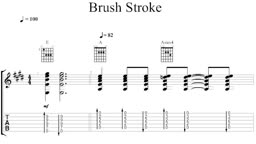
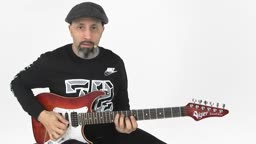
Brush Stroke
Brush Stroke
Demonstration
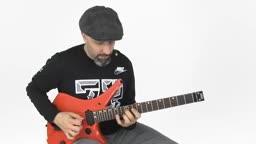
Hybrid Picking
Hybrid Picking
Demonstration
Sweep Picking
Sweep Picking
Demonstration
Economy Picking
Economy Picking
Demonstration

What's included

76 lessons • 64 charts

60 Electric Guitar Techniques You MUST Know
Welcome to 60 Electric Guitar Techniques You MUST Know. More so than any other instrument, the electric guitar presents guitarists with a seemingly endless range of right and left hand techniques to embellish their playing. In this course I'll demonstrate over 60 of the most popular techniques found in blues, rock, jazz, metal and other contemporary genres of music. I'll also show you how they're notated in standard notation and tablature to help you better understand sheet music and charts.

I've organized the handbook into 10 sections. They are...
  • Strumming
  • Picking
  • Legato
  • Slides
  • Bending
  • Harmonics
  • Tapping
  • Vibrato
  • Whammy Bar
  • Other Essential Techniques
The Other Essential Techniques section covers the various techniques and concepts listed here:
  • Alternate Tunings
  • Using a Capo
  • Double Stops
  • Barring
  • Palm Muting
  • Arpeggiation
  • Staccato
  • Accents
  • Pickscrapes
  • Slaps & Pops
  • Palm Punching
  • String Skipping
  • Volume Swell
  • Wah-Wah
I'll describe each of the techniques, give you a brief demonstration, show you how the notation will look in standard notation and tablature AND give you some tips for practicing the technique. It's all here!

Throughout my TrueFire catalog many of these techniques are covered in more depth, most notably in my Guitar Gym course series where I really dig in. Be sure to check the Description sections for links to those courses if you're looking to take your exploration into them further!

Let's do it to it!

Reference Manual
Click on the download link below to get the complete reference manual to work with along with this course.
Strumming Techniques
Perhaps the most basic guitar technique, strumming, is where we'll start. In this section, we'll look at downstrokes, upstrokes, and brush strokes. The latter will be demonstrated with my thumb, while the former will be with a pick. That said, it's not uncommon to see players strum with their fingers with various approaches as well as thumb picks and other alternative thingamajigs both archaic and technological!
Downstrokes
It's safe to say that just about every stringed instrument newbie's first move on their axe of choice is a downstroke. That's a great start since many more downstrokes are to come!

I can't stress enough how important it is to establish a connection between this technique and the concept of rhythm and playing in time right from the start. Play along anything that has a consistent pulse. That's what a beat is.
Upstrokes
There's an old adage that says, "what goes up must come down." In the case of an upstroke, it's similar in principle, just opposite. Whether you make contact with the strings or not, for every downstroke there's an upstroke. More often than not, when actual contact is made with the strings, we call it out as an official upstroke. Just like downstrokes, it's important to align your development with playing in time to a beat.
Brush Stroke
An alternative to strumming with a pick is using your pick hand for a technique called brush strokes. The combination of a lighter touch and a less harsh material making contact with the strings equals a softer, more subdued effect when strumming chords with brush strokes.

Another, more advanced approach with brush strokes is playing octaves with your thumb. Look no further than the great Wes Montgomery or his predecessor George Benson for what is widely considered the ultimate approach to playing octaves this way. The resulting tone and phrasing potential is incredible when mastered.
Scratches
A percussive strumming technique known as scratches or "chanking" is great way to vary up your rhythm playing while adding a new tonal element. Most importantly, it serves as a way to create rhythms with syncopation that would otherwise be difficult or nearly impossible to play. While the go-to style this technique is often associated with is funk, scratches are used to play within almost every style of music with varied approaches and prominence. Simply laying a fret hand finger or more over the intended strings to be attacked, it takes but a soft touch to produce the desired effect. Not too soft though, or otherwise you'll allow open strings to ring through. At the same time, a touch that's too heavy will defeat the intent and result in fretting the very notes you're trying scratch out!

+ 69 more lessons

Start Course

Reviews

11 results

doogietrueman

Verified buyer

03/05/25

For guitarists who don’t know a barre chord from a whammy bar

The amount of techniques that can be performed on an electric guitar is overwhelming. Rakes, bends, pre-bends, dive bombs, etc. Chris is one of my favorite teachers and each lesson explains how to perform these techniques and what pitfalls to avoid.

cmfedosky

Verified buyer

01/05/25

Fun ideas!

Just what I was looking for! Some ideas to spice up my playing. Thanks!

CCCowboy

Verified buyer

11/13/22

A MUST HAVE in my opinion!

Chris teaches you all the little 'tricks & techniques' that a modern Electric guitar player should know to be more 'complete'...kind of a prep guide to expand your abilities, if you will.

ianmitchell

Verified buyer

10/09/22

Solid overview

This course gives a brief overview of a bunch of essential techniques. It's not built for really diving into any of them in depth (there are other more focused courses for that) but a good introduction and well presented.

brosblues

Verified buyer

10/06/22

I have just started to progress through the course. So far, it appears to be quite useful and comprehensive and well worth the money!

Stop searching. Start improving with All Access.

Try 14 days free. Cancel any time.