Play Acoustic Guitar 9: Advanced Style Diversity
Diversify Your Acoustic Guitar Chops with this Acoustic Learning Path Core Course


Get this course and 1,000+ more with All Access
Try 7 days free. Cancel any time.


TrueFire
Educator
Genres
About this course
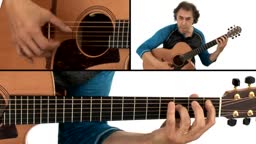
This Acoustic Learning Path core course is presented by 6 top TrueFire educators: Pierre Bensusan, Roberto Dalla Vecchia, Tim Sparks, Vicki Genfan, Raughi Ebert and Leo Henrichs.
The Advanced Style Diversity curriculum is comprised of select Acoustic guitar lessons from the educators’ existing TrueFire course libraries.
One of the qualities that attracts all of us to the guitar is the virtually infinite range of styles and techniques that are possible on the instrument. Having a grasp on a wide variety of styles and techniques not only broadens your musicality, it opens the door to many more playing opportunities with other musicians. You’ll gain more clarity on the instrument overall and expressing yourself on it will become a richer experience. The video guitar lessons in this core course will diversify your skill set and help take your playing to the next level.
Play Acoustic Guitar 9: Advanced Style Diversity is organized into 5 sections. In the first section, Pierre Bensusan presents a mini-masterclass in DADGAD tuning. Tim Sparks presents 10 boogie variations to spice up your fingerstyle blues vocabulary in the second section. In the third section, Vicki Genfan presents 3 performance studies in 3 different open tunings. In Section 4, Roberto Dalla Vecchia presents 3 performance studies designed to impart some serious flatpicking chops. In the fifth and final section, Raughi Ebert and Leo Henrichs introduce you to Nuevo Flamenco, an ideal study program for any guitarist who wants to delve into the world of Flamenco or world music.
When you’ve completed the lessons here in Advanced Style Diversity, you’ll find more lessons focused on variations in Advanced Style Variations, also a Play Acoustic Guitar 9 core course.
The educators demonstrate all of the key examples over jam tracks (where and when applicable) to simulate a real-world application, in a musical context. All of the key examples are also tabbed and notated for your practice, reference and study purposes.
You’ll also get Guitar Pro files so that you can play, loop or slow down the tab and notation as you work through the lessons. Plus, you’ll have all of the available jam tracks to work with on your own.
Take as much time as you need to work through each video guitar lesson before moving on to the next lesson. If you want to dig deeper or wider into any of the topics covered in this core course, check out the recommended supplementary courses in your learning path where you’ll find more examples, techniques and insight from top TrueFire educators.
Grab your guitar and let’s get started!
What you'll learn
- Master drop D tuning techniques
- Develop cross-picking skills
- Learn advanced tuning techniques
- Understand syncopated rhythm patterns
- Develop versatile playing skills
What's included
49 lessons • 23 charts • 4 Jam Tracks
This Acoustic Learning Path core course is presented by 6 top TrueFire educators: Pierre Bensusan, Roberto Dalla Vecchia, Tim Sparks, Vicki Genfan, Raughi Ebert and Leo Henrichs.
The Advanced Style Diversity curriculum is comprised of select Acoustic guitar lessons from the educators' existing TrueFire course libraries.
One of the qualities that attracts all of us to the guitar is the virtually infinite range of styles and techniques that are possible on the instrument. Having a grasp on a wide variety of styles and techniques not only broadens your musicality, it opens the door to many more playing opportunities with other musicians. You'll gain more clarity on the instrument overall and expressing yourself on it will become a richer experience. The video guitar lessons in this core course will diversify your skill set and help take your playing to the next level.
Play Acoustic Guitar 9: Advanced Style Diversity is organized into 5 sections. In the first section, Pierre Bensusan presents a mini-masterclass in DADGAD tuning. Tim Sparks presents 10 boogie variations to spice up your fingerstyle blues vocabulary in the second section. In the third section, Vicki Genfan presents 3 performance studies in 3 different open tunings. In Section 4, Roberto Dalla Vecchia presents 3 performance studies designed to impart some serious flatpicking chops. In the fifth and final section, Raughi Ebert and Leo Henrichs introduce you to Nuevo Flamenco, an ideal study program for any guitarist who wants to delve into the world of Flamenco or world music.
When you've completed the lessons here in Advanced Style Diversity, you'll find more lessons focused on variations in Advanced Style Variations, also a Play Acoustic Guitar 9 core course.
The educators demonstrate all of the key examples over jam tracks (where and when applicable) to simulate a real-world application, in a musical context. All of the key examples are also tabbed and notated for your practice, reference and study purposes.
You'll also get Guitar Pro files so that you can play, loop or slow down the tab and notation as you work through the lessons. Plus, you'll have all of the available jam tracks to work with on your own.
Take as much time as you need to work through each video guitar lesson before moving on to the next lesson. If you want to dig deeper or wider into any of the topics covered in this core course, check out the recommended supplementary courses in your learning path where you'll find more examples, techniques and insight from top TrueFire educators.
Grab your guitar and let's get started!
TIP! Everything you work on should be started slowly, paying attention to the fine details of finger placement, minimum motion, efficient picking hand movement, and proper intonation. Then GRADUALLY increase your speed. Think baby steps. Don't try to jump from zero to 60 - take it slow. As you gradually speed up you will see other technique issues that need to be addressed. These are more easily discovered and dealt with at slow tempos. It is way harder to fix a problem that you have burned into your muscle memory than it is to just start slow and fix things along the way. So always start practicing a new thing slowly, and then build up your speed.
I wrote this song in 1977 with Ireland in my heart, as I was on a ferry boat traveling from the harbor of Le Havre in Normandy (France) to Roeselare in the south of Ireland to do my first Irish tour. I've been performing there (south and north) every other year ever since.
"Le Voyage pour l'Irlande," from concept to structure, is a good starting point as it offers the opportunity for the player to see the basic structure and look at the development of the piece (i.e., Segment 7: "Concepts and Approaches: 5").
Melody is very important in the music that I play. Many guitar players focus on harmony first, often at the expense of melody. I always try to make the guitar sing, perhaps this is because singing has also been an important part of my musical experience. I often use the voice as a vehicle for the melody or a different harmony, improvising the vocal "colors." Sometimes the humming will be replaced by real lyrics later on, even though many of the tunes I write are songs without words or voice parts.
In this segment, we'll be working on developing a hierarchy of resonances. Here I'll show you that the fingers of our right hand (when the player is right handed) can be used to create sound but also to mute. In other words, the same finger can be used to pick a string and then to stop the resonance of that same string, letting the next string—plucked by another finger—ring by itself. Practicing this will help you discern what the essential notes are in your playing, better organize both their mixing and length of their resonance, and stop the overlap of undesired tones.
There are several different ways to control the notes' sustain. Here, each finger has a dual function: pick and stop or pluck and rest. Have your left hand mute all six strings at the seventh fret while your right hand plucks each string, creating a more rhythmic and drier sound that helps articulate what you're doing. For the next hand movement, you'll stop muting the strings with your left hand, having each of them resonate openly until you apply the resting/stopping technique I described.
The little triangle in the tab, next to a letter and arrow, indicates that the referenced finger comes down in rest stroke position on the string (with the triangle) at the same time as the other bass is being played. This way, it stops the resonance of the bass note on which that finger rests. This results in hearing only one bass at a time—no overlap, no undesired interval, more precision, clarity, more music, and less confusion. This technique, relevant no matter the tuning, will make your right hand much more capable and in control. It's even more crucial in DADGAD, where the tuning has a tendency to regularly drown everything out.
Here we'll be looking at the chords behind the melody of "Le Voyage Pour l'Irlande."
Now let's look at placing the bass line. The location of the bass often gives a clear indication of the tempo. Once you've established a tempo, we can change the placement of the bass notes to make it unpredictable, more exciting, and more musical.
+ 42 more lessons
Reviews
No reviews yet
Complete this course and be the first to share your experience.
Stop searching. Start improving with All Access.
Try 14 days free. Cancel any time.