




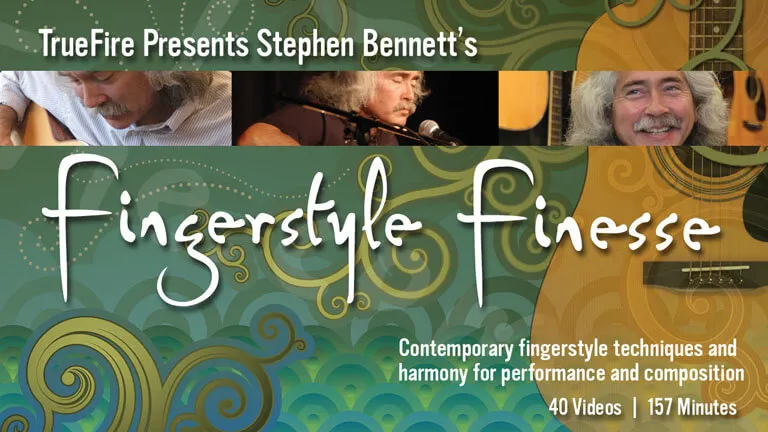

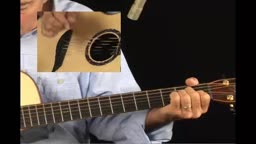

Fingerstyle Finesse

Contemporary fingerstyle techniques and harmony for performance and composition

Marty FriedmanTommy EmmanuelSteve VaiEric GalesEric Johnson

Get this course and 1,000+ more with All Access

Try 14 days free. Cancel any time.

Purchase Individual Course for $5.00
Fingerstyle Finesse

About this course

We can all recall experiences when we've been absolutely mesmerized by a particular artist's solo guitar performance. Those moments live with us forever, and for many of us, that's why we play. And as players, we all strive to achieve that same magical quality in our own performances. Fingerstyle Finesse focuses on the technique, performance and composition skills you'll need to make that same magic happen with your music.

There's no one more qualified to serve as your Fingerstyle Finesse mentor than Stephen Bennett. Bennett's "magic" is powerful stuff. Prolific composer, performer, recording artist and award-winning finger-picker, Bennett has amazing chops, but it's his sense of melody and presentation that casts such a profound spell on his audiences worldwide.

While Fingerstyle Finesse includes breakdowns of five of his original tunes (the ones most people ask him about learning), the course goes way beyond just adding a few tunes to your repertoire.

Throughout the course, Bennett will emphasize and demonstrate key concepts such as the importance of melody in all aspects of your playing and composition, integrating harmonics, leveraging the backbeat, working with a capo, composing original material along with a variety of other techniques and concepts that will "finesse" your playing and compositional skills.

What you'll learn

  • Create melodic textures using harmonics
  • Explore scale-based improvisation
  • Right-hand fingerstyle technique
  • Improvisation techniques
  • Understanding non-standard blues structures
Release date: 03/10/2007 • 2h 34m runtime
Start Course
Sample lessons
I Believe
I Believe
Performance
I Believe
I Believe
Breakdown 1
I Believe
I Believe
Breakdown 2
Burnside
Burnside
Performance

What's included

40 lessons • 5 charts

Fingerstyle Finesse
Again, this is the Native American name for the coastal plain of Virginia., where I live. It's part of a set of pieces I composed entitled the Powhatan Suite and is on my Music From Tsenacommacah cd, released in 2003. The original recording of this tune was performed on baritone guitar and though the fingerings are the same as what I'm about to show you, it would sound a major third lower on the original recording. I firmly believe that any tune can teach us something; actually I believe that most tunes contain an entire musical education within them, if only you look... The most important thing I learned (or was reminded about) from this tune was that simplicity is good; sometimes a beautiful melody will sit easily in very simple chord positions - and that's a good thing! I am constantly looking for new sounds and that often leads me into chord positions with big, uncomfortable stretches. But in this tune, the melody began to speak to me immediately in very basic positions. So - much of this tune will seem very easy to you, particularly as far as the left hand is concerned. Don't be fooled though; it's somewhat of a deceptive simplicity, for although the left hand chord shapes are no problem, the right hand rhythm is a little tricky. Remember to make the melody sing out.
Song For Tsenacommacah
Again, this is the Native American name for the coastal plain of Virginia., where I live. It's part of a set of pieces I composed entitled the Powhatan Suite and is on my Music From Tsenacommacah cd, released in 2003. The original recording of this tune was performed on baritone guitar and though the fingerings are the same as what I'm about to show you, it would sound a major third lower on the original recording. I firmly believe that any tune can teach us something; actually I believe that most tunes contain an entire musical education within them, if only you look... The most important thing I learned (or was reminded about) from this tune was that simplicity is good; sometimes a beautiful melody will sit easily in very simple chord positions - and that's a good thing! I am constantly looking for new sounds and that often leads me into chord positions with big, uncomfortable stretches. But in this tune, the melody began to speak to me immediately in very basic positions. So - much of this tune will seem very easy to you, particularly as far as the left hand is concerned. Don't be fooled though; it's somewhat of a deceptive simplicity, for although the left hand chord shapes are no problem, the right hand rhythm is a little tricky. Remember to make the melody sing out.
Tsenacommacah
Along with the melody, the backbeat is important in this tune. In case you don't remember what that means, it's an emphasis on beats 2 and 4. It is not quite so dominant here as in many of the other tunes in this course, but it is definitely there and an integral component of the music. I have not notated the backbeat completely. Just be aware of it and it will start to happen. This piece seems simple, but will likely be a little trickier to get right than you think. I don't necessarily play the rolling arpeggiated patterns exactly the same way. I also don't always play the melody exactly the same way. That's ok; you don't have to either. Get it 95% the same and you'll be sounding good. Make sure that the melody rings out above the arpeggios. Make sure your notes are all clean and rich. Make sure that your harmonics sing out as they should. Make sure you brush your teeth after every meal. OK, twice a day is fine...
Tsenacommacah
Along with the melody, the backbeat is important in this tune. In case you don't remember what that means, it's an emphasis on beats 2 and 4. It is not quite so dominant here as in many of the other tunes in this course, but it is definitely there and an integral component of the music. I have not notated the backbeat completely. Just be aware of it and it will start to happen. This piece seems simple, but will likely be a little trickier to get right than you think. I don't necessarily play the rolling arpeggiated patterns exactly the same way. I also don't always play the melody exactly the same way. That's ok; you don't have to either. Get it 95% the same and you'll be sounding good. Make sure that the melody rings out above the arpeggios. Make sure your notes are all clean and rich. Make sure that your harmonics sing out as they should. Make sure you brush your teeth after every meal. OK, twice a day is fine...
Tsenacommacah
Breakdown 3 is is the middle section of the tune. Not so many easy, familiar chords shapes here. Rather, the music is very clearly a melody line along with a bass line and not so apparently related to chords. Try to make sure that both lines can be heard. There is a bit of contrary motion in this part, which is a wonderful and fundamental musical principle. It's what happens when one part is going up while another is going down. Your ear is always intrigued by that contrary movement, whether you are conscious of it or not. We also have an example of integrating harmonics into a melody line here. This will occur in Breakdown 4 when we do a variation on the main melody higher up the neck. There is also a harmonic variation. Basic chords, but a nice change underneath the melody. And last, there is a very cool bit with harmonics intermingled with open regular notes. Fingering is crucial here, so pay attention. Whenever my wife uses that word "attention", I always use that as my cue to remind her that when I was a kid, my family was so poor we couldn't afford to pay attention... Get back to work.
Tsenacommacah
Breakdown 3 is is the middle section of the tune. Not so many easy, familiar chords shapes here. Rather, the music is very clearly a melody line along with a bass line and not so apparently related to chords. Try to make sure that both lines can be heard. There is a bit of contrary motion in this part, which is a wonderful and fundamental musical principle. It's what happens when one part is going up while another is going down. Your ear is always intrigued by that contrary movement, whether you are conscious of it or not. We also have an example of integrating harmonics into a melody line here. This will occur in Breakdown 4 when we do a variation on the main melody higher up the neck. There is also a harmonic variation. Basic chords, but a nice change underneath the melody. And last, there is a very cool bit with harmonics intermingled with open regular notes. Fingering is crucial here, so pay attention. Whenever my wife uses that word "attention", I always use that as my cue to remind her that when I was a kid, my family was so poor we couldn't afford to pay attention... Get back to work.
I Believe
This tune was written for a young girl named Faith, who lives in California. It originally appeared on my Everything Under The Sun cd, released in 2004. Like Song For Tsenacommacah, it was originally recorded on a baritone guitar. As a result, if you listen to it there, the sound will be a major third lower than I'm playing now on a standard guitar. The fingering, however, is the same. Why did I pick this tune? There are a couple of reasons. One is the compositional aspect of it. This tune came into being as I was sitting with guitar in hand reflecting on my friend Faith. Her very name has to do with believing something, right? So I was sitting there thinking about that and the words I Believe came out through the guitar. What do I mean by that? There are no lyrics to this tune, but I would wager that you can clearly hear the words of the title throughout the piece.

+ 33 more lessons

Start Course

Reviews

3 results

mccambda

Verified buyer

02/25/21

Fingerstyle Finesse

Amazing guitar work from insrtuctor. A bit challenging and not a beginner course. Although,everyone will pick up some great tips on his guitar style,especially composition. His songs are well crafted and presented. So many great guitarists concentrate on technique and speed so its refreshing to hear someone talking about leaving the listener humming the melody. Work to be done. (by me)!!!

lahna

Verified buyer

03/22/20

very good course

Jeffochka

11/24/18

Fingering Finesse

My wife is my biggest fan and critic. She often complained that my fingering was a bit aggressive and lacking emotion. Upon completion of this course, she noticed significant improvement. She praised my fingering as being gentle, full of emotion and finesse. It's like I can finger the whole notes with greater depth. I am currently taking what I have learned in the course and applying them and have come up with some interesting fingering styles for some Bush songs. Very deep material. I have only positive things to say about the course.

Stop searching. Start improving with All Access.

Try 14 days free. Cancel any time.