Play Blues Guitar 6: Soloing Approaches

Energize Your Blues Guitar Solos with this Blues Learning Path Core Course

Marty FriedmanTommy EmmanuelSteve VaiEric GalesEric Johnson

Get this course and 1,000+ more with All Access

Try 14 days free. Cancel any time.

Purchase Individual Course for $5.00
Play Blues Guitar 6: Soloing Approaches

About this course

Welcome to Play Blues Guitar 6: Soloing Approaches for intermediate to late Intermediate students of blues guitar.

This Blues Learning Path core course is presented by 7 top TrueFire educators: Larry Carlton, Robben Ford, Andy Timmons, Jeff McErlain, Corey Congilio, Andy Aledort, and Robert Renman.

The Soloing Approaches curriculum is comprised of select blues guitar lessons from the educators’ existing TrueFire course libraries.

Solid rhythm chops may get you the gig but it's your soloing chops that gets you the spotlight and the opportunity to electrify the audience with your musicality. Creativity, technique, and vocabulary are the essential skills you’ll need to master the art of improvisation and develop into a great soloist. The video guitar lessons in this core course will equip you with the requisite tools and guidance to take your soloing skills to the next level.

Play Blues Guitar 6: Soloing Approaches is organized into 2 sections. In the first section, you’ll work on learning new concepts like playing off of the root, and adding chromatic notes to your solos. In the second section of Performance Studies you will play your way through a mixed bag of essential blues solos.

When you’ve completed the lessons here in Soloing Approaches, you’ll find more lessons focused on soloing in Soloing Principles, also a Play Blues Guitar 6 core course.

The educators demonstrate all of the key examples over jam tracks (where and when applicable) to simulate a real-world application, in a musical context. All of the key examples are also tabbed and notated for your practice, reference and study purposes.

You’ll also get Guitar Pro files so that you can play, loop or slow down the tab and notation as you work through the lessons. Plus, you’ll have all of the available jam tracks to work with on your own.

Take as much time as you need to work through each video guitar lesson before moving on to the next lesson. If you want to dig deeper or wider into any of the topics covered in this core course, check out the recommended supplementary courses in your learning path where you’ll find more examples, techniques and insight from top TrueFire educators.

Grab your guitar and let’s get started!

What you'll learn

  • Creating structured solos
  • Advanced blues soloing skills
  • Improvisation techniques
  • Understanding blues soloing vocabulary
  • Develop improvisation skills
Release date: 09/14/2016 • 2h 08m runtime
Start Course
Sample lessons
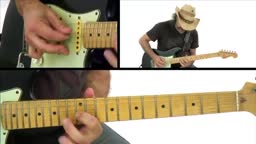
Hybrid Scales
Hybrid Scales
Concept #4
Rumba Blues
Rumba Blues
Performance
One Way Street: Lead 1
Performance
Sweet Windy City: Lead 1
Performance

What's included

41 lessons • 18 charts • 16 Jam Tracks

Play Blues Guitar 6: Soloing Approaches
Welcome to Play Blues Guitar 6: Soloing Approaches for intermediate to late Intermediate students of blues guitar.

This Blues Learning Path core course is presented by 7 top TrueFire educators: Larry Carlton, Robben Ford, Andy Timmons, Jeff McErlain, Corey Congilio, Andy Aledort, and Robert Renman.

The Soloing Approaches curriculum is comprised of select blues guitar lessons from the educators' existing TrueFire course libraries.

Solid rhythm chops may get you the gig but it's your soloing chops that gets you the spotlight and the opportunity to electrify the audience with your musicality. Creativity, technique, and vocabulary are the essential skills you'll need to master the art of improvisation and develop into a great soloist. The video guitar lessons in this core course will equip you with the requisite tools and guidance to take your soloing skills to the next level.

Play Blues Guitar 6: Soloing Approaches is organized into 2 sections. In the first section, you'll work on learning new concepts like playing off of the root, and adding chromatic notes to your solos. In the second section of Performance Studies you will play your way through a mixed bag of essential blues solos.

When you've completed the lessons here in Soloing Approaches, you'll find more lessons focused on soloing in Soloing Principles, also a Play Blues Guitar 6 core course.

The educators demonstrate all of the key examples over jam tracks (where and when applicable) to simulate a real-world application, in a musical context. All of the key examples are also tabbed and notated for your practice, reference and study purposes.

You'll also get Guitar Pro files so that you can play, loop or slow down the tab and notation as you work through the lessons. Plus, you'll have all of the available jam tracks to work with on your own.

Take as much time as you need to work through each video guitar lesson before moving on to the next lesson. If you want to dig deeper or wider into any of the topics covered in this core course, check out the recommended supplementary courses in your learning path where you'll find more examples, techniques and insight from top TrueFire educators.

Grab your guitar and let's get started!
Concepts and Insight
In this section you will look at how to play off the root note, and always make your way back home. You will also look at how to add some chromatic passing tones to your soloing approach. If you get these concepts down, it will allow you to get to the next level in your soloing.

TIP! Soloing is more than just licks. You need to understand the correlation between phrasing, melody and harmony. Becoming a good soloist is as much if not more mental than physical.

When you are working on various soloing concepts, ask yourself questions like - What chords will this approach work over? What groove or feel does this solo fit best over? What is the best note choice for this part? How can I get from here to there in the solo? Are there other scale options? Does my solo have a beginning, a middle and an end? - Or am I just rambling on.

Asking yourself these questions as you are beginning to build up your soloing chops will help make sure you are really thinking about what you are playing and working on. If you put in the time on this now, it will eventually lead you to the ultimate place for soloists where you won't have to think about any of it at all - you just play!
Finding Roots & Going Home
Finding Roots & Going Home - Concept 3 is a video guitar lesson presented by Andy Timmons and is sourced from Electric Expression: Blues.

Let's build on some of those rhythm and comping ideas with some double stops. I'll show you some of the classic ones that I and other blues players use.
Free Yourself of Patterns
Free Yourself of Patterns - Fundamentals: Demo is a video guitar lesson presented by Robben Ford and is sourced from Blues Revolution.

Most guitarists lock themselves into set fretboard patterns, especially when using the pentatonic scale, which significantly restricts creativity and sucks the life out of the music you make.

Robben shows you how to break out of this pattern-based mindset with a fretboard workout designed to free up your playing and expand your musical ideas.
Listen. Play. Emulate.
Listen. Play. Emulate. - Fundamentals: Insight is a video guitar lesson presented by Robben Ford and is sourced from Blues Revolution.

Robben shares some great advice on how to speed up your personal development as a musician through playing as much as possible with other musicians and by emulating those artists that you admire to train your ear and start building a vocabulary that you can craft into your own sound and style.

Listen. Play. Emulate.
Approaches to Soloing
Approaches to Soloing - Lesson 1:3 is a video guitar lesson presented by Larry Carlton and is sourced from 335 Improv.

In this segment, I'm emphasizing lines that use common chord tones. Even as I stretch out a bit, notice how those common tones keep the solo tied into the changes.

The improv I play in this clip is transcribed in the PowerTab. Throughout the course, I've included reference notation and text annotations in the tab/notation material to point out some of the key points that we're discussing in use. In addition to seeing common tones from the chord progression laid out in plain black and white, you'll also get some insight into how chromatic lines, triads, and arpeggios can function in an improvisation.

If you take your time and reverse-engineer what I've played in this video example, you'll start to gain a better understanding of how a single-note line can weave its way through chord changes. We often say that we're playing "over" the changes, but we're really playing right through the middle of them.
Hybrid Scales
Hybrid Scales - Concept #4 is a video guitar lesson presented by Robert Renman and is sourced from Blues Booster.

This is my own way of viewing 3 useful scales that you can use over the 1-4-5 chords in a blues. All it is, is the Minor Blues Scale for the 1 chord & the Mixolydian modes for the 1-4-5 chords combined. I find this to be a useful concept. Each hybrid scale is very closely related, since the A minor blues scale is present in all 3 of them. Study the neck diagrams and make sure you can "see" how the Mixolydian for A, D and E are combined with the A Minor Blues scale. The scale that is the foundation is the A Minor Blues scale, and the Mixolydian for each chords provides extra color. I find this approach to be very handy when navigating the fretboard. When you know the A Minor Blues scale and the A, D and E Mixolydian, combine them as I explained, and you have lots of great notes to choose from. These are notes you already knew anyway!

+ 34 more lessons

Start Course

Reviews

5 results

littlesister

Verified buyer

10/07/25

Play Blues Guitar 6: Soloing Approaches

There’s always something in these courses to learn. I recommend.
tyfirefighter31

Verified buyer

02/11/25

GREAT COURSE

This is a Great course for soloing ideeas

vprice

Verified buyer

07/18/20

Lots of good material

A good mix of concepts and ideas as well as a lot of solos to learn and study. Recommended.

bdasource

Verified buyer

06/29/20

VERY GOOD FOR LEARNING SOLOS

ITS JUST WHAT YOU NEED TO GET TO THE NEXT LEVEL AND ELEVATE YOUR PLAYING TECHNIQUE.

GregoryV

Verified buyer

06/27/20

Blues Guitar 6 Soloing Approaches

Excellent instalment in this well structured learning path

Stop searching. Start improving with All Access.

Try 14 days free. Cancel any time.