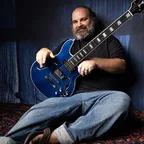
The blues is a double-edged sword. At first, the style is very easy to learn; a few moveable chords to get comfortable, a simple 1-4-5 progression to apply those chords over, and a single minor pentatonic or blues scale to start soloing with, over that progression. You’d be hard pressed to find a quicker, more satisfying way to start making good music with the guitar. But then one day you wake up and everything you play sounds tired, boring and un-creative. You don’t even have the energy to pick up the guitar anymore. Happens to ALL of us.
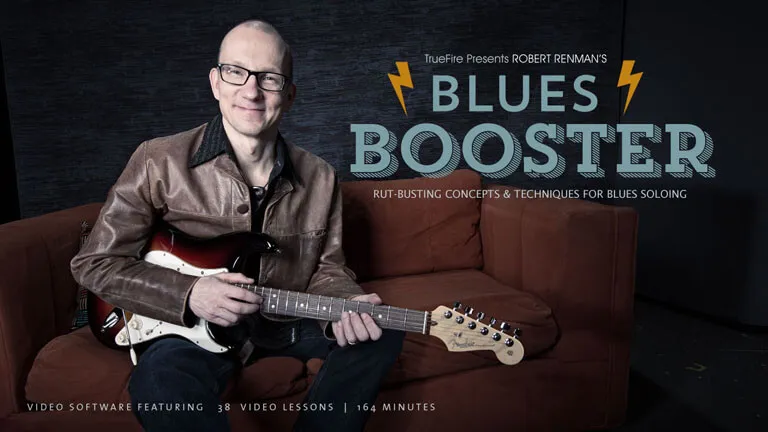
The only cure for all that ails your blues playing is a bagful of fresh perspective, creative insight along with the new harmonic and technical tools to put it all in play on the fretboard. And that’s exactly what Robert Renman delivers in Blues Booster.
Blues Booster is very likely the ticket to your own personal musical renaissance. It’s chock-full of creative, harmonic and technical epiphanies that you’ll be able to put to work immediately without having to struggle through tedious theory or boring exercises. In fact, spend just fifteen minutes with any lesson within the course and you’ll have something fresh and interesting to play that very night at the jam or with your buds.
Robert has organized Blues Booster into two sections. In the first section, Robert guides you through 15 Key Concepts and Techniques, which will majorly boost your blues musicality by adding more colors, textures and rhythmic approaches to your solos and improvisations. Robert explains, demonstrates and shows you how to apply Intervals, Mixolydian Mode, Minor Blues Scale, Hybrid Scales, Dorian Mode, Triads, Diminished Scale, Triplets, Rhythmic Phrasing, Hybrid Picking, 2-Note Hammers & Pull-Offs, Slide In/Slide Out, Chromatic Passing Notes, Skip the 2nd and the The Moving 4.
You’ll also play your way through the second section, as you apply all of the concepts and techniques from the first section, across six bluesy performance studies, in a variety of tempos, feels and keys. The Bye Babe Boogie, Funky Rhumba, Dorian Funk, Fat Groove, Texas Twist and Minor Swing performance studies all feature a rhythm track, which Robert will demonstrate over, after which he will breakdown his performance identifying the key concepts and techniques in play. You’ll then work with the rhythm track on your own, soloing and improvising using those key concepts and techniques.
All of the performances are tabbed and notated, plus you’ll get Guitar Pro files as well along with all of the rhythm tracks that Robert uses to demonstrate over.
Robert also happens to be the winner of TrueFire’s 2013 Next Top Guitar Instructor competition, which means that not only has a panel of judges validated his vast acumen as an educator but more importantly, hundreds of Robert’s students have also chimed in with their votes as testimony to just how effective Robert’s teaching approach is. We’re very proud to share his educational magic with you here in Robert’s first TrueFire course, Blues Booster.
“I'm excited for the opportunity to share some of the concepts that I've developed over the years as a guitar teacher and guitar player. I've been influenced by a variety of styles over the years, which is reflected in my playing style. When people ask me what style I play, I say its blues-based, with influences from jazz, funk, rock and country. I’m very excited for this opportunity to share some of my approaches to soloing and improvising in a blues format.”
So, if you woke up a little tired with your blue bag, step up for a serious Blues Booster shot!
What you'll learn
Use pre-bends and bend-release techniques for expressive phrasing
Apply hybrid picking technique with middle finger on right hand
Combine pentatonic and blues scale vocabulary with triadic ideas
Play a complete solo over a 16-bar blues progression
Create repetitive, groove-oriented phrases that 'milk' ideas
Hi there, I'm Robert Renman, and I'm excited for the opportunity to share some of the concepts I've developed over the years as a guitar teacher and guitar player. I've been influenced by a variety of styles over the years, and I think this is reflected in my playing style. When people ask me what style I play, I usually come up with a lengthy answer! Let's call it blues-based, with influences from jazz, funk, rock and country. In this course, which is split in two sections, I will teach you some of my approaches to soloing and improvising. In the first section, I will cover some of the scale and technique concepts I use when I'm improvising. Then in the second section, we'll apply these concepts in six different performance studies, using backing tracks that are in a variety of styles. So, pick up that guitar, and let's get started!
In section one, I'll go over a variety of concepts I use when playing lead guitar. I learned to play by listening to records, and copying what I heard, which is how many people still learn to play. Perhaps those days are gone now, with technology making it so easy to learn by slowing down songs and videos, etc. It was way harder back in the day, I tell you! However, I was also fortunate enough to study some music theory in my late teens, and that really helped me understand music better. So, I am going to share with you some useful theory concepts, such as some scales and triads, as well as some of the techniques I use, such as hybrid picking, hammer-ons, pull-offs, and sliding into notes.
I try not to think too much when I play, because the more I think, the stiffer my playing becomes. You've probably heard expressions such as "learn music theory, then forget about it and just play". There's truth to that. In general, the more you know, the better. It does not mean you have to use everything you know, all the time, but it's very helpful, in that guesswork is eliminated. If you really know it, you don't have to think about it, and this knowledge is ingrained into your playing, without you having to think about it. In other words, it's become a part of you. This leads us to the first concept, Intervals. If there's is anything I do think about, it's usually the intervals. This is simply a way to refer to each note of a scale. Let's look at the A major scale, and simply refer to each note by a number. We end up with 7 notes, and each of them has it's unique sound. 1,2,3,4,5,6,7. What I mean by that, is that when listen to, for example the 3rd note, it sounds very "fitting", for lack of a better word. In other words, it's a strong note. In comparison, the 4th note, it sounds like it wants to go somewhere. To me, that is a weaker note, but it all depends on how you use it. Where the power lies, is knowing the sound of each interval in relation to the chord being played. If you can immediately tell you are on a root note, 3rd, 5th or a 7th, you have an immediate advantage over those who can't, because that means you will know which are strong notes to focus on (especially when ending licks). The way you learn to hear these intervals is the good old way, by listening to music! There are also websites and apps you can use for ear training. The more you do this, the easier it gets. I strongly recommend spending time on this, because it'll make you a better musician and you'll be able to learn licks and songs faster. It may seem simplistic to refer to the major scale, but the truth is, it's the basis for almost all music we hear today. I highly recommend you learn the major scale in as many was as you can (fingerings, string combinations, etc), because it provides a great foundation for other scales too, as we will see next.
*Please note that around 3 minutes in, I mentioned E is the 1 for A. That was a mistake - E is of course the 5th in relation to A. In relation to D, the note E is the 2nd.
So compared to the Major scale, the Mixolydian is very different in sound and color, even though there's just one note that's different. It's an important note however! By lowering that major 7th note a half-step to a minor 7th, we get the Mixolydian mode. This scale works over Dominant 7 chords. Sometimes it's referred to as the Dominant Scale. We can use the Mixolydian mode for each of the chords in a blues, in this case the chords A7, D7 and E7. Let's do just that over a rhumba blues in the key of A. As you are studying the neck diagrams, you will see that these 3 modes/scales have many notes in common. It's the notes that are different that you want to pay the most attention to.
The Minor Blues scale is a universal scale, it works in so many situations. I view it as the go-to scale, never leave home without it! It has 6 notes. The intervals are 1, b3, 4, b5, 5, 7. Let's listen to the sound of it, over the A7 rhumba backing track. Compared to A Mixolydian, this scale has a minor 3rd and a flatted 5th (also called diminished 5th), otherwise, all the notes in the A Minor Blues scale are also present in A Mixolydian. If you look at it from another perspective - the Mixolydian has the 6th and the 2nd, which the Minor Blues scale doesn't have. The cool thing is you can use both of these scales over a 7 chord.
This is my own way of viewing 3 useful scales that you can use over the 1-4-5 chords in a blues. All it is, is the Minor Blues Scale for the 1 chord & the Mixolydian modes for the 1-4-5 chords combined. I find this to be a useful concept. Each hybrid scale is very closely related, since the A minor blues scale is present in all 3 of them. Study the neck diagrams and make sure you can "see" how the Mixolydian for A, D and E are combined with the A Minor Blues scale. The scale that is the foundation is the A Minor Blues scale, and the Mixolydian for each chords provides extra color. I find this approach to be very handy when navigating the fretboard. When you know the A Minor Blues scale and the A, D and E Mixolydian, combine them as I explained, and you have lots of great notes to choose from. These are notes you already knew anyway!
This scale works great over minor chords. It's one that I primarily use for most minor chords. Compared to the Natural Minor scale (Aeolian), it has a Major 6th. That's the only difference. Let's also compare it to the Mixolydian. We can see that the only difference is that the Dorian mode has a minor 3rd. That's what makes it a minor scale. So, if you use the Dorian over a 7 chord, just bend that 3rd a bit and you have the Mixolydian. In blues, you can get away with almost anything, and playing a minor scale over a 7 chord is good example of that. It works well, as long as you do it tastefully. Just don't use the major 3rd over a minor chord - it will not work well. I also recommend you spend time listening to the sound of Dorian, and get it in your head. Note that the notes of Dorian are also present in the Hybrid Scale, which is interesting.
*Please note that around 2:22 in, I said "Major 2nd". That was a mistake, I meant to say "Major 6th".
well explained by very good player. nice job, learning a lot
J
jessehurlbut
Verified buyer
07/25/24
Boosted!
Robert is an outstanding instructor. This course hit me exactly at my level (intermediate) and I've already learned a ton.
M
Min T.
09/23/22
One of the best blues courses
I keep coming back to this course every time I want to add some freshness to my playing. Reman's teaching style is clear and articulate. I really dig his rhythmic approach to blues playing. Hopefully Robert Renman with release a follow-up material.
R
RockyRoll
Verified buyer
06/24/22
A valuable addition to your blues!
Robert is a really great teacher. There are some really great tips and tricks in this course. I particularly liked his lesson on playing 'outside'. Some trick concepts here, but he explains them clearly. I'm really enjoying the course.