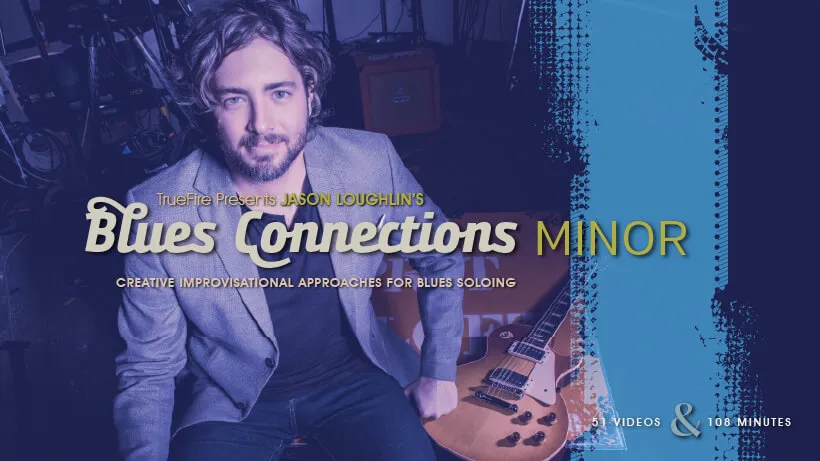

Blues Connections: Minor

Creative Improvisational Approaches for Blues Soloing

Marty FriedmanTommy EmmanuelSteve VaiEric GalesEric Johnson

Get this course and 1,000+ more with All Access

Try 14 days free. Cancel any time.

Purchase Individual Course for $9.99
Blues Connections: Minor

About this course

One of the key qualities that distinguishes great blues players is their ability to 'play the changes' by targeting chord tones in their solos for the chords they're improvising over. Accomplished improvisers can also take simple musical statements (motifs) and develop them into powerful solos that connect creatively and harmonically. In Jason Loughlin's Blues Connections: Minor, you'll learn both of those critical soloing skills for blues progressions in a minor tonality.
"For most guitar players their introduction to improvisation is through using the minor pentatonic scale. One of the benefits of this scale is that it sounds good over a minor blues, major blues and good amount of rock progressions. Unfortunately, too many guitarists never take the next steps and actually learn how to play over changes with it. In other words, being able to use the corresponding scale to the chord you are playing over.”
Blues Connections: Minor lays out a system for learning how to play over changes, which will bring a whole new depth to your lead playing by focusing on building a language, not just connecting licks. We'll achieve this by doing a few things: Knowing our minor pentatonic scales in all five positions and in multiple keys, voice leading the minor pentatonics into each other, connecting our positions, minor chord arpeggios and targeting their extensions, converting the minor pentatonic into a blues scale and using improvisational devices to shape powerful solos.

You'll learn how to play minor pentatonic scales in all five positions, how to voice lead them, and how to effectively and easily target tones. Jason will also share a variety of powerful improvisational devices that will help you shape powerful and engaging blues solos.

All of the performances are tabbed and notated for your practice, reference and study purposes. You'll also get Guitar Pro files so that you can play, loop and/or slow down the tab and notation as you work through the lessons. Plus, Jason generously includes all of the rhythm tracks for you to work with on your own.

Grab your guitar and let's play the changes with Jason Loughlin!

What you'll learn

  • Navigate blues scales across neck positions
  • Improvise across different modal positions
  • Use articulation techniques in soloing
  • Create melodic variations
  • Build five modes of minor pentatonic scale
Release date: 08/25/2016 • 1h 47m runtime
Start Course
Sample lessons
Five Modes Of The Minor Pentatonic
Demonstration
Targeting Chord Tones
Demonstration
Position 4 Solo Study
Overview
Position 4 Solo Study
Performance

What's included

51 lessons • 23 charts • 4 Jam Tracks

Blues Connections: Minor
Hi, I'm Jason Loughlin and welcome to Blues Connections: Minor. For most guitar players their introduction to improvisation is through using the minor pentatonic scale. One of the benefits of this scale is that it sounds good over a minor blues, major blues and good amount of rock progressions. Unfortunately, too many guitarist never take the next steps and actually learn how to play over changes with it. In other words, being able to use the corresponding scale to the chord you are playing over.

This course lays out a system for learning how to play changes that will bring a whole new depth to your lead playing by focusing on building a language, not just connecting licks. We'll achieve this by doing a few things: Knowing our minor pentatonic scales in all five positions and in multiple keys, voice leading the minor pentatonics into each other, connecting our positions, minor chord arpeggios and targeting their extensions, converting the minor pentatonic into a blues scale and using improvisational devices to shape powerful solos.

The course is divided into six sections. Section 1 will cover the basics of the minor pentatonic. We'll learn how to build it on single strings, all five modes, and look at how to voice lead the scales over a three chord progression. Section 2 will walk us through improvisational concepts that will help us make music out of our scales. Section 3 we teach how to put these ideas together through learning five solo studies. We'll learn a solo for each position of the minor pentatonic. Section 4 will show you how to convert the modes of the minor pentatonic into the modes of the blues scale by adding one simple passing tone. Section 5 is called "Highways", in which we'll review the minor pentatonic on single string scales to help us connect positions and move across the neck. We'll learn a solo that connects the positions and incorporates the blues scale. Section 6 will target the extensions of the chords we're playing over. We'll use the 9th and 6th to add some unique color to our solos. I've included all the backing tracks, notation, and tab for all the examples. Let's get started!
SECTION 1: Minor Pentatonic Scale
In Section 1, we're going to learn how to build the minor pentatonic scale on single strings by learning it's scale formula ascending and descending. Then, we're going to learn the five modes of the minor pentatonic in five positions on the neck. Finally, we'll learn how to voice lead the modes together over a 12-bar blues in A minor.
Building The Minor Pentatonic Scale
First let's look at the minor pentatonic formula: Root-b3-4-5-b7. We're going to build the scale off of a single string so we can see the intervallic relationships between the scale degrees. You can create a minor pentatonic off of any note if you follow this formula: minor 3rd, whole step, whole step, minor 3rd. A minor 3rd interval is one and a half steps. As you're going through the scale, focus more on what scale degree you're on rather than the note's name. We're going to build this scale off of an A, D, and E since these are the keys we'll need for the course.
Five Modes Of The Minor Pentatonic
There are five notes in a pentatonic scale, which means there are five modes of it or five positions on the neck you can play the scale. We'll be building a scale pattern off of each note in the pentatonic scale, always starting on the 6th string. The goal is to try to stay in position as much as possible, only shifting positions to make more efficient fingerings. Say the scale degree numbers out loud as you move up and down the scales. Even better, sing them!
Voice Leading Minor Pentatonics
In order to voice lead pentatonics, we need more than one chord. For this lesson, I've picked a three chord progression for us to practice our voice leading. We'll be using Am, Dm, and Em, meaning that we have to have command of the corresponding minor pentatonics for each chord. So, we need to know A, D, and E minor pentatonic and the five modes for each. The idea is to ascend and descend through the A minor pentatonic scale until the chord changes to Dm. At that point, we need to change to the closest note in the D minor pentatonic scale and keep moving in the same direction.

I've picked eighth notes as my rhythm and I begin by ascending. I recommend not doing this with the track at first, just take the time to really think about what you're doing and where the next note is before you move. You shouldn't be rushed. Once you're feeling comfortable, try it with the track. As you progress, try using dotted eighth/sixteenths, triplets, sixteenths, and various combinations. Also try starting descending from the high E string. Keep forcing yourself out of comfort zones. I've included backing tracks in three different keys for this lesson.
Voice Leading in Position 1
For this example, we'll voice lead over a 12-bar blues in A minor. I'm using mode 1 in A minor which puts me on the root, mode 4 in D minor which puts me on the 5th, and mode 3 in E which puts me on the 4th. This will make sure I stay in or around the same position. Take a second and review these modes. Take note of what notes they share and which ones are different. Also, start to map out your root, b3rd, and 5th.
Voice Leading in Position 2
For this example, we'll voice lead over a 12-bar blues in A minor. I'm using mode 2 in A minor which puts me on the b3rd, mode 5 in D minor which puts me on the b7th, and mode 4 in E minor which puts me on the 5th. This will make sure I stay in or around the same position. Take a second and review these modes. Take note of what notes they share and which ones are different. Also, start to map out your root, b3rd, and 5th.

+ 44 more lessons

Start Course

Reviews

16 results

sclayblues

Verified buyer

05/07/25

Good so far

Only part way through, as have other courses going. Pretty good so far.

miguelangelmunoz

Verified buyer

01/06/23

Got It!

Great teacher , clear conclusions, optimous personal results

dspoling

Verified buyer

10/20/22

Blues Connections: Minor Course

Jason Loughlin is an excellent instructor. He clearly explains concepts and demonstrates those concepts in a way that's easily understood. This course's content is appropriate and logical for building skill in playing chord changes (so that a guitarist can move beyond the minor pentatonic of a blues song's key). I recommend this and Jason's other courses.

Dave58

Verified buyer

07/06/22

always fun!

This is a great lesson package from a master musician and teacher. Very clearly explained and taught. Always interesting example choices supplemented with background information. The reason why I keep going back to Jason's guitar lessons. He's a damn great guitarist.

zoopit

Verified buyer

06/27/22

Bought this course not knowing what to expect and man I'm glad I bought it. Great teaching style and the explanations by the instructor are so clear and concise. Get this course you will not regret it.

Stop searching. Start improving with All Access.

Try 14 days free. Cancel any time.