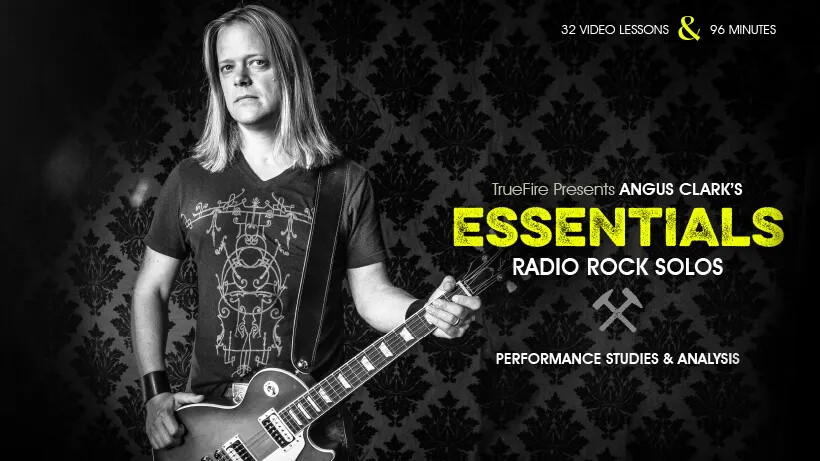
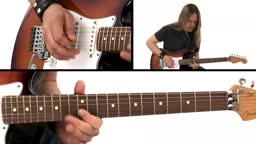
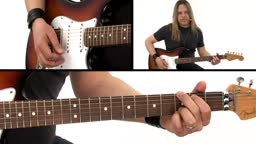
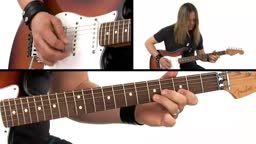
If you can scat along, note for note, to the guitar solo from one of your favorite rock tunes, then that’s a ‘radio rock’ solo. If the solo distinguishes the tune even more than the lyrics do, then that’s a ‘radio rock’ solo. If your favorite guitar solos trigger involuntary air guitar convulsions, then Angus Clark’s Radio Rock Solos edition of Essentials will transform your own guitar solos into the tasty, melodic, and memorable solos that define the art of ‘radio rock’ guitar.
”I've put together ten solo studies to show you how to construct concise, exciting, and memorable solos in the context of a pop rock tune. Along the way, we're going to borrow from some of the best, in a variety of decades and styles: Hendrix and Clapton, Neal Schon and Angus Young, Neil Giraldo and Elliot Easton, Dan Huff and Richie Sambora. We'll see what similarities they share, what makes them unique, and most importantly, how to incorporate their creative approaches into our own playing.”
Angus demonstrates all of the solos over backing tracks and then breaks them down by stepping you through the key concepts, techniques and creative approaches that he used in each soloing performance study. Each backing track features count-offs into the buildup to the solo section demonstrated. The rest of the track is a repeating mini song form that allows you to frame the solo within the context of a pop song, staying true to the radio rock format, where your entrance and exit are just as important as the solo in between.
Schon's Journey - “I'll perform a solo in G in the style of Neal Schon from Journey. For this solo, we’re in G major with a progression of G - D - Em – C, simply repeating for the entire solo. This is called a I - V - vi - IV. In this case the V chord is inverted, with the 3rd in the bass (D/F#). First Lick: All on one string - try it some time. Starting on the 5th is a fairly safe bet too. Second Lick: This is a G Major pentatonic played using a 2-string pattern with a slide between the 5th and 6th degrees of the scale in both octaves. Third Lick: I'm playing a 2-string arpeggio pattern lick using pull-offs. Take your time on this one! It ends with a scalar lick using pull-offs (technique!). Fourth Lick: Ascending stabs - we're building to the end, so we're getting higher and higher. Finale: This is the highest note in the solo!”
Eric's Bridge - “This is a quick solo in the style of Eric Clapton over a I - bVII - IV - I progression, which is perfect for mixing up major and minor pentatonics. First Lick: In the 10th position, starting on a D. Use a half-step hammer-on approach to the major 3rd, then the root on the top string, and bend to the root from the b7. Second Lick: Uses the top two strings, major pentatonic with the 4th degree of the scale added by bending up on the first string. Classic Clapton. Third Lick: Shift up to the upper extension of the blues box, play the lick and be sure to tweak the F up to an F# (or almost there). Fourth Lick: Major pentatonic from the 15th position. Fifth Lick: Minor pentatonic, but has to end on an A in order to get you back into the song - do the math!”
Giraldo's Jessie - “Now let's look at a solo in D Major in the style of Neil Giraldo. When the vamp is moving this quickly, it's almost like the rhythm section is just pedaling a D Major chord. You don't really need to ‘cut the changes’ at all, except where it moves to the A chord at the end for the buildup. Be sure to hit that right on the money, 'cause it's the only harmonic variety that you have to work with. First Lick: Thirds! Second Lick: This is a D Major pentatonic lick ending on the open string. Third Lick: The great thing about using the open string in the last lick is that you can jump registers. Fourth Lick: This is some scaler material with a little motivic development, and a big payoff on the A chord with, you guessed it, a blues lick!”
Easton's Drive - “Here’s a solo in E Major inspired by Elliot Easton on "Just What I Needed". This solo goes by in the blink of an eye, so feel free to watch it a couple of times, 'cause it's jam packed with goodies! The trickiest thing here is nailing the G#dom7 chord in the key of E. In this solo, I successfully target the B# (enharmonic C Natural) on the first rotation and the D# on the second rotation. Lick 1: I'm using the major pentatonic from the upper extension of the traditional blues box. Lick 2: Classic rock/rockabilly lick. Lick 3: Bluesy pentatonic lick! I don’t care if you play this lick exactly, just so long as you nail the subdivisions and the last note, you're good. Lick 4: Ascending E Major pentatonic lick . Lick 5: Sixths.”
Billy Rock - “Here's another Elliot Easton inspired solo in a very classic pop meets rockabilly vein. In this lesson, I'll perform a solo in C major inspired by The Cars classic My Best Friend's Girl. There’s a little vamp at the top and tail, so you'll want to come up with something catchy and repetitive. Vamp: Just follow the chords with a repeated motif. Done. Lick 1: On the F chord, play an F Major pentatonic, on the G chord, play a G major pentatonic. Lick 2: Little bend to the major 3rd on each chord, again, playing the same lick on each chord. Lick 3: This is a challenging lick that involves bending in the diatonic scale to create a slightly pedal steel inspired sound. Lick 4: Welcome to the major scale! Then, back to the vamp.”
Purple Hendrix - “Hendrix is a major inspiration for me, and his influence is not to be underestimated. Hendrix played the guitar like an orchestra, so when you hit that bottom E string, hit it like the tympani, or when you hit the E7#9 chord, be the horns, when you're playing the riff, be the strings, and on the solo, be the singer. Lick 1: Using octaves, again we have a motif in a scalar motion. Lick 2: In the 12th position, I use the same fingering across strings three and four, two and three, and one and two. I’m staying squarely in the Dorian mode. Lick 3: A wobbly unison bend - one of my favorites. Out Section: Play along with the riff with various ad-libs in between.”
Full Sambora - “Richie Sambora brought a lot of classic guitar chops to the plate with Bon Jovi. Let's look at how he integrated his old school roots with the slick arena rock sound of the band. Here's a solo in F# minor inspired by the work of Richie Sambora. Lick 1: Slow bend down from the 5th, using a pinch harmonic for emphasis. Very 80’s. Lick 2: Melodic material - steal the bass line. Lick 3: Pentatonic connector lick to get us up to the next register. Lick 4: Octaves! Lick 5: Melodic material again - steal the bass line up 2 octaves. Lick 6: Ascending pentatonic in groupings of 4 - practice it!”
Huff's Ballad - “Dann Huff, Keith Urban...the power ballad now resides in Nashville - so let's take a trip down to music city! Here's a solo inspired by Dann Huff and the song "When The Lights Go Down" by Faith Hill. Lick 1: We start on the highest note in the solo, then play down the scale into a classic half step bend lick. Lick 2: Coming into the drum fill, we'll go bluesy with a double-stop bend lick - bring the emotion! The descending blues scale ends with a bend to the major. Lick 3: This is material from the beginning of the solo in a lower octave. Lick 4: A down dynamic blues lick. This solo is a great contrast to a lot of what’s in this course, as the form is kind of reversed from a lot of the stuff that starts low and ends high.”
Highway to Angus - “Let's look at the legendary Angus Young from AC/DC. Their appeal cuts across genres, with hits in 2 different decades. AC/DC's music is simple from a strictly "bookish" perspective, but this simplicity is what makes is so strong and so fragile at the same time. When there are only three chords at play, you better make each note count! The licks here are pretty straight forward. More important are the position shifting and resulting structure of the solo. Hot Tip: Note the three fret trick to get from minor to parallel major pentatonic scale, particularly Angus’ use of a descending bend from the b7 to the 6th on the 4th string - this is a signature move of his. Other signature elements of the style are Angus’ rhythmic pocket - it's scary good!”
Big Money Maker - “This solo is built on a lick that I came up with for the first Radio Rock course, we're in D Major on a power ballad groove. This solo starts with major pentatonic, and is strong melodically while being very “inside”. At the end of the chord cycle, we introduce our first blues lick, where we still bend the third major…slowly. The second section is very similar, just up an octave. Quick nod to Steve Lukather here, and then we'll shift into the blues scale at the 13th position. The very end of the solo is a build on an A chord. This descending lick has been seen before in this course, so you should recognize it by now. Make that cash!”
All of the performances are tabbed and notated for your practice, reference and study purposes. You’ll also get Guitar Pro files so that you can play, loop and/or slow down the tab and notation as you work through the lessons. Plus, Angus generously includes all of the backing tracks for you to work with on your own. Each of the backing tracks will not only give you the solo section to play over, but also contains a mini song form so that you can frame your radio-rock solo appropriately.
Grab your guitar and let’s rock the radio with Angus Clark!
Hi, I'm Angus Clark, and welcome to Essentials: Radio Rock Solos. When I first came to TrueFire, we talked about what really inspires people, and what inspired me to play the guitar. We kept coming back to this term "radio rock" - the music that's the soundtrack to our lives, the tunes we hear on the radio.
In this course, I've put together ten solos that are going to take you inside how to construct and deliver amazing solos that evoke all the melodicism and ingenuity that goes into making a concise, exciting, and memorable solo in the context of a pop tune. Along the way, we're going to borrow from some of the best, in a variety of decades and styles: Hendrix and Clapton, Neal Schon and Angus Young, Neil Giraldo and Elliot Easton, Dan Huff and Richie Sambora. We'll see what makes them the same and what makes them unique, and how I’ve incorporated the lessons I've learned from these guys into my own playing. The goal of this course is for you to incorporate some of this into your own style.
Each solo has a full demonstration breakdown along with tab and notation, and you'll also get the backing track to play over. Each backing track featured counts off into the buildup to the solo section you see demonstrated. The rest of the track is a repeating “mini song form” that allows you to frame the solo within the context of a pop song. We did this specifically for the radio rock format, as your entrance and exit are just as important as the solo in between. Have fun with it, I sure did!
Neal Schon is without a doubt one of the most influential guitarists ever to be heard on the radio. With a decade spanning career and numerous hit singles, Journey has firmly implanted the sound of Neal’s guitar in our collective consciousness. You can't escape the infinite appeal of the emotion he faithfully captures (get it?).
I took a minute to include a lick from Gary Richrath of REO Speedwagon in this solo, with REO being my first concert and Gary being a huge influence on me.
In this lesson, I'll perform a solo in G in the style of Neal Schon from Journey.
For this solo, we’re in G major with a progression of G - D - Em – C, simply repeating for the entire solo. This is called a I - V - vi - IV. In this case the V chord is inverted, with the 3rd in the bass (D/F#).
First Lick: All on one string - try it some time. I like the G string; nice and meaty. Starting on the 5th is a fairly safe bet too. Check out the sliding nature of this lick, and the half step bend at the end.
Second Lick: This is a G Major pentatonic played using a 2-string pattern with a slide between the 5th and 6th degrees of the scale in both octaves. Try it sometime, it makes a nice sound. Make note of the recurring melodic device at the end of the lick - it's the same as the first lick just an octave up.
Third Lick: I'm playing a 2-string arpeggio pattern lick using pull-offs. Take your time on this one! It ends with a scalar lick using pull-offs (technique!).
Fourth Lick: Ascending stabs - we're building to the end, so we're getting higher and higher.
Finale: This is the highest note in the solo! There's a long run down to a G and you're done.
Eric Clapton’s global notoriety is built on his playing on pop tunes, so don't be fooled by his legit blues cred. It’s how he snakes that bluesiness onto the radio that made him a household name. Let’s take a look at some of the key elements of his style.
This is a quick solo in the style of Eric Clapton over a I - bVII - IV - I progression, which is perfect for mixing up major and minor pentatonics. Look at the choice of positions as well as the slides and hammer-ons.
First Lick: In the 10th position, starting on a D. Use a half-step hammer-on approach to the major 3rd, then the root on the top string, and bend to the root from the b7. So you've already got a nice mix of playing major from inside the minor pentatonic box.
Second Lick: Uses the top two strings, major pentatonic with the 4th degree of the scale added by bending up on the first string. Classic Clapton.
Third Lick: Shift up to the upper extension of the blues box, play the lick and be sure to tweak the F up to an F# (or almost there).
Fourth Lick: Major pentatonic from the 15th position - get this stuff together, it's really useful!
Fifth Lick: Minor pentatonic, but has to end on an A in order to get you back into the song - do the math!
I find courses by Angus Clark to be interesting, informative, and approachable. This course which I am traversing is no exception. Angus is also a great player which doesn't hurt!
I
IamBenjamin
Verified buyer
01/31/23
Essentials: Radio Rock Solos
Cool riffs from a great guitarist and teacher!
P
pipo76
Verified buyer
01/25/23
NECESSARY FUN!
Totally loved this course. I was always into classic rock guitar and I felt I needed to get some tasty, cool and exciting licks under my belt. Plus, Angus Clark is a great teacher, fun to follow and very on the case.
Highly recommended!!!
D
dahrothgar
Verified buyer
01/08/23
Great course!
Interesting assortment of riffs. Well presented, easy to follow, and quick to absorb. Angus is not only an excellent guitarist, but an excellent teacher as well.