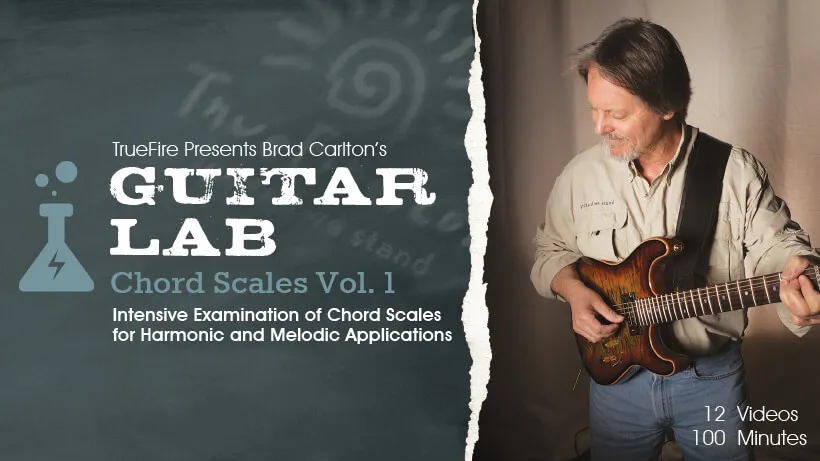

Guitar Lab: Chord Scales Vol. 1

An Intensive Examination of Chord Scales for Harmonic and Melodic Applications

Marty FriedmanTommy EmmanuelSteve VaiEric GalesEric Johnson

Get this course and 1,000+ more with All Access

Try 14 days free. Cancel any time.

Purchase Individual Course for $5.00
Guitar Lab: Chord Scales Vol. 1

About this course

Welcome to Guitar Lab: Chord Scales Vol. 1. In this course, we'll look at the concept of chord scales - one of the most useful tools for generating harmonic and melodic ideas. Through the use of intervals, we'll be studying the E major scale along the string axis on the 4 highest pitched strings of the guitar. Because the major scale has 7 different notes, each structure will yield 6 more structures. You'll be provided with 6 different jam tracks which vary only in the bass note. By playing the structures of each lesson over the 6 different jam tracks, you'll be playing in 6 different modes of the E major scale

You'll be provided with charts explaining the major scale and its respective modes, and you'll also be encouraged to analyze a structure in terms of scale degrees which will allow you to apply these chord voicings against various harmonies. All the structures are plotted out on fingerboard diagrams to help you see this information on the neck.

What you'll learn

  • Exploring chord voicings across different modes
  • Viewing fretboard diagonally
  • Understanding second intervals across guitar strings
  • Developing intervallic thinking on guitar
  • Developing intervallic thinking
Release date: 01/29/2016 • 1h 40m runtime
Start Course
Sample lessons

What's included

12 lessons • 11 charts • 1 Jam Tracks

Guitar Lab: Chord Scales Vol. 1
Hi, I'm Brad Carlton and welcome to Guitar Lab: Chord Scales Vol. 1. In this course, we'll look at the concept of chord scales - one of the most useful tools for generating harmonic and melodic ideas. Through the use of intervals, we'll be studying the E major scale along the string axis on the 4 highest pitched strings of the guitar. Because the major scale has 7 different notes, each structure will yield 6 more structures. You'll be provided with 6 different jam tracks which vary only in the bass note. By playing the structures of each lesson over the 6 different jam tracks, you'll be playing in 6 different modes of the E major scale.You'll be provided with charts explaining the major scale and its respective modes, and you'll also be encouraged to analyze a structure in terms of scale degrees which will allow you to apply these chord voicings against various harmonies. All the structures are plotted out on fingerboard diagrams to help you see this information on the neck.
Chord Scale Principles
In the accompanying video, I'll explain and demonstrate the principles of chord scales along the string axis. I'll then explain and demonstrate how any structure can have 6 different harmonic personalities.
E major in 2nds
The first interval that you'll learn to visualize on the fingerboard will be 2nds. 2nds are quite simply two adjacent notes out of the scale. They're named 2nds because they encompass two letter names of the musical alphabet. There are two types of 2nds that we'll be dealing with: major 2nds, which are two notes a whole step apart, and minor 2nds, which are two notes a half step apart. This lesson will teach you to visualize the E major scale in intervals of 2nds on the 4th and 3rd strings.
E major in 2nds
This lesson will take the same information that you learned in the previous lesson and apply it to the 3rd and 2nd strings. The 3rd and 2nd strings are the only pair of adjacent strings that are tuned a major 3rd apart. All of your other adjacent string groups are tuned a perfect 4th apart.
E major in 2nds
This lesson deals with the E major scale in intervals of 2nds on the second and first strings. The second and first strings and the fourth and third strings are tuned a perfect 4th apart. Therefore, your fingerings will be the same on both of these string groups.
E major in 3rds
Now we'll go back to the 4th and 3rd strings and study intervals of 3rds. 3rds are simply every other letter of the major scale. There are 2 intervals that we will use: major 3rds, which are two whole steps apart, and minor 3rds which are one and a half steps apart.
E major in 3rds
The shapes of the 3rds on the third and second strings will be different than those of all your other adjacent string groups.

+ 5 more lessons

Start Course

Reviews

4 results

Mackysback

Verified buyer

10/17/24

Mackysback

Great course

Osokin

Verified buyer

02/13/23

Chord Scales Explorations!

Brad Carlton and TrueFire have put together an extremely valuable and extensive series of lessons (spread over 4 volumes) examining the concept of chord scales - one of the most useful tools for generating harmonic and melodic ideas. This is challenging material, and as always Brad goes very deeply into the subject material - but the knowledge gained will really elevate the level of your guitar playing. Great stuff!

bikerbaker

Verified buyer

07/19/21

I love this teacher

bhayley

Verified buyer

06/15/21

Guitar Lab: Chord Scales

Brad is really thorough in his approach. Good course.

Stop searching. Start improving with All Access.

Try 14 days free. Cancel any time.