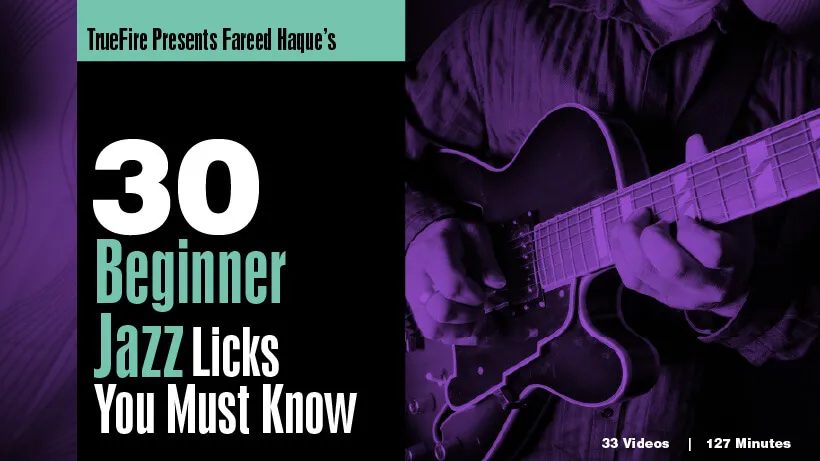
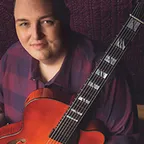
30 Beginner Jazz Licks You MUST Know

Learn how to play jazz guitar with 30 must-know licks

Marty FriedmanTommy EmmanuelSteve VaiEric GalesEric Johnson

Get this course and 1,000+ more with All Access

Try 14 days free. Cancel any time.

Purchase Individual Course for $14.99
30 Beginner Jazz Licks You MUST Know

About this course

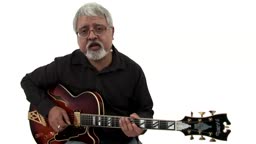
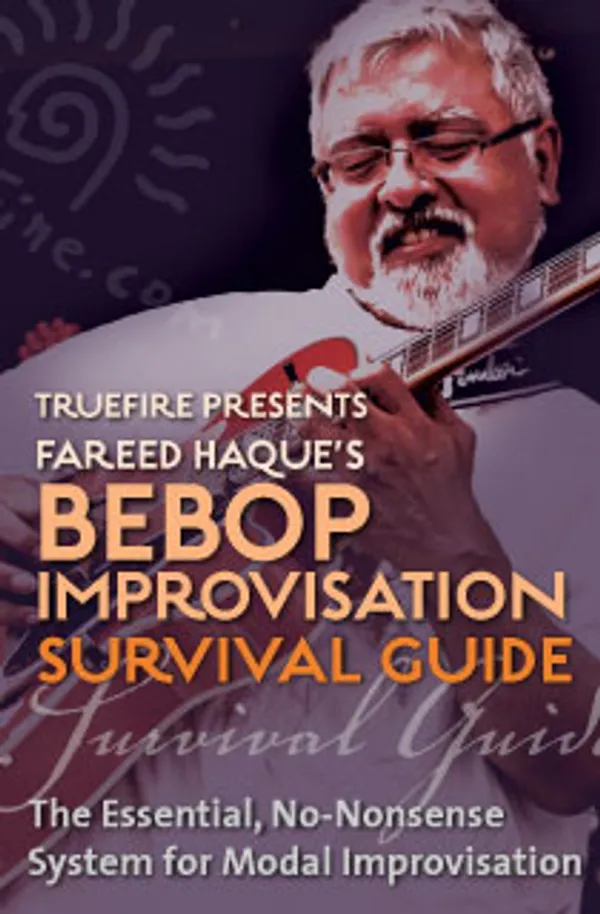
Developing a vocabulary of jazz licks is the first step for learning how to solo and improvise over jazz progressions and songs. Every jazz guitar player learns pretty much the same beginning vocabulary of jazz licks and then, with time and practice, transforms them into their own distinctive jazz guitar sound. To help kick-start your own jazz lick vocabulary, Fareed Haque hand-picked 30 Beginner Jazz Licks You MUST Know to ensure that they were easy to learn and also very versatile.

These 30 beginner jazz guitar licks can be played over a variety of chord changes, and all of them can be connected with other licks to form longer phrases and solos. All of the licks are also ‘moveable’ so that you can move them up and down the fretboard and play them over jazz changes in any key.

You’ll not only expand your vocabulary for soloing and improvisation, but you’ll also build a solid foundation of essential jazz guitar techniques such as slides, hammers, pull-offs and rakes.

You’ll not only expand your vocabulary for soloing and improvisation, you’ll also build solid foundations in essential jazz guitar techniques. ”Jazz guitar players not only rely on their vocabulary of licks to power their improvisations, they also must have command of a variety of techniques to give their licks personality and authenticity. I’ll break down all of the licks for you note-by-note but I’ll also teach you how to properly execute the technique being used to play the lick. I'll guide you step-by-step through the process of making them come to life!”

Fareed demonstrates all of the licks over rhythm tracks and then breaks them down note-by-note showing you the techniques you’ll need to have command of to play the licks correctly.

All of the licks are tabbed and notated for your practice, reference and study purposes. You’ll also get Guitar Pro files so that you can play, loop and/or slow down the tab and notation as you work through the lessons. Plus, Fareed generously includes all of the rhythm tracks for you to work with on your own.

Grab your guitar and let’s play some jazz with Fareed Haque!

What you'll learn

  • Execute a complex bebop-style jazz lick
  • Create tension and resolution in jazz improvisation
  • Develop advanced fingering and picking techniques
  • Understand intervallic movement in jazz improvisation
  • Developing jazz phrasing techniques
Release date: 03/31/2016 • 2h 07m runtime
Start Course
Sample lessons
Bluesy Walk Up
Bluesy Walk Up
Lick 1
Twisting With Bird
Twisting With Bird
Lick 10
A Basic ii V I
A Basic ii V I
Lick 21
On The Bebop Stairway
Lick 23

What's included

33 lessons • 31 charts • 6 Jam Tracks

30 Beginner Jazz Licks
Hi, I’m Fareed and welcome to 30 Beginner Jazz Licks You Must Know. Developing a vocabulary of jazz licks is the first step for learning how to solo and improvise over jazz progressions and songs. I've hand-picked 30 versatile jazz licks, each of which can be played over a variety of chord changes, and each of which can be connected with other licks to form longer licks and solos. You'll not only expand your vocabulary for soloing and improvisation, but you'll also build a solid foundation of essential jazz guitar techniques such as slides, hammers, pull-offs and rakes. For each lick, I’ll give you a demonstration over a rhythm track and then break it down note by note. You'll get standard notation and tab plus all of the rhythm tracks to work with on your own...(Be sure to scroll down to the block diagrams, mini lessons, tips and appendices at the bottom of each PDF!)

Special thanks go to Bill Harrison and the folks at www.PlayJazzNow.com for providing the live-band rhythm tracks in this course. Alright, grab your guitar, and let’s get started!

Bluesy Walk Up
Swing, western swing, and even blues and country players play this one! This lick uses the basic notes in the chord, and especially brings out the major 6th of the scale. In the key of C, it would be an A (just count up the notes in the scale: 1, 2, 3, 4, 5, 6 - C, D, E, F, G, A). In the key of G, it would be an E. The 6th is a signature sound in early jazz and in fact almost all American roots music. Later when we get more into a 1950's jazz sound, we'll start using the major 7th more and more.

A fun way to work out using this (and any of the licks on this course) is to play it as many different ways as possible. Once you can play it comfortably along with the track, try it out on different string sets. For example, start the lick on the A string or even the E string. You'll have to adjust your fingerings, but that will be easier now that you know the lick and your ear can guide you.

If you play it down low on your treble pickup and double up on every note, you'll have that classic boogie-woogie bass line! Then, try mixing and mish-mashing all of the notes! Play the lick backwards, slide into notes, try starting it on different beats...very much like using a new word in a sentence. Once you've created variations on the lick, and used it in many different "musical sentences", each lick will become part of your own personal vocabulary.
Charlie's Walk Down
Please don't take the lick names too seriously - I just make this stuff up. Once again, the 6th is important here. Note the chromatic movement from 6th down to 5th. Try incorporating that into your Lick #1 variations.

Double stops are a natural outcome of slightly sloppy, relaxed playing. They sound great and are part of the whole style and swing of roots guitar. Experiment and enjoy, and don't try to make your playing overly clean, this is swing not Scarlatti!

I'm a huge fan of the great maestro classical guitarist John Williams; in many ways one of my guitar idols. But check him out playing some blues - if you really want to, go check out his recording of Charlie Byrd's Blues on Music of the Americas. Very clean, very precise -  and just awful. So bad. You just gotta laugh. Clean and precise does not a swingin' guitar player make.

Another related general concept in jazz picking is to use downstrokes on strong or accented beats. Wes Montgomery and others even made this concept stronger by playing big, fat downstrokes (using their thumb!). Now put your pick down for a minute and try it out. You'll notice that it's easy to play a big, fat downstroke. Now try playing an upstroke with your thumb...a bit odd, and certainly weaker. This is important because in jazz we don't necessarily want all the notes the same length or volume; accented downstrokes and lighter upstrokes swing! You'll find it's fun to play with the thumb, many have done so - Wes of course, but also folks like Albert Collins, John Abercrombie, and Sting uses his thumb almost exclusively on bass! It's a good, natural sound, but it can be difficult to play evenly and fast. For the same reasons that it's great for jazz and swing, sometimes it's not ideal for other types of music. Experiment and have fun - find your own way.
Grant's Blues
In some ways, Grant Green is the Mozart of jazz and soul guitar. He died broke and alone, but more recently his music and his innovations have inspired generations of guitar players and jam bands. Grant is the father of funky jazz guitar; there is very little film of Grant live, but somehow he always manages to sound like Grant Green. Funky, soulful, tasty, and honest.  Check out Live at the Lighthouse and Matador for some inspiration.

Notice that there's a chromatic scale built into this lick - 5, b5, 4 b3, 3. Usually when we think chromatic, we think weird and avant-garde and theoretical and not funky. But the chromatic notes are the funky ones when you use them right!
One For Joe
To this day, I remember the lesson I had with jazz guitar great Joe Pass (born Joseph Anthony Jacobi Passalacqua, January 13, 1929 - May 23, 1994). I rehearsed and rehearsed the line, so much so that I still remember it - "Mr. Pass, I know you must be very busy but if it's not too much to ask, would you be able to find time to give me a lesson?"

...and then Joe laughed.

At the time I was not sure why he was laughing, but in retrospect, I think it might have been the blue polyester suit, the skinny kid, and the big eager eyes. I brought him a box of his preferred cigars, and we hung and jammed for like 3 hours. A gift from heaven.

Still miss you, man.
Long Walk Down Blues Alley
This lick is really two licks put together, and it ends as many licks do, with the minor 3rd sliding up to the major third. The sadness of the minor third gives way to the uplifting major third. When you play that first double stop, notice that it's not that far away from Chuck Berry's "Johnny B. Goode".

In truth, the difference between western swing, country, bluegrass, jazz, and rock 'n' roll is not in the notes but in the feel.

The more laid back, the more jazzy, the more straight the more country…but the notes are pretty much the same!
Greasy Pedal
Oh man, this lick will come in handy, I guarantee!  Every one lays this one on from Pat Martino (fast) to Kenny Burrell (medium) to Jim Hall (slow and soulful). Oh, and did i mention it was chromatic? Chromatic is funky - so very funky.

Use down strokes at a slow tempo, alternate picking for faster tempos. Try playing this one backwards, upside down, on different strings sets...make it your own!

+ 26 more lessons

Start Course

Reviews

18 results

leeofcalifornia

Verified buyer

04/18/25

30 Beginner Jazz Licks You Must Know

This is a great course course and moves through the material methodically and slowly which greatly helps to play the licks well and also in understanding the intervallic relationships relating to how the lick is formed.

Ludovic

08/20/23

Sounds good!

Awesome licks, awesome teacher. A real moment of fun when learning. Thanks Mister Haque.

lfmn16

Verified buyer

10/27/22

Not just for beginners. Simple ideas, but easy to build on. EVERYTHING you learn doesn't have to be hard. It's nice to pick up some easy phrases that you can combine with other phrases and your own lines to make a nice solo.

Luis R.

07/12/22

Great teacher and always entertaining

This was my first Jazz course. Everything about it was perfect for me to develop my jazz ear.. First of all, little details like when Fareed mentions a Jazz artist or group in relation to a lick helped me discover artists I never heard of as a newbie, and so I started listening to more jazz. I discovered Grant Green this way and can't stop listening to his records. Second of all, Fareed made it so beginner friendly and explained everything with clarity in a very relaxed and humorous (sometimes) way that truly made jazz guitar not intimidating to me anymore. I find myself naturally after using some of these licks + a lot of concepts drawn from these licks in my improvisations and achieve a decent jazzy sound... using minor and major thirds in the same line, using pedals, double stops, thinking like im part of the horns section all these concepts really stuck to me and I think will be very influential going forward. I can't recommend this course or this educator enough!! Go Fareed!!

Radiofm74

04/22/22

The best introduction to jazz soloing

Along with Fareed's "Jazz comping survival guide", this is THE course to have to begin the journey in jazz guitar, and it remains valuable throughout that journey. The licks (especially the short ones, 1-20) are foundational jazz phrases that are at the core of jazz vocabulary and capable of a thousand applications. They are a lot more useful than flashier but longer and thus less adaptable licks found elsewhere. If you study them in-depth, they have lots to teach on harmony, phrasing, melody. I bought the course while starting out and loved it. I've returned to it now that I am a few years in and play in a big band, and got a lot out of it again. Meanwhile these licks have become old friends providing for inspiration every time I take a solo. Fareed's playful presentation is tremendously effective. A must buy course.

Stop searching. Start improving with All Access.

Try 14 days free. Cancel any time.