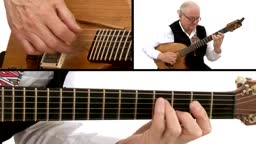
In the Origins edition of Adrian Legg’s Fingerstyle Revisionist, Adrian presented many of the specific approaches that he undertook to develop his own fingerstyle skills and artistry. Here in the Adagio Songbook edition, Adrian enhances your skill set with more essential techniques and creative approaches. You’ll learn how to apply your new skills while expanding your repertoire with six more fingerstyle arrangements.
”I remember early on in my guitar career, someone said to me, ‘Can you play a song?’ At that point, I couldn't. It seems to me to be tremendously important that you can return something to the people, and one of the nicest things you can give them is a completed song. In this collection, we'll be looking at tunes that vary from simple waltzes to complex, more developed ballads. Every tune is written in standard notation and tablature, broken down piece by piece and analyzed completely so that you can understand it.”
Adrian demonstrates and then breaks down six arrangements of his original tunes section-by-section, technique-by-technique. No tedious theory or exercises to struggle through — you’ll play your way through The Adagio Songbook.
QUEENIE'S WALTZ - “I wrote this tune quite a long time ago, after I had been introduced to a tuning that was a variation on DADGAD. By dropping the 5th and the 6th down a further tone, we arrive at CGDGAD, which leaves the bottom string very slack (so don't hit it too hard!). We'll use it in this tune to mark the bass each bar as we go through it. Queenie's Waltz is essentially in four sections, with nothing too terrible complicated in it - it doesn't require a strong right hand pattern, with a lot of the work being accomplished by hammer-ons and pull-offs in your left hand. It's a simple piece to play, but a very nice piece to listen to (and to dance to!).”
EMNETH - “Emneth is really a reflection of quite a lot of my early music background, which was spent in church choirs where I learned quite a bit about harmony, suspension, resolution, and simplicity. In a good church choir, the variations would come in arrangements, with a fairly direct first verse, some decoration in the second verse, or using different organ pipes to color it. Emneth came out of a reaction of this process, trying to emulate it. As a guitar piece, it's a nice simple structure using the kind of right hand patterns that we went through in my first course. The right hand is very simple, only complicated by the need to shift chords in the middle of a pattern.”
MRS. CROWE’S BLUE WALTZ - “This tune is the title track to an album I did. It's not a waltz - it started out with a definite emotional concept, and became something very different. It's in drop C, with your thumb marking the low C in the bass. We're looking for a sort of "grace" in this piece, creating space and using drop bends to make the notes ‘cry’. There isn't anything too terribly difficult with it, however there are a couple of fingerings that I've found a bit awkward here. Take your time with this one! It's quite hard to hold slow guitar pieces back. The tendency is to want to fill spaces, yet pieces like these are about leaving the space to give the idea some room to breathe.”
KAREN - “This piece is named after Karen Carpenter, who I'm a fan of. She did things that were considered pop that I actually grew up with, using 50's pop song structures (1-6-4-5). I unconsciously absorbed a good deal of these songs, so I've tried to write a lot of this kind of thing for guitar. It hit me one day, by dropping the fifth string down to G you can get an open structure with a good range of 6ths up the fretboard that makes it more accessible. This song is fairly easy to play and understand, but it does have a few tricky parts that you'll learn by spending time with it. The tuning for this piece is EGDGBE, which is standard except for the fifth string going down. This gives us our 1-6-4-5 sequence. ”
A WALTZ FOR LEAH - “I wrote this tune for a child, which is one of the most important things you can do. If your music engages them, then you're succeeding as a musician. I wrote this for my granddaughter who was feeling sad. Because you can't always explain to a child why they're feeling sad, a song can help. It might look quite complicated, but really it's just a lot of little simple bits stuck together. This piece is tuned in DADGAD, with a capo at the fifth fret. Let's go slowly through the first part of the piece.”
THE IRISH GIRL - “This is a piece I wrote quite a long time ago, in which I wanted a piece that sounded Irish. I chose open D for it's beautiful, warm quality, and knew that I needed to cover at least an octave to make it sound the way I wanted. With a little fiddling around with an octave arpeggio, the tune came together after applying simple compositional rules to develop the piece. I think this song is very simple and shouldn't give you too much trouble, but there are a few difficult pieces that I’ll guide you through easily enough.”
Adrian performs all of the Performance Examples and then breaks them down stepping you through the key concepts and techniques used in the study. All of the key examples and performances are tabbed and notated for your practice, reference and study purposes. You’ll also get Guitar Pro files so that you can play, loop and/or slow down the tab and notation as you work through the lessons.
Grab your guitar and let’s play some songs with Adrian Legg!
Hi, I'm Adrian Legg and welcome to The Adagio Songbook, the second installment of The Fingerstyle Revisionist series. This course extends the basic fingerstyle techniques we learned in The Fingerstyle Revisionist: Origins into actual melodic songs.
I remember early on in my guitar career, someone said to me, "Can you play a song?" At that point, I couldn't. It seems to me to be tremendously important that you can return something to the people, and one of the nicest things you can give them is a completed song.
In this collection, we'll be looking at tunes that vary from simple waltzes to complex, more developed ballads. Every tune is written in standard notation and tablature, broken down piece by piece and analyzed completely so that you can understand it.
This piece is called "Queenie's Waltz", I wrote it quite a long time ago, after I had been introduced to a tuning that was a variation on DADGAD. By dropping the 5th and the 6th down a further tone, we arrive at CGDGAD, which leaves the bottom string very slack (so don't hit it too hard!). We'll use it in this tune to mark the bass each bar as we go through it.
"Queenie's Waltz" is essentially in four sections, with nothing too terrible complicated in it - it doesn't require a strong right hand pattern, with a lot of the work being accomplished by hammer-ons and pull-offs in your left hand. It's a simple piece to play, but a very nice piece to listen to (and to dance to!).
Now I'll perform "Queenie's Waltz". When playing this piece, focus on keeping things steady and gentle at a level tempo. Imagine that people are waltzing along, and avoid acceleration to keep them from tripping up!
Let's look at "Queenie's Waltz" in bits. Let's first take a look at Sections A and B as they're nearly the same as each other.
In Section A, there's nothing too crazy going on - the thumb is marking the start of the bar, and there's not actually that much treble picking going on. There's quite a bit of legato, with several of the notes played with hammer-ons and pull-offs. The right hand is very simple, using my middle finger (medio) for a lot of it.
In Section B, we'll repeat the same thing, the difference being that we end up on the tonic, back on the G. And that's it - very, very simple.
Moving on to the second verse (Section C and D), we're doing quite a bit of the same things we were doing in the first part - playing legato and using the thumb to mark the bar on the bass.
Now, you don't have to be strict about the phrasing I've written in the notation, maybe go for my phrasing the first time, but don't be afraid to vary it a little as you go through the piece. If someone's going to be waltzing around for a long time, you're going to want to change it around a bit for them! I've also added in a couple of extra bars at Bar 26 and 27 to add a bit of "hang" to the section; feel free to do a variation on them as well.
We're now at Bar 37, which puts us at Section E. There's a slight variation on the tune here, however there are no new technical demands on us. There are a couple of points where you might want to pull-off, hit again, or tie, such as Bar 38.
You'll probably remember from the previous course me talking about the "ker-bonk" problem, where you're hitting a note with your left hand and then your thumb on your right hand is hitting slightly afterwards. Do you hit twice with the thumb and finger, or do you leave the finger out and just use the thumb and the left hand to strike the pull-off?
The nice thing about pull-off is that they encourage movement. If you can again imagine someone dancing, the pull-off anticipates the step and gets them to take it. You can play around with this depending on the audience you are playing to, feel them out and see if they respond to it.
Now we'll be dealing with Section F, going straight into it from Section E. Again, nothing too difficult here - the right and left hands are essentially repeating what's come before. The big difference is that we essentially have a "blues waltz", a swing waltz where we'll be playing duplets instead of where we would be playing triplets. How you play them is up to you; you can swing it, dot it, let it come through smooth, it's really a function of how many times you've gone through the part. Run through it normally a few times and then feel free to change it up.
We have another couple of extra bars here as well, it's up to you if you want to use them or not. I find myself putting in little roll flourishes here and there during this section, which will come naturally to you as you play it.
little bit concerned that the full tablature is not avalaible and the studio tablature is not complete
N
nweekesjunk@gmail.com
05/18/22
Guitarist of the Decade
There is a reason Guitar Player magazine readers voted Adrian Legg "Best Acoustic Fingerstyle Guitarist" for 1993, 1994, 1995, and 1996. Adrian is a legend in the guitar world.
I have played guitar for three decades. I began my guitar journey largely because of Adrian. I’ve acquired nearly four dozen tutorials by various instructors but Adrian's is very thorough, precise, and informative. Certainly one of the best tutorials.
Aside from Adrian’s incredible playing, he is a phenomenal teacher. It is rare for someone to master both fields. Adrian does this extremely well.
You won't regret any of Adrian's lessons.
I
Inigo1970
Verified buyer
02/26/21
Good
V
vprice
Verified buyer
06/21/20
Deceptively Simple
Listening to the pieces they sound simple enough, but there is a lot of detail in each song. Fortunately, Adrian has done an excellent job of breaking down those details and making them accessible. It is a great follow up to his Finger-style Origins course.