Most blues tunes share very similar chord progressions and so, if you’re stuck on using just pentatonic approaches when you solo -- you’re greatly limiting your creative potential. On the other hand, if you know how to apply a variety of relatively simple -- yet still sophisticated -- harmonic, melodic and improvisational approaches to “color” your playing, you’ll unleash an unlimited resource for crafting engaging, fresh and distinctive solos that your audience will never tire of hearing.
In this masterclass from Jack Ruch, you’ll learn 10 of Jack’s favorite approaches for “coloring” your blues solos over basic blues changes, sophisticated changes and even across various styles such as slow blues shuffles, gospel inspired changes, funky New Orleans style grooves, jazz-blues tunes, latin flavored feels, sophisticated soul changes and lots more.
”For each approach, we’ll first dive deep into the harmonic information you need to know, and then we’ll work through a few versatile ways to create lines, licks, and embellishments that work well together in your solos. You’ll apply it all, over backing tracks, as you play your way through 10 soloing performance studies.
We’ll explore minor and major pentatonic crossover points, chord-tone-focused approaches, diminished and other alterations for functioning dominants, go-to substitutions, superimposed arpeggios, harmonic minor applications, lydian dominant colors and many other approaches that you’ll be able to put to work immediately.”
Every now and then someone tips us off to a blues artist that blows our mind from the very first note we hear them play. Jack Ruch is a perfect example. Jack hails from Nashville. His bio reads, “Husband, Dad, and guitar player in Nashville, TN. Available for Skype lessons.” A phone call later and we knew Jack had to come down and collaborate on a project with us.
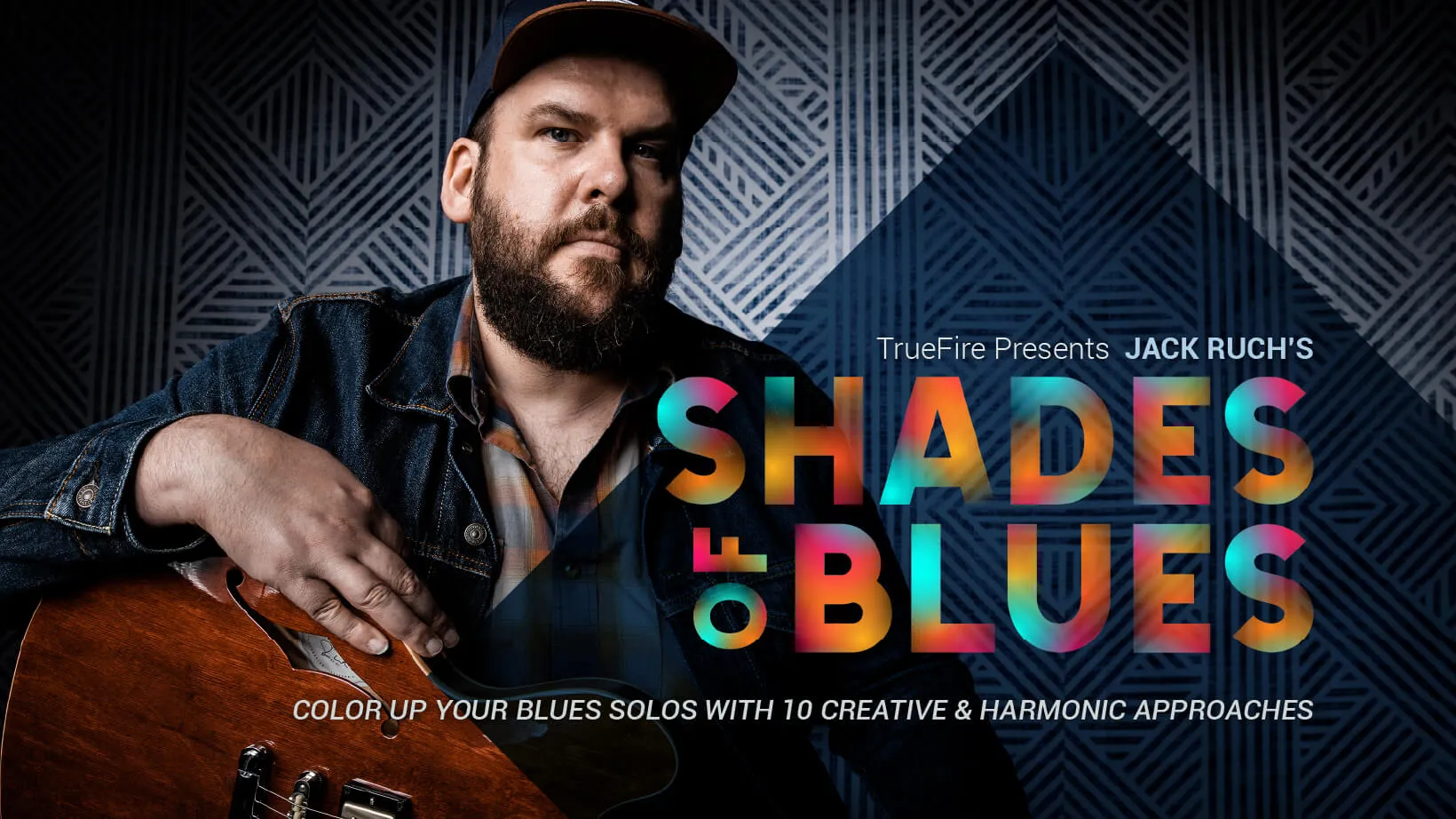
We’re thrilled to welcome Jack to the family with his first TrueFire course, Shades of Blues! You will also likewise be thrilled when you play your way through his enlightening curriculum focused on “coloring” up your blues playing!
Jack will explain and demonstrate all of the key concepts and approaches along the way. You’ll get standard notation and tabs for all of the performance studies. Plus, you’ll be able to use TrueFire’s learning tools to sync the tab and notation to the video lesson.
You can also loop or slow down the videos so that you can work with the lessons at your own pace. All of the backing tracks are included to work with on your own as well.
Grab your guitar and lets “color” our blues solos with Jack Ruch!
What you'll learn
Use diminished passing chords to transition smoothly between I and IV chords
Create chromatic runs that connect chord tones smoothly
Navigate altered dominant sounds with b9, #9, and #5 extensions
Target specific chord tones to outline harmonic movement
Visualize and execute diminished chord inversions moving in minor thirds
Hi I’m Jack Ruch. Welcome to Shades of Blues. Most blues tunes share very similar chord progressions and so, if you’re stuck on using just pentatonic approaches when you solo -- you’re greatly limiting your creative potential. On the other hand, if you know how to apply a variety of relatively simple, yet still sophisticated, harmonic, melodic and improvisational approaches to “color” your playing, you’ll unleash an unlimited resource for crafting engaging, fresh and distinctive solos that your audience will never tire of hearing. In this course, I’ll share 10 of my personal favorite approaches for “coloring” your blues solos over basic blues changes, sophisticated changes and even across various styles of the blues such as slow blues shuffles, gospel inspired changes, funky new orleans style grooves, jazz-blues tunes, latin flavored feels, sophisticated soul changes and lots more. For each approach, we’ll first dive deep into the harmonic information you need to know, and then we’ll work through a few versatile ways to create lines, licks, and embellishments that work well together in your solos. You’ll apply it all, over backing tracks, as you play your way through 10 soloing performance studies. We’ll explore minor and major pentatonic crossover points, chord-tone-focused approaches, diminished and other alterations for functioning dominants, go-to substitutions, superimposed arpeggios, harmonic minor applications, lydian dominant colors and many other approaches that you’ll be able to put to work immediately. I’ll break everything down in detail and of course you’ll have TrueFire’s learning tools to work with along the way. Grab your guitar, and join me as we explore my favorite “shades” of the blues!
Before we get started, i'll talk a bit about my personal journey with learning the fretboard and how to map things out along the neck of the guitar.
To start things off I discuss the major and minor pentatonic scales and the interval relationships between the notes in the scales and the chords I’m playing over. I take a simple 12 bar blues consisting of A7, D7, and E7 and isolate which notes from each scale we want to target and which we want to avoid to outline the changes.
This track is a straightforward slow 12 bar blues in the key of A.
I keep it simple and play phrases based entirely out of the major and minor pentatonic scales.
In this solo I alternate between the major and minor pentatonic scales and combine notes from both scales to target chord tones for each chord.
Here I talk about the importance of targeting chord tones when playing over changes and how we can map out our chord tones with arpeggio shapes.
Every concept is very easy and simple to grasp. Plus, he is a guitarist with great taste in phrasing. Highly recommended.
H
haniamra
Verified buyer
05/18/26
Very good
Good stuff, very clear and useful, very good for beginner like me. Defenetly recommend.
E
EltonSquyres
Verified buyer
01/28/26
Shades of Blue by Jack Ruch
I am still working my way through this set of lessons. So far, Jack Ruch clearly demonstrates his mastery of the blues and has many new ways to add to playing the blues in a tasteful and smooth way. His style is one to admire for its simplicity and mastery.
T
Tom67
Verified buyer
11/28/25
Excellent course with great depth and good explanations!
S
steveV
Verified buyer
10/27/25
Shades of Blue
One of the better presentation styles on the web. No hype. Great musicality. Excellent teacher.