I want to talk about a musician who was very special to me, Albert King, one of the most influential blues guitar players of all time. His influence was so profound that even the blues guitarists who were active before him started playing differently after hearing his work. Albert's influence extends beyond just blues fans; rock-oriented blues fans would recognize parts of his playing in the work of Steve Ray Vaughan, Gary Moore, Eric Clapton, Jimi Hendrix, and Jeff Beck.
Albert King is a titanic figure within the blues genre. He inspired me to focus on becoming a blues guitar player from a young age. I remember being in my childhood home, around 10 or 11 years old, listening to records. My dad had a collection from the 60s featuring the Beatles, Stones, Dylan, Hendrix, Clapton, and a few blues records, including a live Albert King album called "Wednesday Night in San Francisco." I was already a fan of blues-based guitar playing, but it was while listening to this album, particularly the track "Got To Be Some Changes Made," that I realized this was the sound I wanted to achieve.
Albert's playing had a raw power that resonated with me as a young, confused kid. Today, I still find his playing powerful, but I also appreciate the nuances and tenderness in his style. Albert had a set of stock phrases that he owned and invented, always finding ways to surprise listeners with his nuanced touch. His influence is evident in many guitar players, but no one plays quite like him.
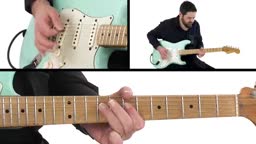
Albert was a master of string bending, achieving nuances from a bent string that went beyond typical guitar sounds, almost like a human voice. When demonstrating these techniques, I focus on the key of A, particularly bending the C note up a major third to E and hitting the notes in between. A good practice method is to target pitches within that wide bend. Albert sometimes grabbed two strings at once, offering a lot of variety within the bend.
I also discuss my right-hand technique, contrasting it with Albert's unique style. He played left-handed on a right-handed guitar, with his high E string closest to his face, and used his thumb. I had to adapt to get a similar sound on a standard-tuned guitar using a pick, with the pick barely sticking out from my finger and thumb and grazing the string with flesh and fingernail.
Albert's phrases, especially lower on the neck, were basic blues but slightly surprising in direction, often ending on a slide, partial chord, or double stop. His big slide down on the top three strings served as a punctuation mark. Another aspect of Albert's playing is his call-and-response style, a fundamental component of blues phrasing, where a phrase sets up a question followed by an answer, especially over different chords.
From Albert's playing, there's much to learn and apply to your own style. Whether it's mastering the big bends, adopting the question-and-answer style of phrasing, or experimenting with different pick attacks for varied tonal qualities, these techniques can enhance your playing. I'm excited to share more about what I've learned from Albert.