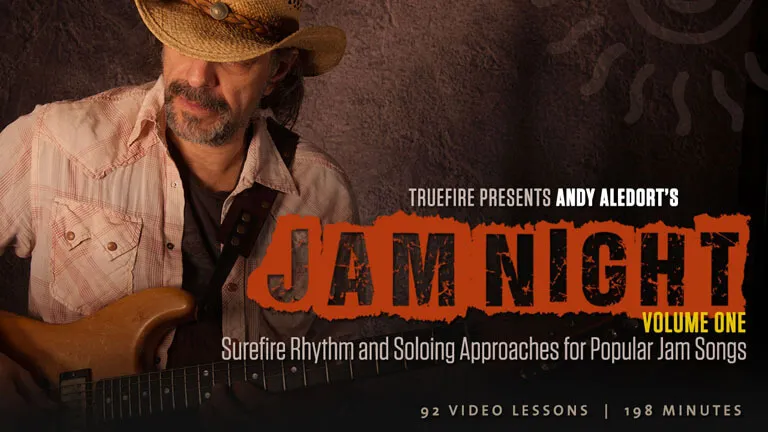
Jam Night Vol. 1

Surefire Rhythm and Soloing Approaches for Popular Jam Songs

Marty FriedmanTommy EmmanuelSteve VaiEric GalesEric Johnson

Get this course and 1,000+ more with All Access

Try 14 days free. Cancel any time.

Purchase Individual Course for $14.99
Jam Night Vol. 1

About this course

You raced home from the day gig, threw the button-down in the hamper, pulled on your favorite Stones tee, kissed the wife and kids — you’re out the door ‘cause it’s jam night down at the Big Al’s! The Strat is freshly strung and you’ve worked all week on the tunes they usually call out and so maybe, just maybe this will be the night that you actually bring the guitar in and sign up on the sheet.

But of course, you get there and see all the regular dudes laughing it up on the deck, getting ready for their call to the stage, your chest tightens up and once again the guitar stays in the trunk and you join the rest of the guitar players in the audience who also wish they had the confidence and chops to take the leap and sign the sheet. Some day... maybe.

Every player here at TrueFire, every player we know, and every one of the world-class artists that we’re so privileged to work with, including the author of this Jam Night series, has been exactly in that same spot at one time in their playing career. It’s a rite of passage. Thanks to Andy Aledort and this brand-spanking new Jam Night series, this rite of passage is going to be a breeze for you. Here’s why...
"I own all of the videos in Andy's Jam Night series. Learning two rhythm and two leads for each song was groundbreaking for me as it really opened up the possibilities of guitar arrangement for me. It's also a joy to learn full songs and rhythms and leads and play along to the jam tracks. Really enjoy Andy as a teacher and his style." - Tom Sweet, TrueFire Student
Andy equips you with the three most important skills you need to take to the stage; command of the popular song list, a diverse rhythm guitar vocabulary, and the ability to improvise solos over popular song progressions.

1. Command of the Popular Song List
There are really only 30 or so songs that are called over and over again at the local jams — they’re the ‘standards’ of rock and popular music. You don’t need to learn them note-for-note like you would for a cover, but you do need to be familiar with their basic structure.

2. Diverse Rhythm Guitar Vocabulary
You’ll be playing a lot of rhythm guitar at the jams. The better your rhythm chops, the more you’ll get asked to the stage because EVERYBODY loves to play with a strong rhythm section. Again, while your rhythm parts might be inspired by the original recorded version — you MUST bring some originality and diversity to the bandstand to keep things interesting over what could be a 15-minute jam on that song.

3. Improvising Over Popular Progressions
Jam songs are selected because they’re familiar to players and audiences alike, AND they provide an interesting and very jam-friendly progression to play over. Your blues chops will certainly be helpful BUT they won’t take you all the way there. You MUST be able to navigate your improvisations through a variety of other 3- and 4-chord progressions.
"This course is probably the most fun of any course I've tried, and I've tried a few. There is so much in this course. Apart from learning some tunes I was blown away by how a simple chord progression can sound so interesting with the inversions and melody lines Andy adds. What's more is he makes it seem straight forward and I wasn't overawed. It's nice to learn some real songs while learning techniques and stuff. It's not note-for-note replication and it's much more enjoyable as a result." - Andrew R., TrueFire Student
In this first volume of Jam Night, Andy guides you through all three of the above elements for 10 of the most popular jams patterned from the progressions and grooves similar to Jumping Jack Flash, The Shape I’m In, Beast of Burden, Into The Mystic, The Weight, Down By The River, I Got You (I Feel Good), La Grange, Blue Sky and One Way Out.

For each of these popular jams, Andy will first overview the vibe, structure and progression of the tune. He’ll then demonstrate and breakdown two rhythm guitar approaches, and then two lead guitar approaches — 20 rhythm approaches and 20 lead approaches in all. Everything is tabbed and notated, plus you’ll get all of the rhythm tracks to work with on your own.

You’ll pick up countless new rhythm parts and lead moves to pack your jam bag with from the performance demonstrations alone, BUT the real gold is found in the breakdowns for each of those demonstrations because what you’ll learn there can be applied everywhere.

Important to note that while Andy is one of the most prolific and accomplished educators of our times, he also walks the walk. Andy loves to jam and does so frequently anywhere and anytime he gets a chance to do so. You’ll find him at the local jams in his own community when he’s not out recording or touring with the Who’s Who of blues and rock artists. Andy knows exactly what is needed on the jam stage and that’s exactly what he delivers in his Jam Night series.

Your rite of passage to the jam bandstand is now just a click away...

What you'll learn

  • Navigate a blues progression using chord tones
  • Use third and seventh voicings to emulate horn sections
  • Create movement with sliding diad shapes
  • Incorporate string bends into boogie rhythm playing
  • Incorporate ninth chord arpeggios into rhythm parts
Release date: 03/26/2014 • 3h 17m runtime
Start Course
Sample lessons
Bird 'n' Some Beast: Rhythm 1
Performance
Bird 'n' Some Beast: Lead 2
Performance
Mystic Journey: Rhythm 2
Performance
Mystic Journey: Lead 2
Performance

What's included

92 lessons • 40 charts • 40 Jam Tracks

Jam Night: Volume 1
Welcome to "Jam Night!," the first in a series of instructional lessons that focuses on learning to jam on rhythm and lead guitar to the most popular open jam songs of all time. For many musicians, going out to the local jam and playing with friends is their primary, if not only, musical outlet. The goal of this "Jam Night!" series is to broaden your skills as both a rhythm guitarist and as a soloist, with specific instruction directed within the scope of standard, tried-and-true open jam night songs. Each volume of the series includes 10 of the most popular songs played at open jams all over the world on a nightly basis. This instructional course will help you to hone and develop your rhythm guitar and soloing chops while teaching you a variety of ways to navigate through some of your favorite song progressions. For each of the ten songs included in this set, I will demonstrate two examples of how to play rhythm guitar parts on the tune, and two examples of how to solo over the tune. It is my hopee that you will use each of these examples as jumping off points to your own musical inventions.
Flashy Jack
This first jam is along the lines of the Rolling Stones' classic, "Jumping Jack Flash," a song that is not only often played during virtually every open jam night but is also in the standard repertoire of most club bands. I recommend all guitar players hone up on their Rolling Stones catalog in order to be prepared to play Stones songs at a moment's notice. There are so many great rhythm and lead guitar techniques one can learn from playing Stones material, which one can then elaborate on and be inventive with during an improvised jam. The rhythm parts outlined here are intended to complement the primary part that exists on the record, parts that will add rhythmic drive, by locking in with the drum and bass parts, as well as harmonic interest to the musical landscape.
Flashy Jack: Rhythm 1
The structure of this rhythm guitar part is very simple and repetitious: the verse section sits on the I (one) chord, B, for eight bars, with chordal accents on beats one and two followed by single-note and two-note melodic phrases. The chorus then is formed by a bIII (flat three)-bVII (flat seven)-IV (four)-I (one) progression, which, in the key of B, translates to D-A-E-B. This second four-bar pattern is played twice, and is approached in a similar way, with chordal accents on beats one and two followed by single-note phrases.
Flashy Jack: Rhythm 1
The B5 power chord that kicks off this example is fretted in an unconventional way, as I use the fret hand thumb wrapped around the top to the neck to sound the low B root note (sixth string/seventh fret) and then use a ring finger partial barre to fret F# and B at the ninth fret of the fifth and fourth strings, respectively. After the chordal accents on beats one and two, the remainder of bar 1 into bar 2 is executed with two-note partial barres fretted with the index and ring fingers ala Jimi Hendrix, alternated with the low B bass note. Bar 3 is a reprise of bar 1, but afterwards I follow with a descending single-note note line. All of the fills are based on B minor pentatonic (B D E F# A). A similar approach is used for the chorus part as each approriate power chord is accented on beats one and two, and each of the chorus chords is followed by a bass-line like riff that is transposed to each succesive chord in the progression. The part ends with a chordal stab on B7#9.
Flashy Jack: Rhythm 2
In this second approach to devising an effective rhythm guitar part, I begin with a spread Jimi Hendrix-style voicing of B7#9: Like the previous example, the chord is accented on beats one and two, followed by a single-note melodic theme. The chorus section is then executed with a static chord voicing that is moved up and down the fretboard in a similar manner.
Flashy Jack: Rhythm 2
This time, I approach the primary rhythm guitar part with an unusual voicing of B7#9: a B octave is sounded on the sixth and fourth strings and fretted with the index and ring fingers (and with the fifth string muted), and then I add the b7th, A, and the b3rd, D, by barring the pinkie at the tenth fret of the top two strings (with the third string muted). The intervening single-note melodic theme is based on B minor pentatonic (B D E F# A) the first time through, and B major pentatonic (B C# D# F# G#) the second time through. The chorus chords, D A E B, are all fretted on the top four strings in triadic form, with a single-note ornamental melody added that is sounded on the second string for D, A and E, and is then moved to the first string for the return to the I chord, B.
Flashy Jack: Lead 1
One of the greatest recordings of "Jumping Jack Flash" is the cover version performed by the blues/rock guitar great Johnny Winter, released on his seminal Johnny Winter And Live LP. In this first solo, I use a JW-style approach by incorporating a combination of unison and oblique bends, along with single-note melodic patterns based on alternating between B minor and B major pentatonic, which is, of course, the standard soloing approach found in the playing of most blues and blues/rock guitarists.

+ 85 more lessons

Start Course

Reviews

18 results

guitarguy234

Verified buyer

12/24/24

The Man.

A fun teacher, been with him over 20 years. One thing about his topics, they are all relevant today, blues country , slide. Step by step! Enjoy

docguitarman

06/17/22

Love it. Lots of practical stuff.

Haven't had a chance to indulge in my Truefire courses for many years. Finally got a chance and revisited Andy;s courses. Forgot how great this course was! Excellent teaching. If you like classic blues rock Andy is an excellent instructor for the genre!

Starglazer

Verified buyer

04/08/22

Good Tittle

Songs are great , I find he has a good variety and a great Player.Thanks.

jezzer

Verified buyer

12/16/21

Excellent selection of songs and well taught

magditfr

Verified buyer

11/09/21

Ready to Jam after going through this course

Andy Aledort's style of teaching is great. Combine this with Truefire's platform and you have an excellent course. There are many nuggets of information here to help you become a better, more confident player. Andy's song selections cover a wide spectrum. Learning these songs and his techniques for playing them is pure enjoyment.

Stop searching. Start improving with All Access.

Try 14 days free. Cancel any time.