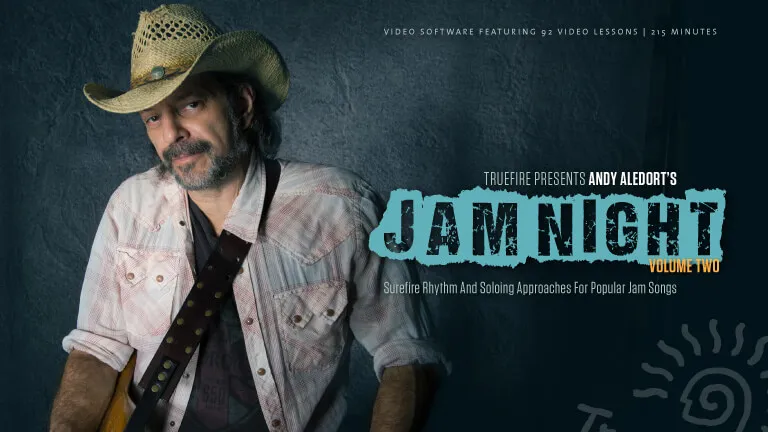
Jam Night Vol. 2

Surefire rhythm and soloing approaches for popular jam songs

Marty FriedmanTommy EmmanuelSteve VaiEric GalesEric Johnson

Get this course and 1,000+ more with All Access

Try 14 days free. Cancel any time.

Purchase Individual Course for $14.99
Jam Night Vol. 2

About this course

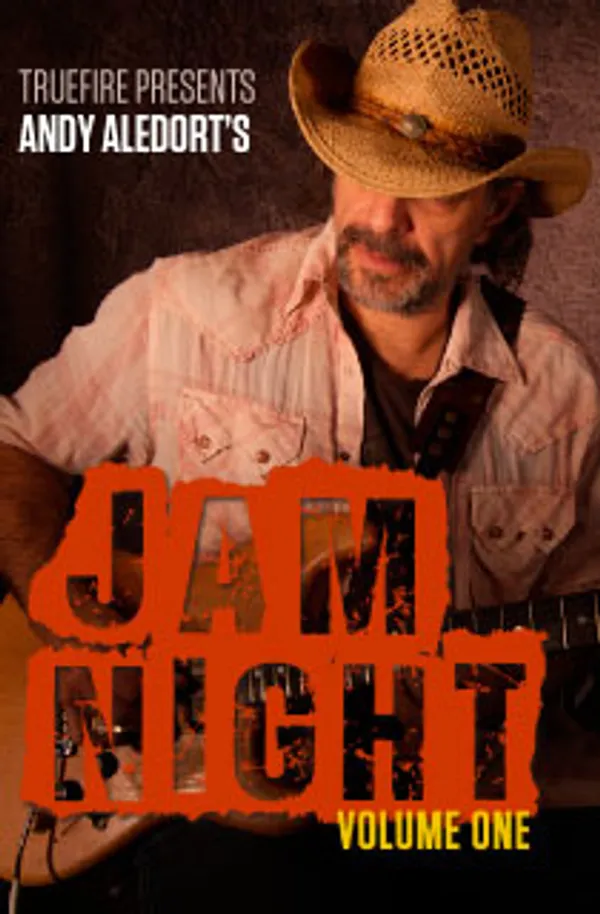
For many musicians, going out to the local jam and playing with friends is their primary, if not only musical outlet. The goal of Andy Aledort’s Jam Night series is to broaden your skills as both a rhythm guitarist and soloist, with specific instruction directed within the scope of standard, tried-and-true open jam night songs.

Each volume of the series includes 10 of the most popular songs played at open jams, all over the world on a nightly basis. The Jam Night series will help you develop your rhythm guitar and soloing chops while teaching you a variety of ways to navigate through popular music’s most common song progressions and stylings.
"I own all of the videos in Andy's Jam Night series. Learning two rhythm and two leads for each song was groundbreaking for me as it really opened up the possibilities of guitar arrangement for me. It's also a joy to learn full songs and rhythms and leads and play along to the jam tracks. Really enjoy Andy as a teacher and his style." - Tom Sweet, TrueFire Student
Jam Night: Volume 2 is designed with specific musical styles presented in pairs: two songs in the classic Soul/R&B style, two songs in the Rock 'n' Roll style of the Rolling Stones, two songs structured in the style of classic Chicago Blues, two Jimi Hendrix-type song progressions and two examples representative of a Reggae style.

The progressions and grooves are patterned after Sitting On The Dock of the Bay, In the Midnight Hour, Dead Flowers, Honky Tonk Women, Key to the Highway, Sweet Home Chicago, Like a Rolling Stone, Hey Joe, I Shot the Sheriff, and No Woman No Cry.

Working with Andy’s Jam Night series will equip you with the three most important skills you’ll need to take to the jam stage; command of the popular song list, a diverse rhythm guitar vocabulary, and the ability to improvise fresh solos over popular song progressions.

Command of the Popular Song List: There are really only a handful of songs that are called over and over again at the local jams — they’re the ‘standards’ of rock and popular music. You don’t need to learn them note-for-note like you would for a cover, but you do need to be familiar with their basic structure.

Diverse Rhythm Guitar Vocabulary: You’ll be playing a lot of rhythm guitar at the jams. The better your rhythm chops, the more you’ll get asked to the stage because EVERYBODY loves to play with a strong rhythm section. Again, while your rhythm parts might be inspired by the original recorded version — you MUST bring some originality and diversity to the bandstand to keep things interesting over what could be a 15-minute jam on that song.

Improvising Over Popular Progressions: Jam songs are selected because they’re familiar to players and audiences alike, AND they provide an interesting and very jam-friendly progression to play over. Your blues chops will certainly be helpful BUT they won’t take you all the way there. You MUST be able to navigate your improvisations through a variety of other 3- and 4-chord progressions.

For each of these 10 popular jams, Andy will first overview the vibe, structure and progression of the tune. He’ll then demonstrate and breakdown two rhythm guitar approaches, and then two lead guitar approaches — 20 rhythm approaches and 20 lead approaches in all.

Everything is tabbed and notated, plus you’ll get all of the rhythm tracks to work with on your own.

Your rite of passage to the jam bandstand is now just a click away…

What you'll learn

  • Navigate harmonized major scale up the fretboard
  • Play rhythm guitar parts in 8th position
  • Create sus2 voicings from major triads
  • Arpeggiate chord voicings while maintaining sustain
  • Develop thematic unity in rhythm guitar parts
Release date: 12/12/2014 • 3h 39m runtime
Start Course
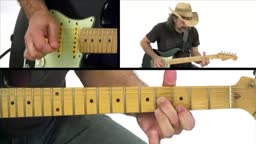
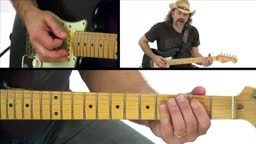
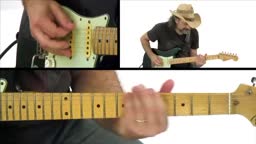
Sample lessons
12 AM
12 AM
Overview
12 AM: Rhythm 1
12 AM: Rhythm 1
Performance
12 AM: Rhythm 1
12 AM: Rhythm 1
Breakdown
Gin Soaked Queen: Rhythm 1
Performance

What's included

92 lessons • 40 charts • 40 Jam Tracks

Jam Night: Volume 2
Welcome to "Jam Night! Vol. 2," the second in a series of instructional lessons that focuses on learning to jam on rhythm and lead guitar to the most popular open jam songs of all time. For many musicians, going out to the local jam and playing with friends is their primary, if not only, musical outlet. The goal of this "Jam Night!" series is to broaden your skills as both a rhythm guitarist and as a soloist, with specific instruction directed within the scope of standard, tried-and-true open jam night songs. Each volume of the series includes 10 of the most popular songs played at open jams all over the world on a nightly basis. This instructional course will help you to hone and develop your rhythm guitar and soloing chops while teaching you a variety of ways to navigate through some of your favorite song progressions. This volume of "Jam Night!" is designed with specific musical styles presented in pairs: there are two songs in the classic soul/R&B style, two songs in the rock 'n' roll style of the Rolling Stones, two songs structured in the style of classic Chicago blues, two Jimi Hendrix-type song progressions and two examples representative of a reggae style. Once you have become familiar with how to play rhythm guitar as well as solo over all of these musical sounds and styles, you will be primed to get up and play at the next jam night session you attend.
Pier of the Sea
Our first Jam Night song is along the lines of the Otis Redding soul/R&B classic, "(Sitting on the) Dock of the Bay." Soul and R&B songs are standard fare at all jam sessions; they are also perfect examples of creative and interesting song forms and chord progressions, which are perfect ingredients for building up one's rhythm and lead guitar abilities during an improvised jam. The rhythm parts performed here are intended to complement the original parts that are heard on the record. These new rhythmic ideas will add rhythmic drive as well as harmonic interest to the overall musical environment of the song.
Pier of the Sea: Rhythm 1
For the majority of the following rhyhm guitar examples, the first example will represent a very basic, straight forward approach akin to what the primary rhythm guitar player in a band would play. This way, this rhythm part can be used effectively as a "bed" track to the secondary rhythm part that could, for example, be played simultaneously by a second rhythm guitarist. I took this approach because a great many of us play in two-guitar bands, and, to me, this is the most useful way to look at the integration of complementary rhythm guitar parts. The verse chord progression is G-B-C-A, and the chorus chord progression is G-Em (2x)-G-A-G-E.
Pier of the Sea: Rhythm 1
For the verse section, I begin with a G "cowboy" chord, after which I switch to barre chords for the B, C and A chords. For each of these, I like to add quick hammer/pulls on the B string using the pinkie, one fret higher than the ring finger barre, to make brief reference to a sus4 (suspended fourth) sound. The strumming pattern is executed using a combination of 8th and 16th notes; be sure to keep the pick hand wrist as loose as possible in order to achieve a smooth and even sound. For the chorus, I switch to two-note voicings for G and Emadd2: over G, the index and middle fingers fret the ninth, A, and fifth, D, respectively, after which the ring finger hammers onto the major third, B. This Hendrix-y hammer-on is moved up two frets for the A chord, and on the final E chord, a quick trill is performed between the minor third, G, and the major third, G#.
Pier of the Sea: Rhythm 2
This second example of rhythm guitar utilizes chord voicings positioned higher on the fretboard, with focus placed on the top three strings for added melodic content. During the verse, each chord is played with a thumbed root note - the low root note positioned on the low E string is fretted by wrapping the fret hand thumb over the top of the fretboard. During the chorus, my intent is to demonstrate the classic soul/R&B Motown/Stax approach used by rhythm guitar greats like Steve Cropper by playing melodic rhythm parts high on the fretboard.
Pier of the Sea: Rhythm 2
During the verse section, the low root notes fretted on the sixth string are only hinted at while most of the activity takes place on the top three strings. With the thumb wrapped over the top of the board to fret the low root notes, the ring, middle and index fingers are used to fret notes on the D, G and B strings, respectively. The fret hand pinkie is then used for quick hammer/pulls on the top three strings for added melodic content. Be sure to stand all of the fret hand fingers up straight so that each string will ring clearly. During the chorus, I move up to 10th position to sound the ninth-to-major-third hammers on the B string (A to B over G). This part sounds one octave higher than the chorus rhythm part demonstrated in the first approach. I then use a "spread" voicing for Esus2, with the index, middle and ring fingers all placed two frets apart. Sliding sixths are then used to add melodic flavor over the G to A to E chords, and once again, at the end of the progression, I move down to a hammer between the open G string and G# at the first fret.
Pier of the Sea: Lead 1
Oftentimes, an immediately effective approach to take for an initial leap into a guitar solo is to emulate the vocal melody, which is the idea behind this first solo example. A great scale to use for soloing on this song is G major pentatonic (G A B D E), and I use it in single-note and doublestop (two-note) fashion throughout the example. Another essential part of this solo example is that every lick that is played directly references the chord it is played over, which serves to solidify the effectiveness of the improvisation.

+ 85 more lessons

Start Course

Reviews

12 results

Mike

09/14/22

Good Balance

I enjoy Andy's cool laid back style. He covers a good balance of musical background, theory, tips and tricks, and this is how you do it. I originally bought this course for a handful of songs, but have learned quite a bit more from the others now too.

DavidMcN

Verified buyer

04/14/22

Lessons from a true expert

Great selection of songs and Andy shows you how to develop strong rhythm and lead parts over them. His laconic teaching style is really effective. You know you're learning from a true expert. Can't recommend it too highly.

EddieFast

02/17/22

Some classic styles and structures to jam on.

Andy's ability to pick classic tunes and break down their structure to create strategies to jam on rhythm and lead guitar over is excellent! I love all the themes these jams are based on, and there is a nice variety of modes, from the ranchy barroom favorites to smooth Motown favorites. By giving us multiple examples, he provides a way to find a fit in a crowded jam session and inspire ideas for still more variations.

panc10

Verified buyer

03/27/21

Fantastic!

Awesome teacher!

ZzzenDog

06/26/20

Keys to the Jam!

I picked up this Jam Night, Volume 2 because I wanted to learn more advanced ways of playing Key to the Highway. There are a series of lessons on Interstate Blues that addresses the eight bar format. I really enjoy the way that the lessons are broken down into two rhythm options and two lead options, with accompanying breakdowns of each. I also appreciate that it’s not just given to you, Andy gives you ideas. Very Cool!

Stop searching. Start improving with All Access.

Try 14 days free. Cancel any time.