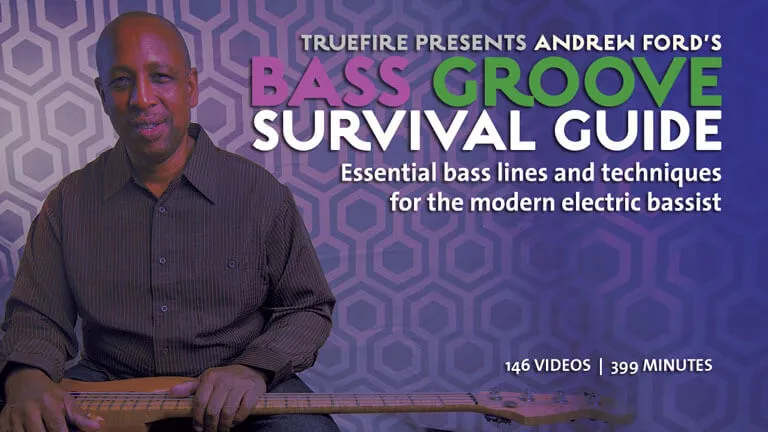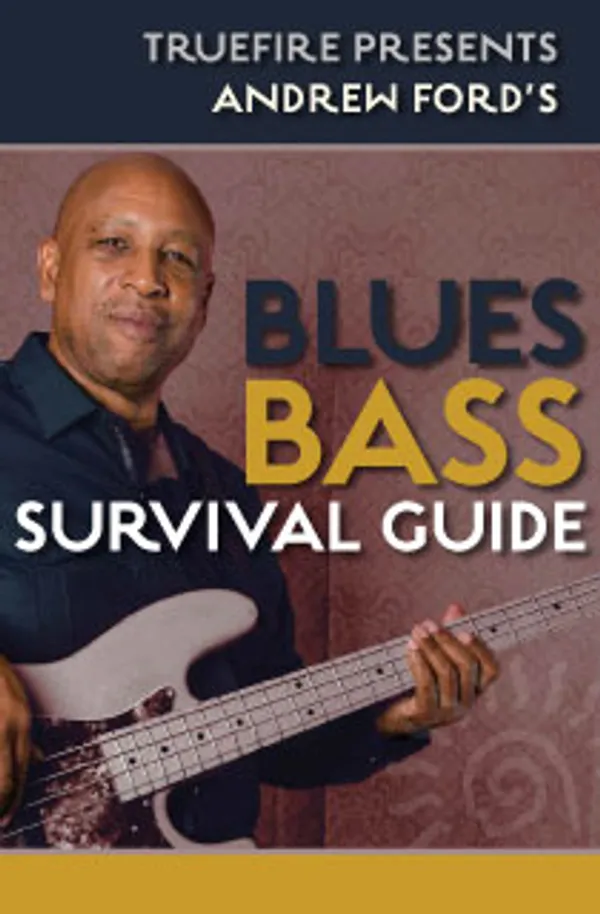
Bass Groove Survival Guide

Essential bass lines and techniques for the modern electric bassist

Marty FriedmanTommy EmmanuelSteve VaiEric GalesEric Johnson

Get this course and 1,000+ more with All Access

Try 14 days free. Cancel any time.

Purchase Individual Course for $14.99
Bass Groove Survival Guide

About this course

Composer, arranger, producer, educator and monster bass player, Andrew Ford's groove pedigree features recordings, tours and performances with the likes of Al Jarreau, Whitney Houston, Robben Ford, Chaka Khan, George Duke, Gladys Knight, James Ingram, Patti Austin, Christopher Cross, Michael McDonald, The Emotions, The Stylistics, Larry Carlton, Oleta Adams and so many other world-class musicians that it makes your head spin. Nobody on the planet is better qualified than Andrew Ford to present this Bass Groove Survival Guide.

The Bass Groove Survival Guide will indeed feed you for a lifetime. This extraordinary learning experience for bass players imparts a sense of groove without relying on technical explanations or tedious theory to work through. Rather, you will play your way through a series of 72 groove studies working with rhythm tracks and video playalongs across a wide variety of popular styles of music; Reggae, Shuffle, Country, Salsa, Samba, Bossa, R&B, Motown, Rock and Jazz. Learn to groove in these six styles and you'll be able to step into any gig, do the job, and get invited back time and time again.

For all of the musical styles, Andrew has prepared rhythm tracks featuring three common progressions; the 5-4-1, the 1-4-5-4 and the 1-5-6-4. Andrew will teach you 54 bass lines to play over those progressions, across all of those styles. After learning a set of bass lines in a particular style, Andrew guides you through a playalong where you put those lines to work immediately in a musical context.

Throughout the entire course, Andrew illustrates how to make the lines 'groove' through the use of timing, rhythmic variation, tone, technique, note choice and use of space. While some of the lines might appear to be very simple to play, they are actually very challenging to play correctly and so Andrew stresses and demonstrates how to capture the subtleties of each groove. All of the bass lines are tabbed and notated, plus Power Tab and Guitar Pro files are included as are all of the rhythm tracks to work with on your own.

Learn the 54 bass lines and work through the 72 studies presented in the Bass Groove Survival Guide and you will be able to apply the key learnings to any bass line, in any style of music. Groove on!

What you'll learn

  • Apply left-hand muting using non-fretting fingers
  • Execute authentic Texas shuffle rhythm feel
  • Create melodic bass lines while maintaining groove
  • Use right-hand finger muting for staccato articulation
  • Develop call-and-response practice skills
Release date: 02/25/2013 • 6h 39m runtime
Start Course
Sample lessons
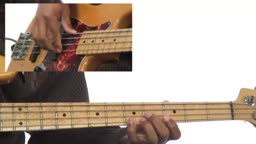
5-4-1 Shuffle #3
5-4-1 Shuffle #3
Performance
5-4-1 Shuffle #3
5-4-1 Shuffle #3
Breakdown
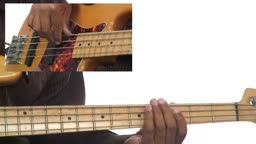
5-4-1 Shuffle Groove
Playalong
5-4-1 Salsa Groove
5-4-1 Salsa Groove
Playalong

What's included

146 lessons • 54 charts • 18 Jam Tracks

Bass Groove Survival Guide
Welcome to groove bass. In this course you will discover the keys to making any groove feel good. Length of notes, rhythmic variation, tone, technique, note choice, use of space, they all contribute to the overall groove, or lack thereof. I will use three common chord progressions and six different styles of music to show you how to create bass lines that get “Inside the Groove”. I will break each style down into 3 different bass lines. The first one will typically use only the notes of the chord and simplified rhythms. The second will introduce new rhythms and make use of notes in the scale of the chord. The third groove will add even more rhythms and use notes in the chord, in the scale of that chord, and chromatic notes that are not in the chord or the scale. If you are unfamiliar with basic chord-scale relationships, then I would suggest you investigate any number of resources available that explain basic theory as it relates to major, minor and dominant chords. The fingering that you will see notated in the examples are only suggestions that even I won't always adhere to, so don't get too hung up on those. In the jam section of each lesson feel free to begin creating your own lines once you have mastered the bass line in the lesson. Don't move ahead too soon though, many of these bass lines may be simple to play, but are difficult to play right. Make it a point to capture the subtleties in each groove, then you will begin taking your groove to the next level.

Ok, let's get started
5-4-1 Reggae Groove
This first chord progression we will use is often refered to as 5-4-I. You will find it in a ton of songs like Sweet Home Alabama. You may be wondering, what does 5-4-1 mean?, basically, I am talking in terms of intervals, or the distance each chord is from the root. To figure out the chords in a 5-4-1 progression in the key of F we would first determine the note that is an interval of a fifth or 5 from F. That would be C, our first chord of the progression. Then the note which is a fourth away or 4 of F, that would be Bb. The final chord of this progression is the 1 or root which is F. So a 5-4-1 progression in the key of F would be C, Bb, and then F.

This is a mid tempo reggae groove where the drums play a one drop beat. This is a drum beat where beat one is left open in the groove. There should be a nice swing to the rhythms played here. The use of space and accenting unconventional beats of the phrase are characteristics of this groove.
5-4-1 Reggae #1
Here is the basic groove, outlining the chords in bars 1 and 3 by playing a pattern based on the triad of each chord. In bar 2 we have an eighth note pattern that should have a subtle swing. The overall groove is a little laid back but not dragging. Lets check it out.
5-4-1 Reggae #1
Lets slow it down and focus on timing and the eighth note swing.
5-4-1 Reggae #2
This one is slightly more rhythmic, but same attitude, it has a nice melodic phrase that begins in bar 2 and continues through bar 3, reminiscent of the bass work of Family Man who created those classic grooves with Bob Marley and the Wailers.
5-4-1 Reggae #2
Here is reggae groove #2 slowed down, try and create that swing and big groove even without help from the drums or the skank style rhythm guitar.
5-4-1 Reggae #3
Groove #3 begins with the same phrase as the last two examples then moves to a riff in bar 2 that leaves out the root of the chord, F. It continues with a riff in bar 3 that chromatically walks up from the 2nd, D, to the major 3rd or E. Playing D, Eb, and then E over a C chord. We are actually playing melodies or very melodic on top of whatever melody is going on vocally, so, we must be careful not to step on, but in stead compliment the main melody.

+ 139 more lessons

Start Course

Reviews

11 results

5grp9gshwb

Verified buyer

05/26/26

Love it

egonwisdom

Verified buyer

08/28/22

Its great to learn different styles of music.

Dave M.

02/05/22

Wow! What a Great Course

I am a guitar player learning bass and this was a perfect course to introduce to the different styles of bass playing. Extremely well present by Mr. Ford and lots of fun to play.

graycom

01/18/21

A truly monster course

Andrew gives you not only a bassist's perspective, but one of a producer and composer as well. He talks about when a particular bass pattern would work well for a chorus or verse, or when the bass part should be busy or held back. The depth of information from this course can last you for years. The course focuses on chord progressions and how a bassist would handle them in various musical styles. He gives several examples for each style and progression, so you learn different approaches that can be applied to a musical style. His examples include melodic lines that work with a particular style or a straight ahead pattern that can move the progression forward.

1234 d.

12/13/20

1234djembe

the variety of music styles inspire plenty of creativity

Stop searching. Start improving with All Access.

Try 14 days free. Cancel any time.