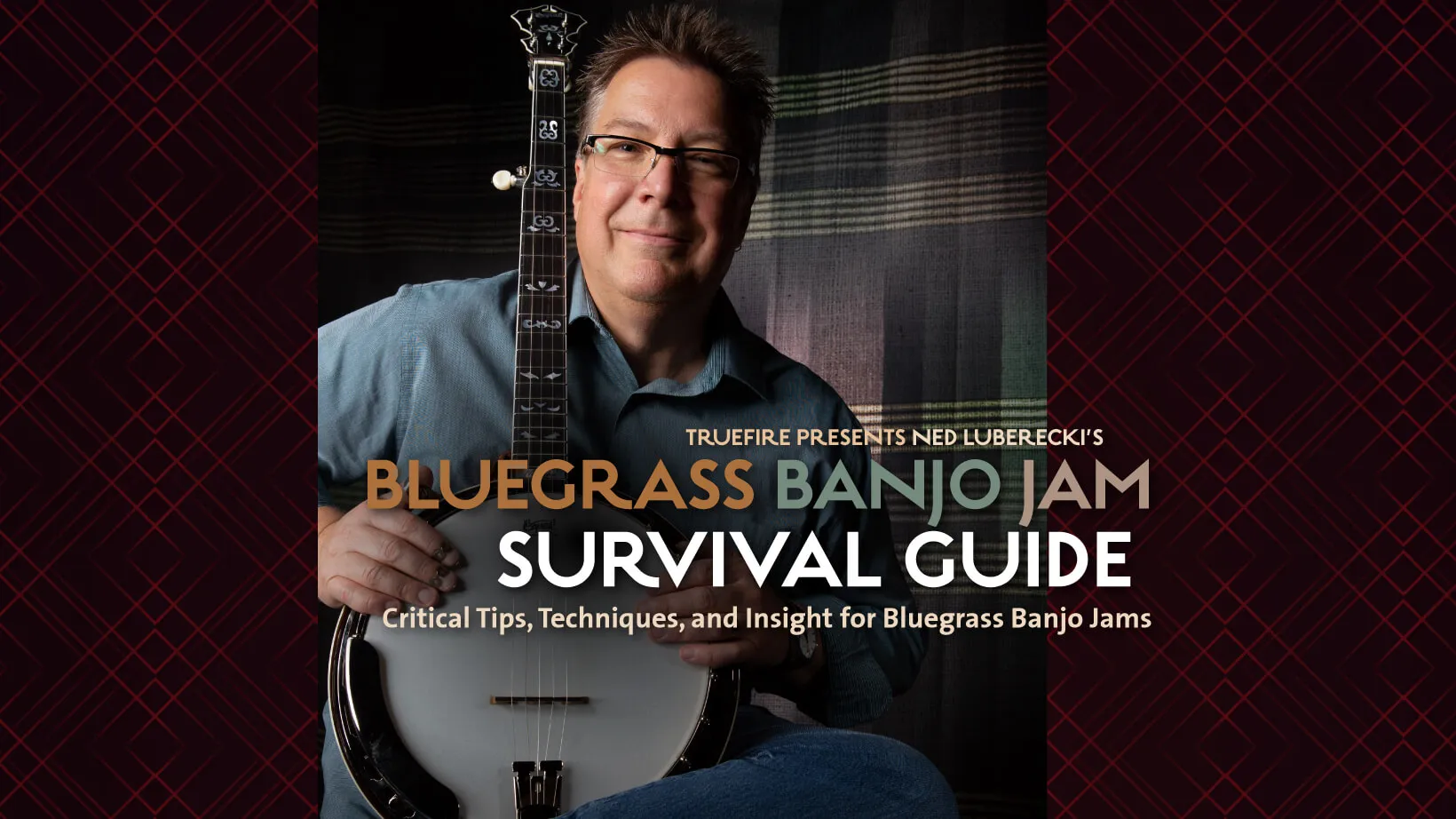
Bluegrass Banjo Jam Survival Guide

Critical Tips, Techniques, and Insight for Bluegrass Banjo Jams

Marty FriedmanTommy EmmanuelSteve VaiEric GalesEric Johnson

Get this course and 1,000+ more with All Access

Try 14 days free. Cancel any time.

Purchase Individual Course for $19.99
Bluegrass Banjo Jam Survival Guide

About this course

Jamming is where the fun really begins for Bluegrass banjo players! But to ‘survive’ a bluegrass jam and have the most fun, you need to have specific skills at your command, be able to interact with the other musicians, hear the chord changes, think on your feet, and come up with something to play on the spot!

Ned Luberecki’s Bluegrass Banjo Jam Survival Guide guides you through everything you need to know to not only ‘survive’ but shine at any bluegrass jam session you participate in.

Ned is one of the most popular banjo instructors at music camps around the world including Nashcamp, Munich Banjo Camp, Camp Bluegrass, B.C. Bluegrass Workshop, Midwest Banjo Camp and many more. Ned was also named ‘Banjo Player of the Year’ in 2018 by the International Bluegrass Music Association and he tours the globe with The Becky Buller Band and with Stephen Mougin (of the Sam Bush Band) as Nedski & Mojo.

”Across the seven sections of the Bluegrass Banjo Jam Survival Guide, we’ll work on ear training, chord groups, double-stop positions, roll patterns, variations, and licks that you can play all over the fingerboard. We’ll apply these skills to all the most common chord changes in bluegrass!”

Ned will explain and demonstrate all of the key concepts and approaches along the way.  You’ll get standard notation and tabs for all of the key examples. Plus, Ned includes all of the rhythm tracks for you to work with on your own. In addition, you’ll be able to loop or slow down any of the videos so that you can work with the lessons at your own pace.

Grab your ‘banjer' and let’s jam with Ned Luberecki!

What you'll learn

  • Navigate between different voicings of the same chord on the fretboard
  • Apply the forward roll pattern over multiple chord positions
  • Play two different voicings per chord within the progression
  • Find the closest chord shape when changing chords
  • Understand which string to start the roll on for different chords
Release date: 02/21/2019 • 1h 24m runtime
Start Course
Sample lessons
Major Inversions Up the Neck
Demonstration
G, C & D Double Stops with Roll
Demonstration
Turning Double Stops Into Licks
Demonstration
Double Stop Licks Jam: G, C & D
Playalong

What's included

47 lessons • 33 charts • 13 Jam Tracks

Bluegrass Banjo Jam Survival Guide
Hi, I'm Ned Luberecki and welcome to Bluegrass Banjo Jam Survival Guide.

Jamming is where the fun really begins! When you're in the jam session, you need to be able to interact with the other musicians, hear the chord changes, think on your feet, and come up with something to play on the spot!

In this course, we'll work on ear training, chord groups, double-stop positions, roll patterns, variations, and licks that you can play all over the fingerboard. We'll apply these skills to all the most common chord changes in bluegrass!

All of the key examples are tabbed and notated and you'll have a variety of jam tracks to work with on your own. You can loop and slow down the videos to work with the lessons at your own pace.

Grab your banjer and let's jam!
SECTION 1: Chords by Numbers
In Section 1, we'll learn how to call chords by numbers instead of letter names. You may have heard of this referred to as the "Nashville Number System", which is based on this same concept. It's a very easy and convenient way to refer to the chords common to a key.
Steps of a Major Scale
Chords are numbered according to the steps of the scale. In this lesson, we'll go over the steps of a major scale.
Chords Common to a Key
In bluegrass music (and lots of other kinds of music), there are certain chords that are most common to the key. You may already be used to the 1, 4 & 5 (in the key of G they are G, C & D), but there are a few more. Learning to hear the difference in these chords is the key to successful jamming!
SECTION 2: Chords on the Neck
In this section, I'll show you how to make the three major chord shapes, locate their different inversions up the neck, and change them from major to minor chords.
The 3 Major Chord Shapes
There are three common ways to make a major chord on the banjo: They're known as the "F" shape, the "D" shape and the barre shape.
Major Inversions Up the Neck
In this lesson, I'll show you a formula or pattern for finding the different inversions of major chords all over the neck.

+ 40 more lessons

Start Course

Reviews

12 results

jussikosse

Verified buyer

03/17/26

Good banjo course

Very good for learning banjo to start playing!

Dolde1

Verified buyer

08/28/25

Excellent book for learning some banjo techniques

Good, clear instruction at an easy pace. Great book!

bcbanjo

Verified buyer

11/22/23

Wouldn't get you through a jam session

While Ned is an excelleent teacher, I thought the material in this course did not measure up to that of his "backup banjo" course. The material was okay, but I thought there would be more insight on how to get through a jam session rather than just the basic Nashville Numbering System, Chord Positions and a very simple ear training exercise. Maybe I expected too much, but hey, if you take a jam session survival guide course I expect to learn how to survive a jam session. I only got part way there with this couse.

guitartramp

Verified buyer

12/01/22

The Best.

This course advanced my banjo playing tremendously. Ned gives you the essential tools needed to play this type of music.

ncbanjoman

Verified buyer

06/15/22

Finding the groove

One of the benefits of participating in jams, is finding and feeling the groove. You know it, when everything in your playing is flowing. The skills and competencies that Ned helps you build in this curriculum, brings the groove quicker. Especially when you are jamming with a new group. This is not a simple set of tips and tricks. It is a solid package of foundational skill development that you will continue to be part of your everyday arsenal.

Stop searching. Start improving with All Access.

Try 14 days free. Cancel any time.