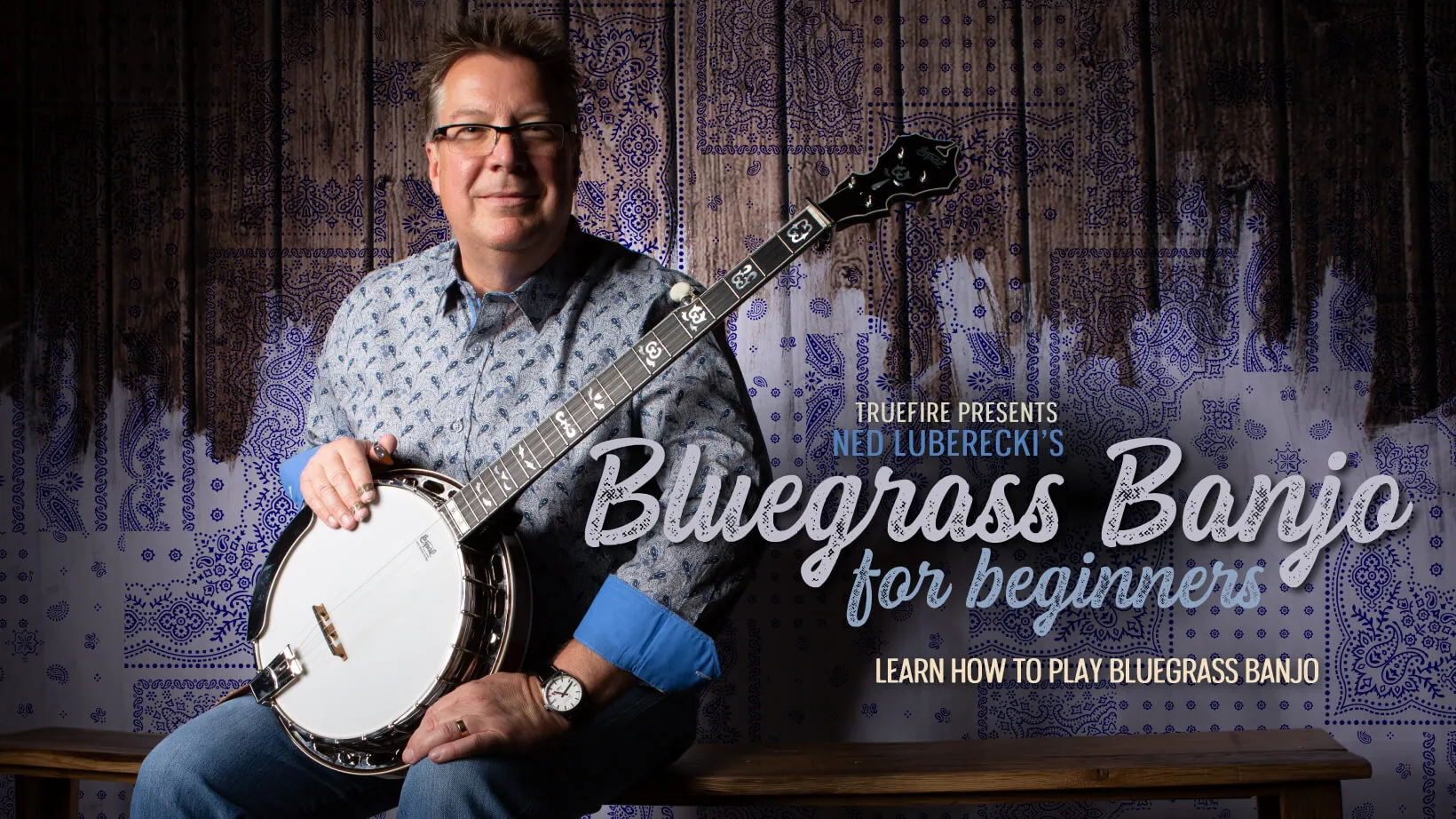
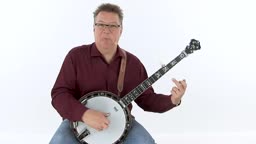
Anxious to learn how to play Bluegrass banjo? You couldn’t be in better hands than Ned Luberecki’s. Ned is one of the most popular banjo instructors at music camps around the world including Nashcamp, Munich Banjo Camp, Camp Bluegrass, B.C. Bluegrass Workshop, Midwest Banjo Camp and many more. Ned was also named ‘Banjo Player of the Year’ in 2018 by the International Bluegrass Music Association and he tours the globe with The Becky Buller Band and with Stephen Mougin (of the Sam Bush Band) as Nedski & Mojo.
We’re thrilled to welcome Ned to the family with his first TrueFire course, Bluegrass Banjo for Beginners! You will likewise be thrilled with how quickly his fast-track, hands-on curriculum gets your Bluegrass banjo chops up to speed without struggling through tedious theory or boring exercises. In fact, you’ll play your way through the course, first learning the essential chords and rolls, and then putting them to work immediately learning a repertoire of popular Bluegrass tunes and melodies.
”We’ll kick off the course learning how to play the fingerpicking patterns that we banjo players call rolls, you’ll learn your first chords, left-hand techniques, and how to start with a basic melody and use fill-ins to turn it all into bluegrass-style banjo. You’ll learn to play Cripple Creek, Cumberland Gap, Jesse James, Worried Man Blues, Tom Dooley and more must-know tunes. By the end of the course, you’ll be able to call yourself a Bluegrass banjo player!”
Ned organized the course into 6 sections. In the first section, you’ll learn the basics. ”We'll go over some of the basics (how to hold the banjo, naming the parts of the banjo, picks, tuning, etc.) If you've played another instrument in the past, some of this will already be familiar, but there are a few terms which are "banjo specific", so follow along. If you've never played an instrument before, just jump right in and get started!”
The second section is focused on banjo rolls. ”Banjo rolls are repeatable finger picking patterns. Practicing rolls will help you develop speed and accuracy with your right hand. While there are many combinations of three fingers and five strings that can be called rolls, we'll focus on 5 basic rolls to get you started.”
Chords are the focus of the third section. ”Now it's time to get your left hand into the game and learn some chords. In this section, you'll learn the chords G, C and D7 and a basic strum to get you playing a couple of easy and familiar songs.”
Combining rolls and chords is covered in the fourth section. ” We’ll combine the new chords you've learned with a couple of rolls and make the Tom Dooley, Worried Man Blues, and Boil Them Cabbage Down songs sound more like banjo picking!”
In the fifth section, you’ll learn how play songs starting with the melody. ”We'll start by playing the melody alone with no embellishments, and then I'll show you how to add some fill in notes and rolls to start to make it sound like bluegrass banjo playing! We’ll work with Jesse James and Good Old Mountain Dew.”
In the sixth and final section, you’ll pick a few left-hand techniques and put them to work. “You’ll learn how to play slides, pull-offs, hammer-ons and we’ll apply them playing Cripple Creek and Cumberland Gap.”
Ned will explain and demonstrate all of the key concepts and approaches along the way. You’ll get standard notation and tabs for all of the playing examples. In addition, you’ll be able to loop or slow down any of the videos so that you can work with the lessons at your own pace.
Grab your banjo and let’s play some bluegrass with Ned Luberecki!
What you'll learn
Play the melody to Jesse James in open position
Create banjo-style embellishments
Pick out basic melodies to songs
Progress from simple melody to decorated arrangement
Hi, I'm Ned Luberecki and welcome to Bluegrass Banjo for Beginners.
The first time I heard bluegrass banjo played, I fell in love with it! That fast-picking sound of songs like "Dueling Banjos" and "Foggy Mountain Breakdown" - I couldn't get enough!
Bluegrass banjo sounds more complicated than it is. In this course, I'll demystify it by showing you how to play the fingerpicking patterns we call rolls, your first chords, left hand techniques, and how to start with a basic melody and use fill-ins to turn it all into bluegrass-style banjo. You'll learn to play "Cripple Creek", "Cumberland Gap", "Jesse James", and more!
All of the key examples are tabbed and notated and you can loop and slow down the videos to work with the lessons at your own pace.
Grab your banjer and let's get started!
In this section, we'll go over some of the basics (how to hold the banjo, naming the parts of the banjo, etc.) If you've played another instrument in the past, some of this will already be familiar, but there are a few terms which are "banjo specific", so follow along. If you've never played an instrument before, then let's jump right in and get started!
In this lesson, you'll learn the names of the parts of the banjo. Many of the parts are the same as on other stringed instruments like the guitar or mandolin, but there are a few that are banjo specific. There are also a few parts which have more than one name. For example, the "headstock" can also be called the "peghead". I'll go over the names of the parts of the banjo and also introduce the capo and the fifth string capo.
In this lesson, you'll learn the proper way to hold the banjo in playing position. I'll also show you how a strap can be helpful to hold the banjo in position, even while sitting down. Since the body of the banjo is round, the weight of the neck tends to make the banjo slide in your lap and you may be tempted to grip the neck in your left hand to hold it in playing position. The more you use your left hand to hold the banjo in position, the less free it is to move around the fingerboard.
This lesson will also show you how to hold the banjo in position while keeping your left hand free to move about. It may take a little practice, but it's so much easier to learn this now than to try to break a bad habit later!
In this section, I'll show you how to wear the fingerpicks used to play the banjo and proper right hand playing position. We'll also cover the naming and numbering of your right and left hand fingers, and how they'll be referred to in tablature.
Modern electronic tuners have made tuning an instrument a lot easier than it used to be, but it's still important to learn how to tune your banjo by ear. In this lesson, I'll teach you the letter names of the notes for the open strings so that you can match them to a tuner or to another instrument, but I'll also show you how to tune your banjo to itself and make sure that the strings are in tune together. Even with an electronic tuner, I still like to fine-tune the banjo by ear.
Tablature (sometimes called TAB) is a system for writing music for fretted string instruments that is often used instead of standard music notations. Standard notation will show you the notes which are to be played, but often on a stringed instrument, a note can be played in more than just one location. In TAB, the lines represent the strings and numbers represent which string is to be played and whether it is to be played open, or fretted at a particular fret. In the lesson, we'll go over the very basics of TAB and also give a overview of how to best fret a note on the fingerboard.
Ned is a AWESOME Player and teacher. I really enjoyed his banjo course. I also had him as a teacher at Midwest Banjo Camp 2026.
M
MichelleRenee17
Verified buyer
12/16/25
Perfect. . . For me!
A
Alan
08/11/22
Great introduction, great motivation
Thank you, Ned. There's only so much you can learn from books. I needed to see the technique and listen to the tone quality to find out for sure how I was going. Looking forward to going through your other courses now. You've got me motivated again.
P
parrishholley
Verified buyer
02/05/21
Banjo Greatness!
Great introduction to the banjo! The best instrument in the world! Ned is an awesome picker and instructor!