Take 5: Boom-Chick

Accelerated Boom-Chick Self-Study Program for Guitar

Marty FriedmanTommy EmmanuelSteve VaiEric GalesEric Johnson

Get this course and 1,000+ more with All Access

Try 14 days free. Cancel any time.

Purchase Individual Course for $14.99
Take 5: Boom-Chick

About this course

Boom-Chick is a versatile technique used and refined by many great Fingerstyle guitar icons such as Mose Rager, Ike Everly, Doc Watson, Merle Travis, Odell Martin, Chet Atkins, Jerry Reed, Tommy Emmanuel, Thom Bresh, Richard Smith, Doyle Dykes, and many more. The technique can be applied to Folk, Country, Blues, Jazz, and Americana tunes. At the core of the technique is an alternating thumb pattern often played with muted bass strings and sustaining treble strings. Upon having a grasp of the fundamental techniques commonly used in this style you can perform bass, chord, and melody simultaneously on one single instrument.

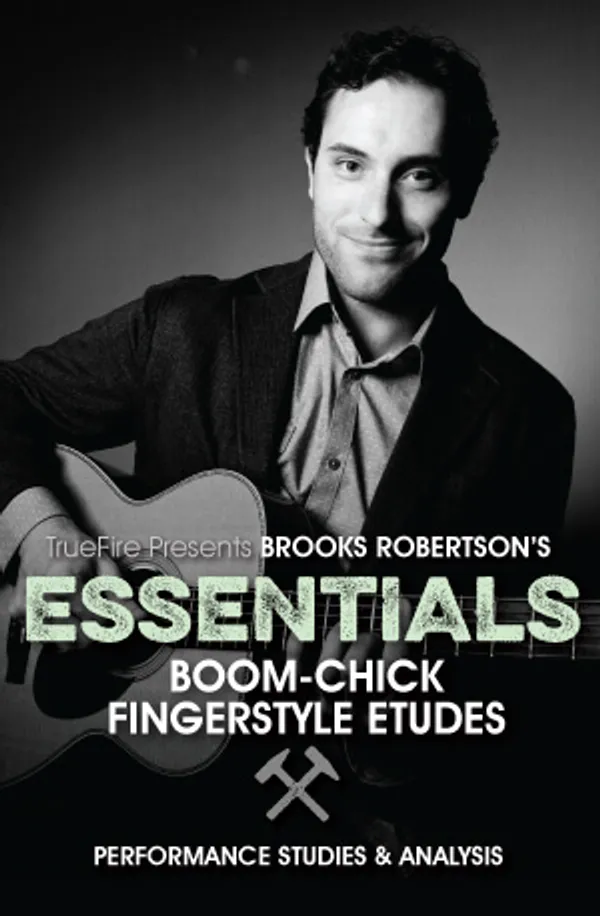
In this edition of Take 5: Boom Chick, Brooks Robertson begins by demonstrating and teaching the essential steps for getting started in this iconic style of playing. The course opens with a 30-minute primer video introducing proper picking hand placement and discusses the common use of fingernails and a thumbpick.

Next, you’ll be introduced to 3 basic alternating bass patterns which will set you up to then slowly work through essential picking patterns using thumb, index, middle, and ring fingers. Taking the time to work on a few beginning patterns will help you develop proper technique in addition to thumb and finger independence. Brooks also covers the common ways to mute the strings using both the left and right hands, an essential tool used with Fingerstyle guitar.

Following the primer video, Brooks will slowly guide you through a series of five short tunes that each introduces a new technique and gradually increases in difficulty.

Brooks will explain and demonstrate all of the key concepts and approaches along the way. You’ll get standard notation and tabs for all of the performance studies. Plus, you’ll be able to use TrueFire’s learning tools to sync the tab and notation to the video lesson. You can also loop or slow down the videos so that you can work with the lessons at your own pace. All of the backing tracks are included to work with on your own as well.

Grab your guitar and let's boom chick with Brooks Robertson!

What you'll learn

  • Navigate chord changes efficiently by holding shapes
  • Play a complete fingerstyle arrangement with syncopated melody over steady boom chick bass
  • Play swing eighth notes with proper feel
  • Create contrast between bass, accompaniment, and melody voices
  • Understand the boom chick fingerstyle technique
Release date: 12/02/2019 • 1h 59m runtime
Start Course
Sample lessons
Level 3: Boom Chick
Level 3: Boom Chick
Overview
Level 3: Boom Chick
Level 3: Boom Chick
Performance
Level 3: Boom Chick
Level 3: Boom Chick
Breakdown

What's included

18 lessons • 6 charts

Take 5: Boom Chick Fingerstyle
Hi, I'm Brooks Robertson. Welcome to Take 5: Boom Chick!

Boom chick is a versatile technique used and refined by many great fingerstyle guitar icons such as Mose Rager, Ike Everly, Doc Watson, Merle Travis, Odell Martin, Chet Atkins, Jerry Reed, Tommy Emmanuel, Thom Bresh, Richard Smith, Doyle Dykes and many more. The technique can be applied to folk, country, blues, jazz and Americana tunes. At the core of the technique is an alternating thumb pattern often played with muted bass strings and sustaining treble strings. Upon having a grasp of the fundamental techniques commonly used in this style, you can perform bass, chord, and melody simultaneously on one single instrument.

In this course, I'll begin by demonstrating and teaching the essential steps for getting started in this iconic style of playing. The course opens with a 30-minute primer video introducing proper picking hand placement and discusses the common use of fingernails and a thumbpick. Next, you’ll be introduced to 3 basic alternating bass patterns which will set you up to then slowly work through essential picking patterns using thumb, index, middle, and ring fingers. Taking the time to work on a few beginning patterns will help you develop proper technique in addition to thumb and finger independence. Next, we'll cover the common ways to mute the strings using both the left and right hands, an essential tool used with fingerstyle guitar.

Following the primer, I'll slowly guide you through a series of five short tunes that each introduce a new technique and gradually increase in difficulty.

Level 1: This short tune in the key of G can be played using only the thumb and the index finger on the picking hand. This performance study will help you develop playing a simple bass line, chord tones, and melody with no syncopation (i.e. all the notes will be on the beat) using only whole, half, and quarter notes.

Level 2: In the key of C, this tune combines an alternating bass with index, middle, and ring fingers to play "pinches" (i.e. thumb and fingers playing at the same time on the same beat) on beats one and four. The melody is based off of this simple rhythmic pattern and demonstrates that melodic motifs can be generated from simple rhythmic picking patterns. This tune will also introduce a partial barre and a hammer-on with the fretting hand.

Level 3: This tune in A minor uses muting on both the fretting and picking hand to perform an accented and staccato melody. The verse has a great groove that is propelled by using a "heavy" alternating bass and swing 8th notes. A syncopated slide will also be introduced which is a common expressive technique used in a variety of fingerstyle tunes. The bridge of the tune contrasts the main melody by changing dynamics and being played with a smooth, sustaining, legato approach which will demand subtle control from your picking hand.

Level 4: This song in the key of A uses more sophisticated picking hand coordination to perform an intricate melody on the 1st (E) and 2nd (B) strings while allowing the chord tones to sustain using both fretted and open strings. We'll also be playing more complex chords combined with a swing rhythm, syncopated 8th notes, and dotted quarter notes while keeping the alternating bass performing steady quarter notes with the thumb.

Level 5: This is a great grooving tune in B minor which uses a combination of the techniques covered so far: alternating bass, muting techniques for left and right hand, straight and syncopated swing rhythms, expressive slides, sophisticated chords and more. The bridge of the tune introduces a soaring lyrical melody with an intricate rhythm using quarter note triplets against the steady quarter note bass. This tune will push you and will be a great transition into playing more challenging fingerstyle pieces.

Boom Chick Fingerstyle Primer
One of the best things you could do to get introduced to the boom-chick style is to listen to some of the pioneers and masters of this guitar style: Mose Rager, Ike Everly, Merle Travis, Odell Martin, Doc Watson, Chet Atkins, Jerry Reed, Tommy Emmanuel, Eddie Pennington, Bob Saxton, Doyle Dykes, Richard Smith, Buster B. Jones and Thom Bresh...to name a few! Spending some time listening to and watching these players will get you introduced to what is possible with the technique and where it came from.

As mentioned in this primer video, it's common to use a thumbpick and often fingernails or fingerpicks, however many players choose not use fingernails, fingerpicks or a thumbpick. I personally use a thumbpick and acrylic fingernails and would advise to try out several ways and see what works for you. 

As you get started with this style it is really important to have proper picking hand placement so that your thumb and fingers are out of each other's way and can work together. Having an efficient technique will in turn produce good tone, dynamics, speed, accuracy, and endurance. Be sure to spend some time with the video around 2:45 - applying the "45 degree angle pencil rule" which was shown to me by Buster B. Jones. Also notice that the knuckle near the midpoint of the thumb rarely ever bends to attack the string, rather the entire thumb and larger muscles attached to the palm all work together to play down through the string.

Alternating bass patterns come in three common variations: 6th string root, 5th string root, and 4th string root. It is very common to begin the alternating pattern on the string which the root of the chord is being played. The thumb plays even quarter notes on every beat of the measure. The key in boom-chick style is to always keep the thumb playing even quarter notes regardless of what the fingers are doing. Take some time to practice these three variations. One extra tip is to practice in front of the mirror to make sure your technique looks clean and that your patterns are correct.

Once you've got a grasp on the three alternating bass patterns you should try muting the bass strings with the palm of the picking hand - see the video around 7:00. Muting the bass strings is a common and characteristic technique that is essential to develop and refine in the boom-chick style. The next step is to bring the index, middle and ring fingers into the mix on the top three strings (these strings will typically not be muted). The difficulty at this stage for most players who are just starting out in this style is to keep the thumb alternating and playing consistent quarter notes. In order to eventually play tunes in this style, one must develop thumb and finger independence. Picking patterns are one of the very best ways to begin developing this type of independence between thumb and fingers.

As you continue to work with the picking patterns, take your time, get a pattern down first with one chord then apply it to an entire chord progression. After you feel comfortable playing all the picking patterns over a few simple chord progressions you're ready to move onto the Level 1 tune.
Level 1: Boom Chick
This tune is in the key of G major and uses basic first position chord shapes. I'd suggest to try playing this tune using only the thumb and the index finger only on the picking hand. Take your time as you work on balancing the bass line, chord tones, and melody with no syncopation using only whole, half, and quarter notes.
Level 1: Boom Chick
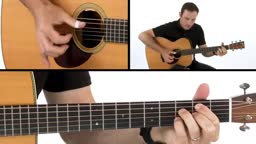
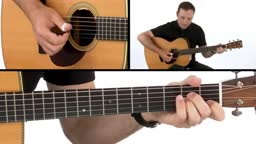
As you watch this performance video try and familiarize yourself with the melody. Notice that the thumb plays steady quarter notes on the three bass strings while all the notes of the melody on the top three strings are on the beat (no syncopation) using only whole, half or quarter notes. I'd recommend to watch it through a few extra times paying close attention to the chord shapes being used with fretting hand and likewise watch closely what the picking hand is doing with just thumb and index finger.
Level 1: Boom Chick
You'll only need five chord shapes on the fretting hand to perform this entire tune. If you don't already know these first position chords I would suggest taking a few moments to get those under your fingers. The chord shapes are important as they'll contain nearly all the notes you'll need to play bass, chord tones, and melody. Strive for a nice muted bass on the bottom three strings and legato sustaining melody on the top 3 strings. Be sure to work on just a few bars at a time vs. trying to learn the whole tune in one go. Don't forget to utilize the TAB/notation!

IMPORTANT: When using the TAB - notes that appear in parenthesis in a new bar are tied over from the previous bar, therefore you don't need to replay or re-attack these notes, rather they are sustained notes you should let ring.
Level 2: Boom Chick
The primary technique behind this tune in C major is to play "pinches" using an alternating thumb in combination with index, middle, and ring fingers all playing at the same time on the same beat. The melody is based off a simple rhythmic picking pattern with pinches on beats 1 + 4. You'll also work on a partial barre and a hammer-on with the fretting hand.
Level 2: Boom Chick
Pay close attention to the chord shapes being used with the left hand during the performance. When a chord change occurs the thumb on the picking hand begins playing the string that contains the root of the chord. See if you can identify which alternating bass pattern is being used on each chord - is it a 6th, 5th, or 4th string root pattern? Listen to how the treble strings are allowed to ring out and sustain, providing the melody with long lyrical quality to the phrase.

+ 11 more lessons

Start Course

Reviews

18 results

leeofcalifornia

Verified buyer

10/16/25

Take 5: Goom-Chick

This is a great addition to the suite of courses that Brooks teaches. I learned about many of his courses through the excellent interview conducted on the TrueFire website. In addition to the excellent patience and instruction reflected in these courses, the Boom-Chick course is a lot of fun to work on.

rm14543

Verified buyer

10/30/23

Outstanding course even for those with experience.

This was a great course. I learned some great exercises that really could be considered tunes and not exercises. Brooks knows how to both play and be a great teacher. The step-by-step learning process he has is a terrific way to learn. It's an outstanding course, even for people with experience in Boom Chick playing.

egungl

Verified buyer

04/12/22

Good explanation

Great course. Easy to follow.

canabina

Verified buyer

01/10/22

Very good course, well explained

tomac

Verified buyer

11/12/21

Good introduction

Stop searching. Start improving with All Access.

Try 14 days free. Cancel any time.