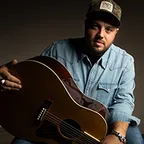
Popularized by players like Doc Watson, Norman Blake and Tony Rice, flatpicking was developed by guitarists arranging old-time American fiddle tunes on the guitar, expanding the instrument's traditional rhythmic role by adding melodies and occasional bass runs on the lower strings.
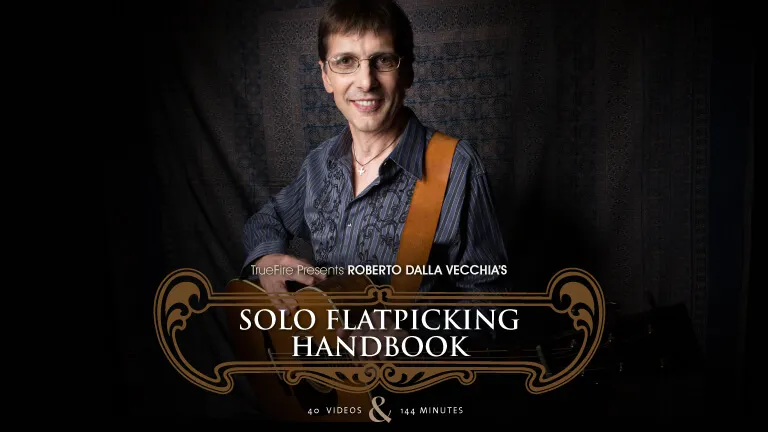
One of Italy’s top recording artists, composers and educators, Roberto Dalla Vecchia designed this Solo Flatpicking Handbook of essential concepts, techniques and creative approaches to take your flatpicking chops to the next level and help you develop a flatpicking repertoire designed specifically for solo performance.
We’re very proud to welcome Roberto to the family with his first TrueFire course! ”Generally, flatpicking guitar is associated with American traditional music where other players accompany you as you play your solos or vice versa. Having both classical and fingerstyle backgrounds, I found myself flatpicking guitar tunes all by myself; maybe because it was hard to find someone to play this type of music where I live in Italy! This is exactly what we'll be doing in this course: flatpicking guitar as a soloist. That means that even if we only play one note at a time, we want to have a rich sound, carefully mixing the melody notes with chords and basses.”
Roberto organized the course into two sections. In the first section, you’ll work through 12 essential concepts and techniques designed to deliver everything you need to start building your solo flatpicking repertoire: Let It Ring, Carter Style, Rest Strokes, Bass On The Offbeat, Melody On The Offbeat, Cross-picking, Floating, Swing Feel, Free Time & Tempo, The Picking Hand, Common Chords & The Capo , and Simple Embellishments.
In the second section, you’ll apply everything you learned in the first section and play your way through 8 flatpicking Performance Studies, composed of both traditional and original compositions, all arranged for solo performance: One More Time, Bill Cheatham, The Storms Are On The Ocean, Aura Lee, Gift Of A Lifetime, Red Haired Boy, Eight More Miles To Louisville, and Ticket To Cesuna.
”We’ll start out with “One More Time” an original in the key of A that’s also an excellent workout for your picking hand. Next we’ll play “Bill Cheatham”, a traditional fiddle piece where we’ll use a capo to move open position chords to the key of A. The Storms Are On The Ocean is a medium tempo waltz where we’ll put our Carter Style approach to use. We’ll use rest strokes and syncopation in the melody of Aura Lee, a progression made popular by Elvis Presley’s Love Me Tender.
Gift of a Lifetime” is an original song in free time that uses a lot of dynamics to convey emotion. Another traditional fiddle tune, Red Haired Boy makes use of the floating technique to create cascading melodic runs. Moving to drop-d tuning, Eight More Miles To Louisville combines cross-picking and simple embellishments in a traditional tune. And finally, we’ll work on “Ticket To Cesuna”, another original that utilizes a simple open tuning and puts all our flatpicking concepts to work.”
All of the Performance Studies are tabbed and notated for your practice, reference and study purposes. You’ll also get Guitar Pro files so that you can play, loop and/or slow down the tab and notation as you work through the lessons.
Grab your guitar and let’s go solo with our flatpicking and Roberto Dalla Vecchia!
What you'll learn
Play the complete song 'Gift of a Lifetime' with proper chord voicings
Develop essential flatpicking techniques including Carter style, rest strokes, and cross picking
Build a repertoire of solo flatpicking arrangements suitable for performance
Develop dynamic control to emphasize melody notes within chord progressions
Hi, I'm Roberto Dalla Vecchia and welcome to Solo Flatpicking Handbook.
Generally, flatpicking guitar is associated with American traditional music, bluegrass, and folk music, requiring somebody to accompany you as you play your solos or vice versa. Having firstly a classical and secondly fingerstyle background, I found myself playing flatpicking guitar all by myself...maybe because it was hard to find someone to play this type of music where I live in Italy! This is exactly what we'll do during this course: play flatpicking guitar as a soloist. That means that even if we only play one note at a time, we want to have a rich sound, carefully mixing the melody notes with chords and basses. Needless to say, I'm not the first one to do this; many flatpickers have being doing it way before me such as Dan Crary and Norman Blake.
I've divided the course into two sections, the first being a toolkit of essential concepts. We're going to look at crosspicking, rest strokes, floating, Carter style, etc. and explore many ideas I apply on a regular basis when I'm arranging a song for solo flatpicking. Again, our goal is to have a full sound without somebody else playing back up.
In the second section, we’re going to look at eight tunes using the ideas we worked on in the first section. We'll play a right hand workout called “One More Time,” a couple of old fiddle tunes called “Bill Cheatham” and “Red Haired Boy," a traditional lovely waltz called “The Storms Are on the Ocean," and a couple of tunes I wrote as well, one very slow “Gift of a Lifetime” and one pretty fast “Ticket to Cesuna." Continuing along, we'll play an old song made famous by Elvis Presley called “Aura Lee” and finally another American traditional song in dropped D tuning called “Eight More Miles to Louisville."
For each performance study, I'll break down the tune and refer back to concepts introduced earlier in the course, finishing up each performance with a slow run through of the tune. In addition to the jam tracks you'll get for each tune, you'll get both standard notation and tablature so you can take as much time as you need to get these tunes under your fingers.
So, grab your guitars and let’s play!
In this section, we'll look at all the essential concepts I use to arrange a piece for solo flatpicking guitar. Consider them different tools that you can apply to a song when you arrange a song on your own. Each song is different, with a certain quality, rhythm, or melody that calls for one or more of these concepts. It's good to practice with each one separately first to analyze and understand how it works.
Let’s get started!
Whenever we play without anyone providing back up we have to combine the melody with some bass notes and arpeggiated chords. It's crucial to leave our left hand fingers down as long as possible, this way we'll have a richer and full sound. Standard notation and tablature are not really able to give us this piece of information, so always keep this idea in mind. You'll hear me repeating “keep your finger down” over and over again throughout this course, it will be our mantra!
The "Carter Style" consists in playing a simple melody on the lower guitar strings while strumming the higher strings to fill up holes in between melody notes. This technique will allow you to play melody and back up at the same time, all by yourself.
This style was named after Maybelle Carter from Carter Family, a folk band really popular in the States back in the 30’s. The most important element when playing in this style is to strum your chords very lightly, always making sure the melody stands out.
Sometimes the melody we're arranging lies on the higher strings of the guitar. In these situations, we can strum through the chord all the way up to the string where the melody is.
If the melody note is on the first fret of the second string and we play an A minor chord, we can strum the chord and rest the pick on the first string so we won't accidentally play it. This type of stroke is called a "rest stroke."
Here we're still arranging the same melody as the last concept, this time twisting the rhythm of it in order to play both the melody and the bass note.
Instead of playing a big strum that includes the melody (the chord and the bass), we'll play the bass first and then strum the chord without the bass up to the melody note. By doing so, we're playing the bass on the offbeat.
Of course, we can apply the same idea to the melody notes by playing the melody first and the bass second. This time we'll play the melody note on the offbeat. This is a technique I use all the time, very useful, and as an extra bonus it adds a very cool drive to our playing.
I have learned almost exclusively through self-learning but recently decided it was time to get some real guidance. This was an excellent resource, I am improving in ways I didn’t realize I could and am having fun at the same time.
J
jimmyjack
Verified buyer
03/26/23
Solo Flatpicking Handbook
I am realy enjoying Solo Flatpicking Handbook. Roberto Dalla Vecchia provides a great number fundamental flatpicking concepts, but shows how to implement them in some very challenging fiddle tunes. The Solo Flatpicking Handbook will help you improve your flatpicking technique if you are willing to put the time in.
M
mgregory55
Verified buyer
01/10/23
Easy to Follow
This looks like it's exactly what I was looking for. These lessons build on each other to get you picking right in no time!
P
pickinandgrinin
Verified buyer
08/18/22
As an intermediate flat picker I an finding the material and Roberto’s approach great. The teaching style is friendly and his picking inspiring in both technique and taste. This course is going to be fun!
F
FrankMcLean
Verified buyer
08/01/22
I like this course a lot. I am an experienced flatpicker but like the concept of playing without the need for backup. I also like going back to basic ''Carter Style Playing''. I am a bit slow with the cross picking, being more familiar with Norman Blake style and the ''floating'' section is taking me some time to get to grips with. Enjoyed what I have covered so far an looking forward to learning the tunes to come later in the book.