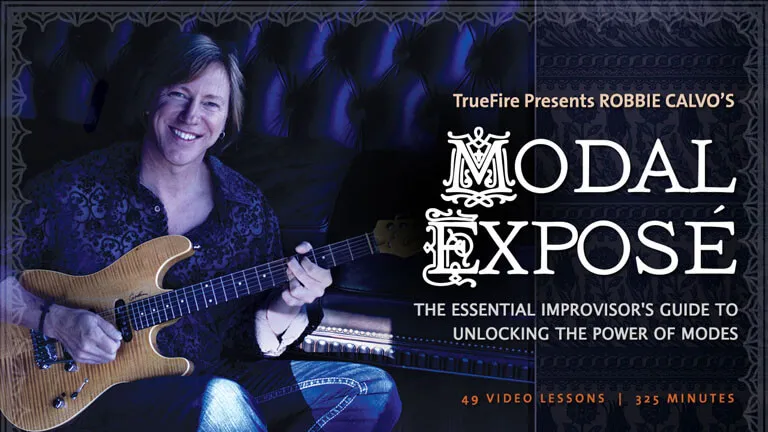
Google "musical modes guitar" and it'll spit back just under 5 million results. Everybody agrees on those funky Greek names but that's where the consensus ends. Try to figure out how to apply modes as an improvisational tool and you might as well try to understand Einstein's theory of relativity, gravitational time dilation and Galilean transformations without a degree in physics. Ain't likely to happen. But all that confusion ends now -- at last, you have at your fingertips a very clear and accessible "modal" approach for improvising over chord changes. No physics degree required.
Granted, there's massive volumes of information, history, and applications related to modes BUT you really only need to know a little to achieve big breakthroughs in your understanding of harmony and ability to improvise over chord changes -- and that's what Modal Expose is all about.
Firstly, an important disclaimer... Modal Expose is NOT another one of those jazzer's mode courses or a thick theoretical syllabus; Modal Expose is simply a very accessible approach for first identifying a progression's tonal center and then crafting great sounding solos, which leverage the characteristic tones within that progression. Simple as that.
If you already know what a major scale is and can play it in any key, you are good to go. First, Calvo shows you the seven modes that live within the seven notes of that scale. Next, Calvo reveals how the major, minor, dominant and diminished arpeggios and chords are built from those seven notes and modes within that key. Then Calvo demonstrates how to use his simple "modal" formula to also quickly grasp the underlying harmony of chord progressions. We guarantee these three epiphanies within the first thirty minutes of working through the course. No physics, no Greek required.
Now then, the fourth epiphamatic breakthrough of Modal Expose will get your heart racing and so we strongly recommend a stress test before undertaking the next section of the course. Calvo shows you how to apply your newfound understanding of modal harmony to improvise melodic lines seamlessly across any set of chord changes, in any progression. Yes, this means you can finally wean yourself off those safe 1-4-5 progressions, give those tired old pentatonic runs a rest, and solo over any progression, in any key, in any style.
As usual you'll play your way through the course; Calvo has created rhythm and soloing playalongs for every section of the course. Of course, all of the practice rhythm tracks are also included and everything is tabbed and notated on PDF, Power Tab and Guitar Pro files.
At last we are able to offer students an extraordinarily accessible, practical, no-nonsense guide to understanding and applying modes as an improvisational tool. Your solos will never sound the same again. And that's a promise.
What you'll learn
Apply percussive rhythm guitar techniques with scratch rhythms
Use rhythmic anticipation and placement for musical expression
Target the characteristic flat 7 tone of mixolydian mode
Build solos using chord tones as strong entry points
Develop improvisational solos by repeating and developing motifs
I still find it amazing to think that all of the music we've ever heard was created from 12 notes and even more mind boggling is the amount of songs, chord progressions and melodies that have been written in one key containing only 7 notes!
This is exactly why I believe that understanding the major scale modes may just be the most important subject a guitarist can study and integrate into his or her playing.
The 'Modal Expose' course is the foundation to unlocking an incredible amount of musical fulfillment for you and your audience. I'll give you the key - are you ready to use it?
Without further ado, I bring you 'The Modal Expose'. A course designed to empower you with the truth about the major scale modes and show you just how simple it is to understand and see the light when the tunnel is made of glass. No smoke and mirrors, just 7 notes! Applied 7 different ways!
I have laid the course out in such a way as to gradually impart new information and ease you towards a full and comprehensive understanding of how the modal system works, one video at a time. Please work through the whole course even if some of the information is a review or refresher for you. You may just find a gem of wisdom in there as you work through everything.
I have presented the course in one key, A major. I've done this to eliminate any confusion and because it's a really good key for guitarists. I have also limited the lesson information to one scale shape in one position on the fretboard and you are going to find out that all of the information you need to become a great modal player exists right there within 4 frets! Guess what? All of the information you'll learn is transposable to every key too, by just moving the shape!
I think you will find out quickly that it just takes a clear understanding of the 7 notes found in the major scale, the chords that are built from those seven notes and the fact that those chords create chord progressions. Chord progressions can and often do, resolve to a Tonal Center other than that of the first chord in the scale, in fact lots of chord progressions don't even contain the first chord in the key! Once you understand where the underlying harmony (chords) resolve to, you can then apply the corresponding mode to that tonal center with your licks and single note phrases.
Remember, there are 7 notes that make up 7 chords. Chord progressions can resolve to any of the 7 tonal centers. We can then apply the 7 modes depending on which tonal center the progression resolves to.
Before we start working through the information in each segment, please take a moment to read the paragraphs below as I think they clearly define the major scale modes and why we employ them in our every day playing as rhythm and lead guitarists.
The major scale modes are created by inverting the 7 note major scale to start and end on each of the 7 tones within the scale. Each of those inverted scales is directly related to the chord that is built from the root of that note. The reason we do this is that chord progressions built from the scale often resolve to a tonality other than that of the first note or chord. You are still playing in the same key but you have a different tonal center.
A tonal center is the place your ear 'hears' as the resolution point or 'home'. I will be explaining how to harmonize the scale, show the resulting chord, arpeggio and modal approach in each of the mode sections.
Understand that modality is as much about the chord progressions as it is the single note lines.
Let's get this party started!
Please take a moment to review the chart we've provided for you as it will define clearly everything you'll need to help you understand each section of the course. I purposely put the course together to work in one key, A major. Why? Because it's a great guitar key and keeping all the information in one key and one area on the fretboard is really going to help you understand the modal system. We have, however, provided you with these charts in every key so you'll be able to reference the information regardless of what key you are currently working in.
Use the charts in relation to your fretboard too and make the information 'applied harmony and theory' not just harmony and theory.
The A major scale from A to A
In this lesson I'll be showing you how to build the first chord in the key of A, the A major triad and the A major 7th chord. You'll learn that chords are built by stacking 3rd intervals. Here's a visual picture of that statement. A B C# D E F# G# A. As you can see the bold letters are a 3rd above the previous bold note. This is how chords are constructed from the major scale. This is called harmonizing the major scale.
Those single notes make up the chord and are also the chord arpeggio. These are the strongest tones to resolve to when improvising using the A major scale over the A major chords because they are in the chord. This is what I refer to as the sweet notes.
We can play the A major 7th arpeggio in position from our scale shape too so let's do that over the backing track. Sounds strong doesn't it.
Lets hear the Scale now over the chords. You'll hear that the scale played A to A over the chord sounds great. That's because we've built the chord from those tones. You can hear that the scale works but you still need to make sure you resolve to the chord tones, A C# E G#.
The A major scale from B to B
Let's continue harmonizing the A major scale by building a chord from the second degree of the scale, the B note. Here's the visual depiction of that - B C# D E F# G# A B. The bold notes are the notes that make up the chord B minor and B minor 7th. You can reference your chart to confirm this too. Those single notes are, as we've said before, an arpeggio and constitute the strongest tones to resolve to over the B minor chords. Let's learn and play through a B minor 7th arpeggio in position over the chord backing track and you will hear how strong that sounds against the chord.
Now we'll overlay the B dorian mode over the B minor 7th chord and you'll hear that the chord, scale and arpeggio all have a 'tonal center' or resolution point of the 2nd chord. This is the second mode in the A major scale and is called B dorian.
The A major scale from C# to C#
Here are our chord tones for the C# chord - C# D E F# G# A B C#. These notes build a C# minor and C# minor 7th chord. The single notes are the chord arpeggio and the sweet notes, chord tones and our solid resolutions. Why? Because they are in the chord.
We can locate the arpeggio in the scale shape we've been using to create the chords. Let's play through that over the C# minor 7th track. Sounds solid and consonant.
We can also play the A major scale from C# to C# to hear the scale relate directly to the chord that is built from those tones. Our ear hears this as the tonal center. This is called the C# phrygian mode and directly relates to the chord and the tones within it.
The A major scale from D to D
D E F# G# A B C# D. The bold tones are the chord tones and arpeggio for the D major and D major 7th chords.
These are your chord tones and resolution points, Sweet Notes Baby! Got to get my plug in whenever I can right?!
We can locate a D major 7th arpeggio in position from within our A major scale shape. Let's play that over our D major 7th chord backing track. As expected the tones are strong and consonant.
Play the A major scale fom D to D over the chord track now and you'll hear the D chord as the tonal center. This is the D lydian mode.
The A major scale from E to E
E F# G# A B C# D E. The bold letters are the chord tones of an E major triad and an E7 chord with the fourth note added. These notes also constitute the chord arpeggio and are your strong resolution points over those chords.
Let's locate and play an E7 arpeggio in position from our A major scale shape. Sounds very strong and resolute. Play the A major scale now from E to E over the E7 backing track and you will hear that the tonal center of the chord, arpeggio and scale are that of the E7 tones. This is the E mixolydian mode.
This course refreshed my knowledge in the best way possible! Robbie is quite the teacher, explains everything very simply in a cool relaxed manner. Also, there are some really tasty, really musical solos in here to spark your creativity. I totally recommend not only for mode learning but also if you want to improve your phrasing and enrich your lick arsenal.
F
FlxTgr
Verified buyer
12/25/24
Just Fantastic
A
Addahia
Verified buyer
12/07/24
You will improve your sound palette
excelent course not only to understand modal music but with tons of practical workouts with very pleasing jam tracks. And as always, Robbie explains everything cristal clear.
R
RobertMcTigue
Verified buyer
07/17/24
Modals
Great class, helps understand modes
M
Marlowe
02/21/24
Best Modal Explanation Ever
Robbie explains the Modal system better than anyone I have ever heard or seen. Just an amazing presentation which makes a very difficult theory system look easy. If you really want to understand how the 7 modes work and how to apply them to your playing, this is the course you need to get.