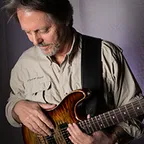
Guitar Lab: Weekend Jazzer

An intensive examination of guide tone structures for jazz comping and soloing

Marty FriedmanTommy EmmanuelSteve VaiEric GalesEric Johnson

Get this course and 1,000+ more with All Access

Try 14 days free. Cancel any time.

Purchase Individual Course for $5.00
Guitar Lab: Weekend Jazzer

About this course

This course is specifically targeted at players who are relatively new to the concept of playing jazz standards. Knowing what and what not to play is critical especially when working with a keyboard player.

Guide tones are the thirds and sevenths of any major 7, minor 7, or dominant 7 chord. Since these are the tones that define the quality of the chord, they are one of the most useful tools for a guitarist whether playing solo, or playing in any group context.

You will receive 16 lessons all of which will deal with a typical bossa nova jam track. You'll be taken step by step through this progression in four bar phrases which will then be assembled into the sections of the tune. After you have learned how to play the entire tune with guide tones, you will then learn how to add the 5, 9, and 6. This will give you many options for extending the harmony which can be applied to any progression.

What you'll learn

  • Create altered dominant chord sounds using tritone substitution
  • Use double stops to create smoother voice leading and free up fingers
  • Create melodic lines using the 6th as a passing or target tone
  • Identify where the 6th/13th is located relative to other chord tones on the fretboard
  • Understand how to apply b5 substitution to bass lines
Release date: 04/05/2013 • 3h 04m runtime
Start Course
Sample lessons
Bossa Nova Track
Bossa Nova Track
Track Analysis
Section A: Pt. 1
Section A: Pt. 1
Measures 1-4
Section A: Pt. 2
Section A: Pt. 2
Measures 5-8
Guide Tone/Root Structures
Right to Left

What's included

29 lessons • 2 charts • 16 Jam Tracks

Weekend Jazzer
This course is specifically targeted at players who are relatively new to the concept of playing jazz standards. Knowing what and what not to play is critical especially when working with a keyboard player.

Guide tones are the thirds and sevenths of any major 7, minor 7, or dominant 7 chord. Since these are the tones that define the quality of the chord, they are one of the most useful tools for a guitarist whether playing solo, or playing in any group context.

You will receive 16 lessons all of which will deal with a typical bossa nova jam track. You'll be taken step by step through this progression in four bar phrases which will then be assembled into the sections of the tune. After you have learned how to play the entire tune with guide tones, you will then learn how to add the 5, 9, and 6. This will give you many options for extending the harmony which can be applied to any progression.
Bossa Nova Track
To understand the harmonic nature of this typical bossa nova tune, it is important to analyze the changes. Chart 1 is the rhythm chart for this tune which shows the form as follows: AABA. As you look at the chord symbols, you will notice that you are dealing with the following qualities: major 7, dominant 7, minor 7, dominant 7 b5, and dominant 7 b9b5.Chart 2 reveals chord scale relationships for the chords in this tune. The arpeggios for the chords are color coded in red to correspond with the chord symbol. The remaining tones are labeled in black to correspond with the names of the modes. This way you can keep track of the color tones.As you look through the rhythm chart for this tune, every place where there is a major seven chord you would play the guide tones for that chord which are the 3 and the 7. Likewise every place where there's a 7 chord (the word dominant is implied), the guide tones would be 3 and b7. This would also serve for the altered dominant chords in this tune; the 7b5 and the 7b9b5. Every place where there's a minor seven chord you would use the b3 and b7.I suggest you memorize the formulas for the chords that you're going to be playing over. This will help you understand the harmony. When we start extending the chords in future lessons, you can apply the various modes as options for note choices.
Guide Tone/Root Structures
As explained in the text for lesson one, we will be dealing with guide tones for the various chords. We will also add the root of the chord which will allow you to establish a bassline when necessary.

Diagrams A through L are master charts of guide tone/root structures on the fingerboard in various layouts. We will use diagrams one through six and will apply them to the chords in this tune.
Section A: Pt. 1
As explained in the text for lesson one, we will be dealing with guide tones for the various chords. We will also add the root of the chord which will allow you to establish a bassline when necessary.Diagrams A through L are master charts of guide tone/root structures on the fingerboard in various layouts. This lesson will use diagrams one through six and will apply them to the chords in measures one through four. This is the first half of section A of the tune.
Section A: Pt. 2
As explained in the text for lesson one, we will be dealing with guide tones for the various chords. We will also add the root of the chord which will allow you to establish a bassline when necessary.Diagrams A through L are master charts of guide tone/root structures on the fingerboard in various layouts. This lesson will use diagrams one through six and will apply them to the chords in measures five through eight. This is the second half of section A of the tune.
Section A: Complete
As explained in the text for lesson one, we will be dealing with guide tones for the various chords. We will also add the root of the chord which will allow you to establish a bassline when necessary.Diagrams A through L are master charts of guide tone/root structures on the fingerboard in various layouts. This lesson will use diagrams one through six and will apply them to the chords in measures one through eight. This is the entire section A of the tune.
Section B: Pt. 1
As explained in the text for lesson one, we will be dealing with guide tones for the various chords. We will also add the root of the chord which will allow you to establish a bassline when necessary.Diagrams A through L are master charts of guide tone/root structures on the fingerboard in various layouts. This lesson will use diagrams one through six and will apply them to the chords in measures 16 through 20. These are the first four bars of section B.

+ 22 more lessons

Start Course

Reviews

7 results

dwa79

Verified buyer

08/06/23

Next Step jazz

Good course to help one start playing jazz.

trader46

Verified buyer

08/02/22

Thorough but approachable

Like all Brads courses, this comprehensive at what it teaches but practical and interesting to learn. A big advantage is the lessons apply broadly to many song possibilities.

Burkhard

06/25/22

Goldmine !!!

From simple to hard - very well thought out.How to play the chords, very much to learn. No soloing - maybe there should be a Weekend Jazzer Soloing Course.

JohnSmithers

Verified buyer

11/07/20

Interesting

I really liked this course,as it gave me various insights into the jazz style.The material is very interesting and well layed out in a relaxed way. It`s fun to learn,as the teacher is very competent, and this course is to be recommended for all players

Anto

07/12/20

Clear and concise

easy to underestand. thanks

Stop searching. Start improving with All Access.

Try 14 days free. Cancel any time.