


Guitar Lab: Shuffle Secrets

Intensive examination of shuffle rhythms for comping and lead guitar

Marty FriedmanTommy EmmanuelSteve VaiEric GalesEric Johnson

Get this course and 1,000+ more with All Access

Try 14 days free. Cancel any time.

Purchase Individual Course for $5.00
Guitar Lab: Shuffle Secrets

About this course

The purpose of this course is to give you a thorough understanding of rhythm as it applies to a swing or shuffle feel. You will receive a breakdown of the subdivisions of the quarter note both from a math and a sound standpoint. The differences between straight and swing eighth notes will be discussed to help you easily categorize music into one of these two rhythmic grooves.

You will receive a number of combined rhythmic figures to aid you in developing your own inventory of note combinations: quarter notes, shuffle eighth notes, eighth note triplets, 16th note triplets, and quarter note triplets. Different groupings of shuffle eighth notes will also be covered which will give you many ideas for creating asymmetrical rhythmic phrases.

You will also learn to utilize the minor pentatonic scale over a shuffle groove by inserting three notes into a fixed rhythmic figure. This concept takes rhythm and phrasing out of the picture and help you focus on scale tone selection. This also teaches you to think ahead in terms of a target note. The format will be as follows: the first and second notes of the rhythmic figure will be fixed and the third note is a variable.

This course will explore many different techniques which will reveal how you can get a lot of different licks out of the same three notes formula. The following techniques will be presented: hammer ons, pull offs, legato slides, grace notes, bends, pre-bends, vibrato, upper and lower neighbors, staccato, pick raking, and octave displacement. Another important tool you will learn is note duplication on the fingerboard which will allow you to explore different layouts of a musical phrase. This often overlooked tool can help you mold and shape your sound as well as solve technical problems.

After you have applied these lessons to your practice regimen, you will be able to enjoy an endless flow of ideas within the shuffle groove.

What you'll learn

  • Apply picking hand thumb dampening to control unwanted string noise
  • Execute clean finger rolls and vibrato technique
  • Create variations by changing the third note (variable) in three-note groups
  • Create three-note phrases using 1-4-variable formula
  • Hear how sustained notes change meaning as chords change underneath
Release date: 06/23/2012 • 4h 27m runtime
Start Course
Sample lessons
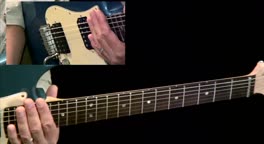
Quarter Notes
Quarter Notes
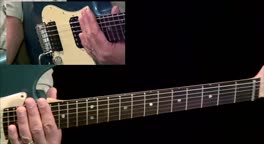
Straight vs
Straight vs
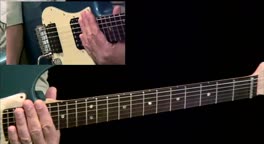
Swing Eighths
Combined Rhythmic
Combined Rhythmic
Figures
Sixteenth Note
Sixteenth Note
Triplets

What's included

36 lessons • 3 charts • 15 Jam Tracks

Shuffle Secrets
The purpose of this course is to give you a thorough understanding of rhythm as it applies to a swing or shuffle feel. You will receive a breakdown of the subdivisions of the quarter note both from a math and a sound standpoint. The differences between straight and swing eighth notes will be discussed to help you easily categorize music into one of these two rhythmic grooves.

You will receive a number of combined rhythmic figures to aid you in developing your own inventory of note combinations: quarter notes, shuffle eighth notes, eighth note triplets, 16th note triplets, and quarter note triplets.

Lessons nine through 15 will involve different groupings of shuffle eighth notes which will give you many ideas for creating asymmetrical rhythmic phrases.
Quarter Notes
This lesson starts with the basics: the quarter note. The quarter note corresponds with the tempo of whatever music you are playing. When you tap your foot, the moment your foot hits the ground represents the quarter notes. These are counted: 1 2 3 4.

You will receive a drum groove track which will establish this rhythmic concept. Spend time counting and playing along with the track so you are rock solid in your understanding of this rhythm.
Straight Eighth Notes
This lesson explains the concept of straight eighth notes. Straight eighths are simply an equal division of the quarter notes explained in the previous lesson. When you tap your foot, the moment your foot hits the ground represents the first eighth note and when your foot is up it corresponds with the second eighth note. These are counted: 1 + 2 + 3 + 4 +. A very important rule to remember is: your foot is down when you say the number and your foot is up when you say the “and”.

You will receive a drum groove track which will establish this rhythmic concept. Spend time counting and playing along with the track so you are rock solid in your understanding of this rhythm.
Eighth Note
In this lesson we will study the eighth note triplet. Eighth note triplets are simply a subdivision of each beat into three equal parts. Therefore each eighth note and eighth note triplet receives one third of a beat. They are counted: 1 trip let 2 trip let 3 trip let 4 trip let.

You will receive a drum groove track which will establish this rhythmic concept. Spend time counting and playing along with the track so you are rock solid in your understanding of this rhythm.
Swing Eighths
Swing eighth notes differ from straight eights in that there is a lope in their sound. This is because the time values of each eighth note are different. In the previous lesson you learned how to count and hear eighth note triplets. To understand swing or shuffle eighth notes, simply tie the first two eighth notes together. What this then creates is a situation where the first eighth note rings two thirds of a beat and the second eighth note rings one third of a beat. To count these all you have to do is delete the syllable “trip”. It would sound like this: 1 (trip) let 2 (trip) let 3 (trip) let 4 (trip) let. As you can see you want to maintain the proper timing by either whispering or leaving space for the syllable”trip” (the second third of each beat). What's important to remember is that you are playing within a rhythmic grid work which consists of three time slots for each beat and 12 time slots for the entire measure.

You will receive a drum groove track which will establish this rhythmic concept. Spend time counting and playing along with the track so you are rock solid in your understanding of this rhythm.
Straight vs
This lesson shows the contrast between straight and shuffle eighth notes. You will receive a drum groove track which will establish this rhythmic concept. Spend time counting and playing along with the track so you are rock solid in your understanding of this rhythm.
Combined Rhythmic
This lesson will present various combinations of quarter notes, swing eighth notes, and eighth note triplets. There will be some examples of tying notes together to create different rhythmic figures. It’s important to be able to play these as strict drum style grooves before you start applying them to your actual rhythm guitar and lead guitar parts..

+ 29 more lessons

Start Course

Reviews

7 results

wholmer

01/04/21

Brads Guitar Lab series is awesome! He takes an element of every aspect of guitar playing and dissects it, laying open so you can easily understand it. The bite size lessons and his teaching method are really very well thought out and very comprehensive. I am always pleased with the outcome.

wholmer

12/31/20

What a GREAT shuffle rhythm course!

This class will break down the shuffle rhythm way better than any other. Brad is a great teacher, of all my Truefire courses I have most are by him. He shows tricks that make it easier to play the blues shuffle in any key! Highly recommended.

jittenbach

Verified buyer

12/07/20

Shuffle Secrets

If you want to solidify your blues foundation and raise the bar on your playing this is a good choice. Brad Carlton is very knowledgeable and knows how to break things down in an understandable way

Bobbyj8866

Verified buyer

11/21/20

Very usable

There was ALOT here I didn’t know, and I see improvements already!

morningfield

Verified buyer

10/08/20

Thanks!!

Stop searching. Start improving with All Access.

Try 14 days free. Cancel any time.