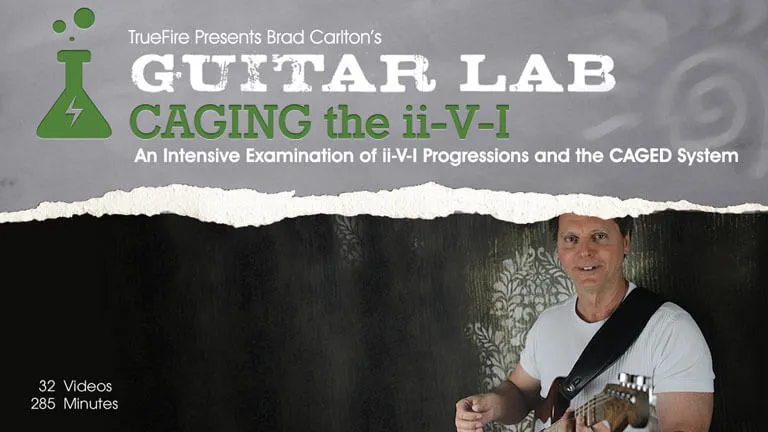

Guitar Lab: Caging ii V I

An Intensive Examination of the 2-5-1 Progressions and the CAGED System

Marty FriedmanTommy EmmanuelSteve VaiEric GalesEric Johnson

Get this course and 1,000+ more with All Access

Try 14 days free. Cancel any time.

Purchase Individual Course for $5.00
Guitar Lab: Caging ii V I

About this course

The ii V I progression forms one of the most important building blocks in all of music. This course will begin with a foundation involving basic diatonic progressions utilizing the CAGED system for fingerboard layout. A prerequisite for this course is a basic understanding of the CAGED system which can be acquired through my course entitled "CAGED Cracked".

In this course, you will learn how to play the ii V I progression in the key of D in six areas on the fingerboard. These are derived from the five areas of the CAGED system plus an alternate form based off the A chord. You will receive charts showing arpeggios and their respective modes which will allow you to harmonically enrich each chord as well as assist you in soloing and/or playing fills over this progression.

You will also receive specific lessons that deal with the five CAGED forms of this progression in the open position.

This group of lessons will establish a solid base of knowledge upon which you will be able to build the extended harmonies and altered chords which exist in jazz versions of the ii V I progression.

What you'll learn

  • Apply voice leading concepts to create musical chord progressions
  • Construct chord voicings using scale form 7 patterns
  • Understand why arpeggios are more harmonically clear than full scales
  • Learn to play chord tones over a bass note in multiple combinations
  • Develop the ability to create accompaniment patterns that combine bass and melody
Release date: 04/05/2013 • 4h 45m runtime
Start Course
Sample lessons
A Form
A Form
Home Base
A Form (Alt. Fingering)
Home Base
Open Position E Form
Home Base
Major Scale Form II 8
ii-V-I Voicings

What's included

32 lessons • 4 charts

CAGING the ii-V-I
The ii V I progression forms one of the most important building blocks in all of music. This course will begin with a foundation involving basic diatonic progressions utilizing the CAGED system for fingerboard layout. A prerequisite for this course is a basic understanding of the CAGED system which can be acquired through my course entitled "CAGED Cracked".

In this course, you will learn how to play the ii V I progression in the key of D in six areas on the fingerboard. These are derived from the five areas of the CAGED system plus an alternate form based off the A chord. You will receive charts showing arpeggios and their respective modes which will allow you to harmonically enrich each chord as well as assist you in soloing and/or playing fills over this progression.

You will also receive specific lessons that deal with the five CAGED forms of this progression in the open position.

This group of lessons will establish a solid base of knowledge upon which you will be able to build the extended harmonies and altered chords which exist in jazz versions of the ii V I progression.
ii V I
This lesson will cover the general theory of the ii V I progression. The major scale contains seven different notes and they are numbered from one through seven with eight being the octave. Roman numerals are used for the scale degrees and chords are built off each degree. The chords are built by using every other note of the scale. Triads are three note chords involving these notes. Because major scales always utilize the same intervallic construction records will always be the same according to what scale degree you are referencing. This means that I, IV, and V will always be major triads and ii, iii, and vi will always be minor triads. The seventh step, the scale produces a diminished triad. This means that in a ii V I progression we will always be dealing with a minor triad for the ii, and major triads for the V and I. We will be organizing this progression in the key of D over the entire fingerboard in the following lessons.
D Form
The ii V I progression in the key of D consists of the following chords: Em (the ii chord), A (the V chord), and D (the I chord). This lesson uses the C form of the CAGED as home base. This will place youThe ii V I progression in the key of D consists of the following chords: Em (the ii chord), A (the V chord), and D (the I chord). This lesson uses the D form of the CAGED as home base. This will place you in open position. Example 1 shows the three chords in open position. Example 2 shows the D major scale in open position. Diagram 1 shows the arpeggio for the ii chord in red scale degrees. All numbering in all diagrams is oriented off the root of the chord. Therefore the notes: E, G, and B are the 1, b3, and 5 of the Em chord. The remaining scale tones are in black and are the source for harmonic and melodic enhancement. Remember that the scale you're playing is a D major scale but because you're playing it over the ii chord (Em), the scale is called E Dorian mode. In other words, one way to perceive the Dorian mode is to simply play a major scale starting and ending on the second step of the scale. The numbering that is presented in diagram one refers to the alterations of an E major scale necessary to form the Dorian mode. Diagram 2 shows the arpeggio for the V chord in red and the remaining black tones formed the mixolydian mode. The mixolydian mode is the fifth mode of the major scale meaning you start and end on the fifth note. Again the numbers in diagram two refer to the alterations of an A major scale that produce an A mixolydian mode. Diagram 3 shows the arpeggio for the I chord which is our home base. The red notes form the arpeggio in the black notes complete the entire major scale which is also called the Ionian mode.
C Form
The ii V I progression in the key of D consists of the following chords: Em (the ii chord), A (the V chord), and D (the I chord). This lesson uses the C form of the CAGED as home base. This will place you in second position. Example 3 shows the three chords in open position. Example 4 shows the D major scale in open position. Diagram 4 shows the arpeggio for the ii chord in red scale degrees. All numbering in all diagrams is oriented off the root of the chord. Therefore the notes: E, G, and B are the 1, b3, and 5 of the Em chord. The remaining scale tones are in black and are the source for harmonic and melodic enhancement. Remember that the scale you're playing is a D major scale but because you're playing it over the ii chord (Em), the scale is called E Dorian mode. In other words, one way to perceive the Dorian mode is to simply play a major scale starting and ending on the second step of the scale. The numbering that is presented in diagram one refers to the alterations of an E major scale necessary to form the Dorian mode. Diagram 5 shows the arpeggio for the V chord in red and the remaining black tones formed the mixolydian mode. The mixolydian mode is the fifth mode of the major scale meaning you start and end on the fifth note. Again the numbers in diagram 5 refer to the alterations of an A major scale that produce an A mixolydian mode. Diagram 6 shows the arpeggio for the I chord which is our home base. The red notes form the arpeggio in the black notes complete the entire major scale which is also called the Ionian mode.
A Form
The ii V I progression in the key of D consists of the following chords: Em (the ii chord), A (the V chord), and D (the I chord). This lesson uses the A form of the CAGED as home base. This will place you in fourth position. Example 5 shows the three chords in open position. Example 6 shows the D major scale in open position. Diagram 7 shows the arpeggio for the ii chord in red scale degrees. All numbering in all diagrams is oriented off the root of the chord. Therefore the notes: E, G, and B are the 1, b3, and 5 of the Em chord. The remaining scale tones are in black and are the source for harmonic and melodic enhancement. Remember that the scale you're playing is a D major scale but because you're playing it over the ii chord (Em), the scale is called E Dorian mode. In other words, one way to perceive the Dorian mode is to simply play a major scale starting and ending on the second step of the scale. The numbering that is presented in diagram one refers to the alterations of an E major scale necessary to form the Dorian mode. Diagram 8 shows the arpeggio for the V chord in red and the remaining black tones formed the mixolydian mode. The mixolydian mode is the fifth mode of the major scale meaning you start and end on the fifth note. Again the numbers in diagram 8 refer to the alterations of an A major scale that produce an A mixolydian mode. Diagram 9 shows the arpeggio for the I chord which is our home base. The red notes form the arpeggio in the black notes complete the entire major scale which is also called the Ionian mode. Diagram 11 shows the arpeggio for the V chord in red and the remaining black tones formed the mixolydian mode. The mixolydian mode is the fifth mode of the major scale meaning you start and end on the fifth note. Again the numbers in diagram 11 refer to the alterations of an A major scale that produce an A mixolydian mode. Diagram 12 shows the arpeggio for the I chord which is our home base. The red notes form the arpeggio in the black notes complete the entire major scale which is also called the Ionian mode.
A Form (Alt. Fingering)
The ii V I progression in the key of D consists of the following chords: Em (the ii chord), A (the V chord), and D (the I chord). This lesson uses the A form of the CAGED as home base with an alternate scale form. This will place you in sixth position. Example 7 shows the three chords in open position. Example 8 shows the D major scale in open position. Diagram 10 shows the arpeggio for the ii chord in red scale degrees. All numbering in all diagrams is oriented off the root of the chord. Therefore the notes: E, G, and B are the 1, b3, and 5 of the Em chord. The remaining scale tones are in black and are the source for harmonic and melodic enhancement. Remember that the scale you're playing is a D major scale but because you're playing it over the ii chord (Em), the scale is called E Dorian mode. In other words, one way to perceive the Dorian mode is to simply play a major scale starting and ending on the second step of the scale. The numbering that is presented in diagram one refers to the alterations of an E major scale necessary to form the Dorian mode. Diagram 11 shows the arpeggio for the V chord in red and the remaining black tones formed the mixolydian mode. The mixolydian mode is the fifth mode of the major scale meaning you start and end on the fifth note. Again the numbers in diagram 11 refer to the alterations of an A major scale that produce an A mixolydian mode. Diagram 12 shows the arpeggio for the I chord which is our home base. The red notes form the arpeggio in the black notes complete the entire major scale which is also called the Ionian mode.
G Form
The ii V I progression in the key of D consists of the following chords: Em (the ii chord), A (the V chord), and D (the I chord). This lesson uses the G form of the CAGED as home base with an alternate scale form. This will place you in seventh position. Example 9 shows the three chords in open position. Example 10 shows the D major scale in open position. Diagram 13 shows the arpeggio for the ii chord in red scale degrees. All numbering in all diagrams is oriented off the root of the chord. Therefore the notes: E, G, and B are the 1, b3, and 5 of the Em chord. The remaining scale tones are in black and are the source for harmonic and melodic enhancement. Remember that the scale you're playing is a D major scale but because you're playing it over the ii chord (Em), the scale is called E Dorian mode. In other words, one way to perceive the Dorian mode is to simply play a major scale starting and ending on the second step of the scale. The numbering that is presented in diagram one refers to the alterations of an E major scale necessary to form the Dorian mode. Diagram 14 shows the arpeggio for the V chord in red and the remaining black tones formed the mixolydian mode. The mixolydian mode is the fifth mode of the major scale meaning you start and end on the fifth note. Again the numbers in diagram 14 refer to the alterations of an A major scale that produce an A mixolydian mode. Diagram 15 shows the arpeggio for the I chord which is our home base. The red notes form the arpeggio in the black notes complete the entire major scale which is also called the Ionian mode.

+ 25 more lessons

Start Course

Reviews

5 results

Jimmcdnyc

Verified buyer

12/12/24

Good stuff

darbyogil

Verified buyer

12/09/24

Caging ii V 1

Like everything Brad Carlton puts out great makes you work at it great for retention

trader46

Verified buyer

08/24/22

Applying Cage System

Excellent applications of the system and opens up a large number of possibilities. As always with Brad's courses he offers high value but expects a good work ethic! The results are worth it. Easy to follow, simple explanations and opens a lot of avenues to build on what you know already...

Christophe C.

Verified buyer

08/11/15

This course by Brad Carlton helped me a lot as a developing, intermediate jazz player. After going through the course and doing the exercises my orientation on the fretboard got a lot better. All the exercises are very well explained. Apparently this is a follow up course, but as I was already familiar with the CAGED-system I could follow the explanations without any problem. For people who don't know the CAGED-system it might be better to start with the first part of this course: "CAGED Cracked".

Ron H.

Verified buyer

05/14/13

I have been an extreme fan of TrueFire for many years. Brad Carlton was teaching the first TrueFire course I ever viewed; Blue Grooves. I have many of his courses; some I must admit have not been studied, but only acquired for future studies in my retirement years. Caging the ii-V-I is one of the most comprehensive, exhaustive studies of the various scale forms that I have ever seen. The material is presented in a clear, intelligent manner that helps the student absorb all the intended possibilities from a given Major Scale Form (it also makes it easy to see how additional studies could be done of matters beyond the scope of the course using the same foundational information). Caging the ii-V-I goes beyond its promise to provide an academic presentation of this commonly used chord progression from a CAGED perspective. It provides and in depth analysis of the various Major Scale Forms and various arpeggios used in each one to play this progression. The presentation reaches into materials that will help a student better understand basic harmony, chord construction, the modes, extended harmonies, and the necessity of technical development. In addition to providing the information to make you a better player, Caging the ii-V-I also gives you the technical exercises to practice so that you can apply the information and develop the technical prowess required to be a more skillful player. The course could be described as satisfyingly academic, boldly practical, appropriately challenging, in depth, and abounding with information for potential further study. Still this description omits many positive features of this excellent work of instruction. When I started to study this course, I was looking for something to help me understand jazz progressions. What I discovered was a course that exceeded all my expectations and gave me a better understanding of all music. Studying the information and practicing the exercises given in this course will enhance your understanding and performance skills in any genre of guitar music from classical to country or from shred to R&B. This is a MUST have course for any serious student of guitar.

Stop searching. Start improving with All Access.

Try 14 days free. Cancel any time.