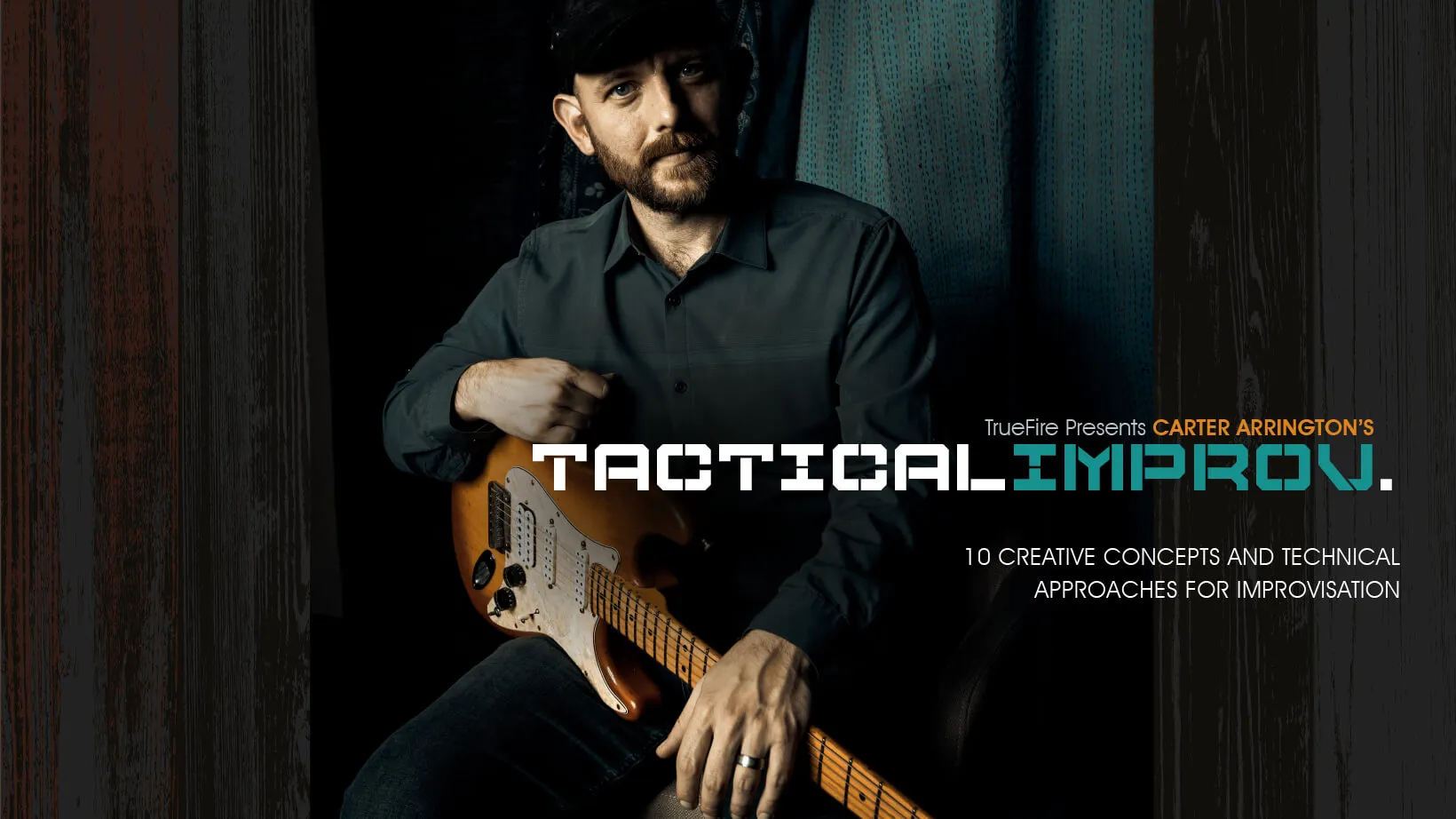

Tactical Improv

10 Creative Concepts and Technical Approaches for Improvisation

Marty FriedmanTommy EmmanuelSteve VaiEric GalesEric Johnson

Get this course and 1,000+ more with All Access

Try 14 days free. Cancel any time.

Purchase Individual Course for $19.99
Tactical Improv

About this course

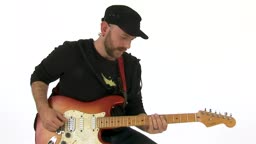
As a guitarist, your ability to Improvise across a variety of styles is key today. From your local jams to touring blues, rock, funk or jazz gigs -- your improvisational chops will keep you working and on the stage. In Carter Arrington’s Tactical Improv course, you’ll dive deep into 10 concepts and approaches that are critical to your development as a guitarist, an improviser, and a musician.

”For each of these 10 tactical improvisation approaches, we’ll start with a quick lesson and demo. I’ll explain the way I use it in my own improvisations, and then we’ll work on it together with a hands-on, application study - we’ll take turns trading ideas back and forth to get the approach under your fingers and on to the fretboard.

Finally, we’ll work through an improvisation study, over a backing track, where I’ll apply these tactical improvisation approaches, and then breakdown the full solo for you. My hope is that by the end of this course, you’ll be able to apply one or more of these tactical concepts to your own playing and vocabulary. “


You’ll explore using three pentatonic scales over one chord and applying diatonic arpeggios through a key. You’ll learn how to tighten up your time with 16th note phrasing options, and how to work on phrasing intentionally in two and four bars. Carter will guide through approaches for applying articulation & dynamics, and double stops. You’ll work on finding different options for playing blues changes, navigating different types of chord changes, taking one melodic shape through all 12 keys, and finally, improvising within limitations.

Carter will explain and demonstrate all of the key concepts and approaches along the way. You’ll get standard notation and tabs for all of the performance studies. Plus, you’ll be able to use TrueFire’s learning tools to sync the tab and notation to the video lesson. You can also loop or slow down the videos so that you can work with the lessons at your own pace. All of the backing tracks are included to work with on your own as well.

Grab your guitar and let’s get tactical with Carter Arrington!

What you'll learn

  • Execute side-slip technique between minor 7th chords
  • Apply melodic minor scales over altered dominant and half-diminished chords
  • Understand which melodic minor scale to use over specific altered chords
  • Phrase musically over complex harmonic movement
  • Develop the ability to see multiple note options while improvising
Release date: 07/06/2020 • 3h 51m runtime
Start Course
Sample lessons
16th Note Phrasing Options
Tactic 3: Demonstration
16th Note Phrasing Options
Tactic 3: Practice Session
JB Groove
JB Groove
Application: Performance
JB Groove
JB Groove
Application: Breakdown

What's included

41 lessons • 10 charts • 10 Jam Tracks

Tactical Improv
Hi I'm Carter Arrington. Welcome to Tactical Improv.

As a guitarist, your ability to Improvise across a variety of styles is key today. From your local jams to touring blues, rock, funk or jazz gigs -- your improvisational chops will keep you working and on the stage.

In this course, we will dive into 10 concepts and approaches that were, and STILL are critical to my development as a guitarist, an improviser, and a musician. You never really master them, you just get better at them.

My hope is that by the end of this course, you'll be able to apply one or more of these tactical concepts to your own playing and vocabulary.

For each of the approaches, we'll start with a quick lesson and demo. I'll explain the way I use it in my improvisation, and then we'll work on it together with a hands-on, application study - we'll take turns trading ideas back and forth to get the approach under your fingers and on to the fretboard. Finally, we'll work through an improvisation study over the backing track where I'll play and breakdown a full solo for you.

All of the key examples are tabbed and notated and you'll be able to sync the tab and notation to the video using TrueFire's learning tools. All of the backing tracks are included and you can loop or slow down any of the videos so you can work with the lessons at your own pace.

Ready to get started? Let's get to work.
The Pentatonic Color Wheel
The pentatonic scale is one of the first scales many of us learn on the guitar, and it's usefulness has been demonstrated by many amazing players over decades. When I was learning to improvise, I played over one chord a lot and this was the first concept I stumbled across that enabled me to get multiple uses out of the same pattern. Since the harmony didn't move around much, each pentatonic box highlighted certain notes in the major scale that had a unique character against the chord, "framing" certain notes and colors. I demonstrate this with a minor 7 chord, but it can definitely be applied to other types of chords. This can be helpful if you are:
  1. Looking for new uses for things you already play.
  2. Wanting to break out of the box.
  3. Curious to explore some sounds that are different, but still inside the harmony and with a familiar pattern.
The Pentatonic Color Wheel
The pentatonic scale is one of the first scales many of us learn on the guitar, and it's usefulness has been demonstrated by many amazing players over decades. When I was learning to improvise, I played over one chord a lot and this was the first concept I stumbled across that enabled me to get multiple uses out of the same pattern. Since the harmony didn't move around much, each pentatonic box highlighted certain notes in the major scale that had a unique character against the chord, "framing" certain notes and colors. I demonstrate this with a minor 7 chord, but it can definitely be applied to other types of chords. This can be helpful if you are:
  1. Looking for new uses for things you already play.
  2. Wanting to break out of the box.
  3. Curious to explore some sounds that are different, but still inside the harmony and with a familiar pattern.
Reggae Vamp
So now let's pull up a track, and I'm going to take a solo in the vein of how I'd play it. I'm not sticking completely to our concept, but you'll see I'm still using pentatonics quite a bit. Let's get started.
Reggae Vamp
Let's finish off the section by breaking down the solo, looking at how I used our concepts while improvising.
Diatonic Arpeggios
One concept that has helped me tremendously on the fretboard was learning the harmonized major scale and it's arpeggios. I was familiar with using scales and modes, but at a certain point I wanted sounds that were more focused and specific. Listening to players like George Benson amazed me because they had these clear lines and ideas that really seemed to pop and the intervals were wider than the scale stuff I was doing...I probably explored 7th arpeggios over a one chord vamp for a solid year because I was so fascinated by how different it sounded. 7th arpeggios can be very effective tools for:
  1. Increasing awareness of the fretboard.
  2. Understanding the relationship between chords and single note playing.
  3. Improvising with smaller shapes that in some cases are easier to think about than full scales.
  4. Understanding some of the vocabulary in many styles of music.
Diatonic Arpeggios
One concept that has helped me tremendously on the fretboard was learning the harmonized major scale and it's arpeggios. I was familiar with using scales and modes, but at a certain point I wanted sounds that were more focused and specific. Listening to players like George Benson amazed me because they had these clear lines and ideas that really seemed to pop and the intervals were wider than the scale stuff I was doing...I probably explored 7th arpeggios over a one chord vamp for a solid year because I was so fascinated by how different it sounded. 7th arpeggios can be very effective tools for:
  1. Increasing awareness of the fretboard.
  2. Understanding the relationship between chords and single note playing.
  3. Improvising with smaller shapes that in some cases are easier to think about than full scales.
  4. Understanding some of the vocabulary in many styles of music.

+ 34 more lessons

Start Course

Reviews

17 results

hhevdschaaf

Verified buyer

08/10/24

Strong rhythmic soloing

Really great. Like the strong sense of rhythm and very technical, less conventional Wayne Krantz like approach.
Tom D.

10/13/23

Great, informative course

A lifetime could be spent on just this group of lessons. A lot to draw from here to keep me busy for a long while. Thanks Carter

Scott

10/01/23

Big Bad Slobberin' Dog

Carter has an amazing grasp of the guitar. He can take you down roads that you might never find. One of the best courses on this site.

jeff

11/12/22

Something different!

Carter does a good job of taking the pentatonic scales and riffs and making some different from them by adding more rhythmic elements. Practicing these elements added a new tool to my arsenal so for me that is a huge success. I got this one on sale so I could not be happier!

azeitegallo

10/02/22

Awesome instructor

One of the best courses here in Truefire and one that really made a difference for me. Most of the courses here pass me by but this one and the first one from Ariel Posen are brilliant.

Stop searching. Start improving with All Access.

Try 14 days free. Cancel any time.