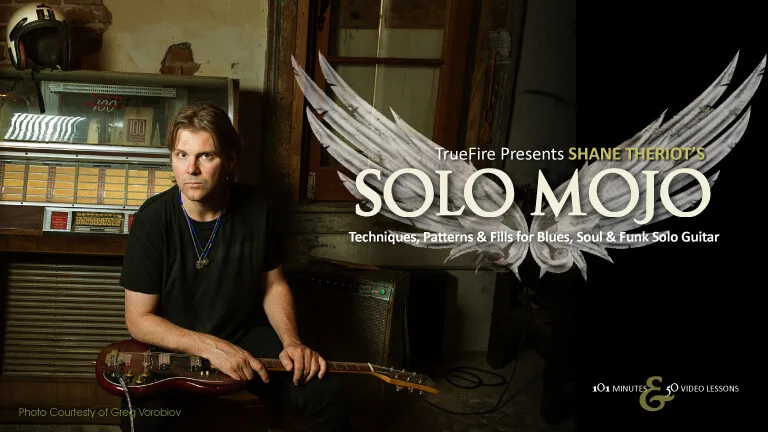
Solo Mojo

Creative Improvisational Approaches For the Versatile Guitarist

Marty FriedmanTommy EmmanuelSteve VaiEric GalesEric Johnson

Get this course and 1,000+ more with All Access

Try 14 days free. Cancel any time.

Solo Mojo

About this course

Shane Theriot is back with more Mojo. Shane's first TrueFire course, Rhythm Mojo revealed an engaging variety of creative and technical approaches for your rhythm playing. This time around with Solo Mojo, Shane focuses on rut-busting, creative soloing approaches, which will surely cure all that ails your solos and improvisations.

Solo Mojo is designed to get you out of ruts and patterns and open up new avenues for your soloing. We'll cover all kinds of topics including how to inject new life into familiar blues scales, re-tooling arpeggio shapes for new sounds, borrowing ideas from saxophone players, chromatic ideas, unison notes, scale bending, melodic minor concepts and much more. By the time you finish Solo Mojo you should be well on your way to becoming a much more confident and competent soloist.

Shane toured with the Neville Brothers for 8 years and has recorded and/or performed with Willie Nelson, Dr. John, Jewel, Beyonce, Rickie Lee Jones, Boz Scaggs, Larry Carlton, LeAnn Rimes, John Waite, Branford Marsalis, Leni Stern, Ben Folds, Amos Lee, Little Feat and Sammy Hagar (to name but a few top artists). He's a 2015 Grammy award winning producer and is currently working as Music Director for Daryl Hall's Live from Daryl's House.

Shane is also a passionate educator who has authored several instructional books, DVDs and columns for virtually every guitar publication on the planet. Fortunately for we students of guitar, Shane is particularly skilled at passing on the knowledge and skills he's developed across his impressive career, in a clear and very accessible manner.

Shane organized Solo Mojo into 6 sections. In the first section, Rut Busters, Shane shares six very effective approaches for stimulating fresh fretboard creativity: Changing It Up: Adding The 6th, Opening Up Old Patterns, Moving Across The Neck, Brecker Pentatonic Pattern, Extended Hybrid Horizontal Arp and Descending Dorian.

In the second section, Bending & Embellishments, Shane covers expressive techniques including Bending Below The Note, Bending The b5, Bending Lower Notes, Scale Bending and a tasty Bend and Descend Lick.

Creative Scale Approaches is the focus of the third section: Knowing Your Scales, Shifting Key Centers, Superimposing Pentatonics, Mighty Melodic Minor, Melodic Minor Application and Double Dipping Arpeggios.

Next up, Chromatic Concepts in the fourth section: Bebop Chord Tone Approach, Half Step Approach, Using Fragments, Descending Chromatic Approach, Stern Fragments and Fast Chromatic Patterns.

In the fifth section, Shane presents four approaches for creating distinctive sounds within your solos: False Fingerings, Brecker Chromatic Unison, The Instant Outside Approach and Rhythmic Displacement.

You’ll learn how to put all of the concepts and approaches, from the previous five sections, to work in a musical context as Shane guides you through five Soloing Performance Studies: Trashy, 1321 Las Palmas, Slow, Pork Tchoup and What's Pho Lunch?.

Shane demonstrates the solos over rhythm tracks and then breaks them down by stepping you through the key concepts, techniques and creative approaches he used to improvise the solo in the performance study.
All of the key demonstrations, performances and examples are tabbed and notated for your practice, reference and study purposes. You’ll also get Guitar Pro files so that you can loop and/or slow any section down as you work through the lessons. Plus, Shane generously includes all of the rhythm tracks for you to work with on your own.

Click now to get your mojo working...
Release date: 07/29/2015 • 1h 41m runtime
Start Course
Sample lessons
SECTION 1: Rut Busters
Overview
Changing It Up: Adding The 6th
Concept 1
Opening Up Old Patterns
Concept 2
Moving Across The Neck
Concept 3

What's included

50 lessons • 23 charts • 15 Jam Tracks

Solo Mojo
Welcome to Solo Mojo! This course is designed to get you out of ruts and patterns and open up new avenues for your soloing. We'll cover all kinds of topics- including injecting new life into those familiar blues scales, "re-tooling" those arpeggio shapes for new sounds, borrowing ideas from saxophone players, chromatic ideas, unison notes, scale bending, melodic minor concepts and much more. By the time you finish Solo Mojo you should be well on your way to becoming a much more confident and competent soloist. So let's get started!
SECTION 1: Rut Busters
Here are a few ideas to get you moving around the fretboard into hopefully some uncharted and unused territory on your axe. These ideas are intended to serve as a springboard for your own ideas.
Changing It Up: Adding The 6th
Let's take a fairly basic pentatonic shape and re-finger it to incorporate the 6th. This will "open up" the sound a bit and break you out of playing the same familiar licks. You could also look at this as a Fmin7 arpeggio, but we replace the b7th with the 6th. This "widens" the sound a bit and you can use this new shape as a launching pad for new phrases.
Opening Up Old Patterns
Let's look at another position of the pentatonic scale and I'll give you a shape that I like to use. Don't worry so much about what this is called, just get the sound and shape under your fingers. This position gives you a lot of options for different chord tone approaches, melodic ideas, etc. Try combining the first shape with this one ascending one and descending the other for more practice.
Moving Across The Neck
Here's a descending idea with the same kind of sound (dominant/mixolydian), but this time I've used a few position shifts. This one is great to get around the fretboard and start connecting chord tones. It moves horizontally across the fretboard and is based over a G7 chord.
Brecker Pentatonic Pattern
Sometimes the same old scale sequences can get stale. I used to transcribe a lot from horn players and practice out of books that were written for other instruments rather than just guitar. Here's a nice pattern that I got from Michael Brecker, the late, great saxophonist. It works over Cmin or sounds great over the relative major Eb as well. Keep in mind when learning these examples that just a few notes from it can be very powerful- you may need only part of this in a real playing situation. Try and keep melody and phrasing in mind at all times.
Extended Hybrid Horizontal Arp
Over the years I've worked out many fingerings and extended patterns to connect the neck. These shapes are not the "stock" arpeggios and they would not be considered a true maj7 or min7 arpeggio in the diatonic sense since I skip a few notes to make the pattern symmetrical. To my ears this keeps the note contour nice and the pattern easy to work with on the guitar. This pattern sounds nice over Gmin or Dmin 7 as well as Fmaj7. I'm going from the lowest possible note. The fingerings are important on these kind of patterns which are reminiscent of Alan Holdsworth or some of the more modern sounding jazz players.

+ 43 more lessons

Start Course

Reviews

14 results

Sam1310

Verified buyer

04/13/21

Great and creative solo concepts.

Shane is a great teacher in creativ New Orleans style funk/blues/soul guitar. Of you already have good theoretical and practical background you’ll realy dig deeper into bis concepts.
David

04/12/21

Inspiring

Truly great presentation from Shane and True Fire. Everything here for me was firmly anchored to real world music...no mindless showoff stuff....just select nuggets of Shane's musicality. Each item sent me off on a tangent of exploration I can honestly say I haven't done in years of pro playing. Top drawer. Top marks

mickstick

Verified buyer

01/04/21

Great stuff! Concise teaching, with a nice original approach to get one out of the dreaded pentatonic rut.

MikeAlan

01/01/21

Finding My Mojo

With Shane Theriot's "Solo Mojo", a couple sayings resonate: "pack a lunch" & "when less is more". Being honest, I do consider the runtime before making a purchase. It, more recorded time, is part of getting the best return on my money. Well, in this case (& many others here at TrueFire), my thinking is completely flawed. Solo Mojo clocks in at a mere 1 hour, 41 minutes. It is the shortest of his courses ((I'd know, I have them all) & is quite brief relative to many TrueFire offerings. Mr. Theriot has compressed so much content into this course, it's keeping me busy for days, searching for my mojo. My playing is a bit redundant to my ears, so it is time well spent as his concepts are invaluable to my soloing, my improvisation.

Ed

12/04/20

Great next level course!

This is an exciting course because it provides not just insights into using theory to add more flavors to your solo playing, but it also brings so many diverse influences. Everything from BeBop to cool Jazz with the skill of an experienced session guitar player. It opens a lot of doors but even better, Shane shows you everything behind the door, all the furnishings, the paintings on the wall, and how to find the hidden rooms within. Fingering techniques you know are suddenly augmented with tricks of the trade. A kind of peek behind the curtain of changing tonal centers, scale alternatives, and extensive vocabularies for traveling the neck. I'm filling my notebook, printing out his charts, and taking my sweet time with this one. It is a goldmine of knowledge and inspiration.

Stop searching. Start improving with All Access.

Try 14 days free. Cancel any time.