A singer takes the stage with you at the country jam, turns to the band, calls out a tune and key, and then shouts out “11 45 62”. The drummer immediately starts to count the band in. Everyone seems to know what’s going on… except you. As the lead guitar player in the band, you’re not only expected to understand that those numbers represent the chord progression for the intro to the tune, you’re also expected to play a killer intro and lead the singer into the tune.
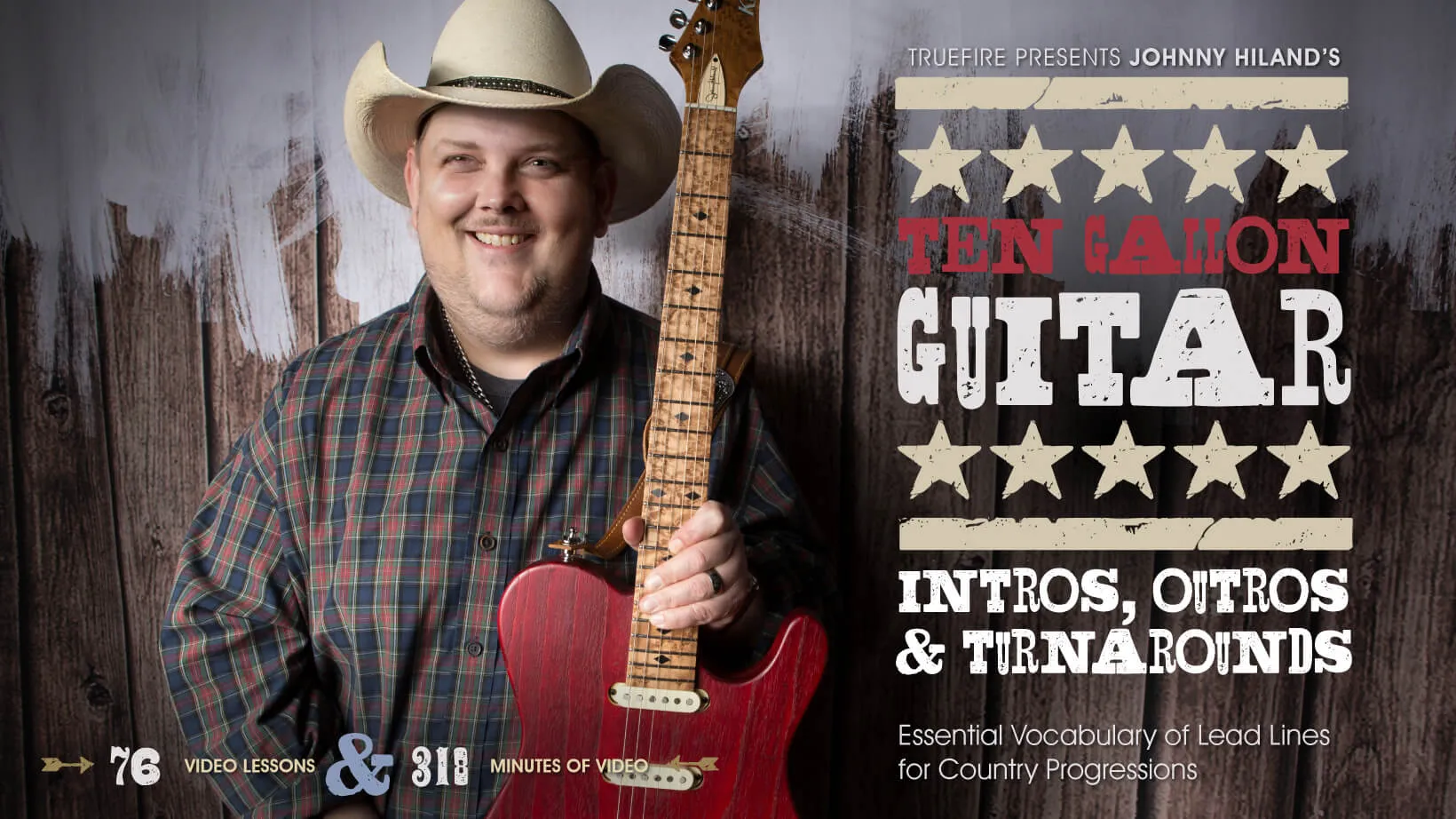
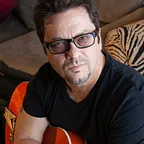
In this Intros Outros & Turnarounds Edition of Ten Gallon Guitar, Johnny Hiland will not only teach you that number system, he’ll also demonstrate some his go-to intros, turnarounds, and outros. Better yet, Johnny will show you how to create your own vocabulary of intros, turnarounds, and outros.
”Say you're the lead guitar player in the honky tonk, and a singer jumps up on the stage, calls out a song that you've never played before, along with a series of numbers. The drummer starts counting the song in. What do you do? As the lead guitar player, you're expected to immediately lead the singer into the song — just rippin' it while you're doing it. In this course, I’ll show you a really simple way to figure out the number system and I’ll also teach you some my favorite intros, outros, and turnarounds.”
You’ll learn intros, turnarounds, and outro parts for 10 live band tracks covering the most common country feels and progressions, in a variety of keys. For each of the 10 performances studies, Johnny will first explain the progression and demonstrate how it relates to the number system and share insight on how he would approach crafting the parts. Johnny will then perform those parts over a backing track and then guide you through a detailed breakdown.
You’ll learn intros, turnarounds, and outros for a working man blues in the key of A, a standard country feel in the key of G, a country shuffle in D, a ballad in the key of C, a bluesy country shuffle, a low down drop D tune, a rockabilly feel in the key of E, a laid-back swingin’ groove in A, a “Neon Moon” type tune in the key of G, and a modern country groove in A.
All of the key examples and performance studies are tabbed and notated for your practice, reference and study purposes. You’ll also get Guitar Pro files so that you can play, loop and/or slow down the tab and notation as you work through the lessons. Plus, Johnny includes all of the backing tracks for you to work with on your own.
Grab your guitar and let’s get our numbers straight and rippin’ with Johnny Hiland!
What you'll learn
Navigate a 'long five' chord progression
Execute fast chromatic double stop runs from the 16th fret down
Use fingernails for double stop picking
Apply slap delay and spring reverb for authentic rockabilly tone
Recover gracefully when running out of time during an intro
Hi everybody, I'm Johnny Hiland, and welcome to the Intros, Outros & Turnarounds edition of Ten Gallon Guitar. Say you're the lead guitar player in the honky tonk, and a singer decides to jump up on the stage who you've never met before, and he decides to pull out a song that you've never played before. You're scared to death, and all of a sudden, the drummer starts calling out all these number to you, and starts counting the song in. What do you do? Well, as the lead guitar player, you're expected to know all the numbers in the progression, and right on the spot, you're expected to lead the song and the singer in with no effort at all - just rippin' it while you're doing it.
In this course, I'm going to show you a real simple way to figure out the Nashville number system, we're going to cover a lot of intros, outros, and turnarounds that I love to use, and I'll also show you how to figure them out on your own with total ease and comfort. Throughout this course, we'll be using ten different jam tracks that I created specifically for this purpose that cover everything from country train beats to Western swing, and yes folks, even "bro country". They'll feature different progressions, feels, and beats. Each performance in the course will be broken down in detail for you, and you'll get standard tab and notation with each one. And, you can slow down and loop each section as you need. Before we get started, I'd like to send a special thank you out to Kyle Jones, Dallan Beck, and Jim Lightman for their hard work in assisting me in getting the band tracks prepared for this course. So, grab your guitar and let's get to pickin'!
Before we dig in to the meat of this course, the first thing I'd like to do is tell you about things that you need to know in dealing with intros, turnarounds, and outros. The first thing is that jamming in your woodshed is fine, but when you get in a band context, the first thing you need to do is getting to know your drummer. Most people will say, "It's really important for the bass player and drummer to have a great camaraderie," which is true, and also that the singer and guitar player have to have great camaraderie as well, because the singer lays out the melody of the song, and our job is to accentuate it. But, the most important thing that you can do as a musician is to get to know your drummer and learn how they count.
For example, when I first moved to Nashville, I didn't realize that people would jump on stage anytime they wanted to and sing a song that I've never heard of. So, I had no idea how to jump into the intro of a song without knowing the drummer's count off. That really got me in a bunch of trouble, so I want to save you and teach you how to learn drummer counts. So, again: Get to know your drummer, and learn how he counts.
The second thing that's really important is that you need to know the number system enough to know the layout of the song. For example, the layout of the song could be an "11-44-55-11". Well, what do I mean by that? It really bases itself off the major scale of whatever key the song is in. If the song is in the key of E, then you would base everything off the E major scale. Your 1 chord would be an E, your 4 chord would be an A, and your 5 chord would be a B. We'll walk through how to find these notes using the major scale in the video, as well as a way to play them that will help you remember these notes.
Well now that we've learned those patterns, let's get back to learning how to form an intro of a song or a turnaround. Essentially, when I say "11-44-55-11", what does that mean? The 11 stands for two bars of 1. What's a bar? It's essentially four beats. That means we have eight beats of 1. Now I actually like to think of it in bars, since beats go by quickly, but by all means if it's easier for you, you can count by beats when you practice. Next, we go to the 4 - which is a "44", meaning that there's two bars of 4. Then we go to the 5, which is a B chord, and play two bars of that as well, then go back to the E chord (1 chord).
So you see how this counting thing really works well, and yeah, you don't want to spend the whole gig counting like that, but after a few gigs you'll get pretty comfortable with how the intro goes. But again, when someone jumps on the stage and start playing a song you haven't heard, and the drummer throws numbers at you like that, you need to know how to form them.
We'll get things started with a working man blues feeling track in the key of A. Now if you picture yourself on stage and you're looking back at the drummer to figure out what y'all are going to play, he'll probably look back at you and say, "Hey man, it's just four bars of 1, I'm going to give you a four count." Now, that doesn't really say if you have pickup notes or not, or if you should play pickup notes, or how you would even do it. When the drummer goes 1, 2, 3, 4...then you need to be playing your pickup notes on 3. But, 9 times out of 10 on a working man blues feel, I just wait for that 1 to hit and just floor it.
So, when you're playing four bars of 1, your blood will start to boil because this groove is really uptempo, and you'll get to do some really fun stuff. But, only four bars of 1 doesn't give you a whole lot of time to blow a bunch of licks. So, really what I think about doing in the intro of a working man blues is to start out on the root and swing from low to high. We're going to land on our feet on the root so the singer can bring himself in.
The difference of what I hear in the intro versus what I do in the turnaround and the outro, is that the intro is basically giving a pathway for the vocalist to actually get in to the song. But then again, with a working man blues kind of feel, you're actually raising the excitement level of the crowd because you're playing something that's uptempo. So, you want to play a signature lick, and then rip a chicken pickin' lick or something to bring the singer in. And of course, when the turnaround comes, most times you can make it solo-ish as long as it fits the song, and for the outro, if I go in from a lower register to a higher register for the intro, I might take it from a higher register to a lower register to finish it off. I always love to end on either the chord that the song is in or somewhere close. Let's get started!
Here's an intro lick to be used when you're playing a working man blues feel in A. The goal here is to play something that can bring the singer in and land on our feet on the root.
This first track is a working man blues style rhythm, which is essentially 4 bars of 1. It seems weird that a song would just start with a 1 chord, but that happens quite regularly in country music. This means we have sixteen beats to work over, so I tend to break them up into two sections. I'll lead into the song with something simple, and of course, bending the strings and getting a really twangy sound really works. In the video lesson, I'll show you how to play this intro part including all the techniques needed to pull it off. Let's check it out.
A brilliant course. Despite the title, there are tons of licks to steal ( and steel ) that can be put into any solo. There’s a whole range of player ability levels represented in all examples.
The format layout makes each example a comfortable length. Not too long ( like a whole solo study ) and not too short ( like just a bunch of unrelated licks ) . The techniques and explanations are kept at a nice surface level but go much deeper once you apply new concepts to different keys and parts of the fretboard.
Johnny Hi-Lo is a legend and an exceptional teacher.
Load yer geetar, we’re going to the wild country !
G
grayham
Verified buyer
10/16/21
Excellent guitarist explains things very well a bit too advanced for me but wotth having just to see how good you could get
J
jotka53
Verified buyer
10/03/21
One of the best learning dvd's
K
kirbywatson
Verified buyer
09/14/21
Ten Gallon Guitar: Intros, Outros & Turnarounds
Five stars for this course! Easy to follow teacher and some great ideas in several keys in this course. I especially appreciated the instruction on how to form intros and outros and look forward to incorporating some of them into my playing.
T
TheWolf2103
Verified buyer
09/07/21
Ten Gallon Guitar Intros Outros and Turnarounds
Although I am not your typical Country player (mainly Jazz influenced Blues and Latin) I love Country guitar playing and Johnny is a true inspiration.
This course is fantastic - nicely structured in sections of the various Country styles - and Johnny has a brilliant way of explaining some of the very challenging techniques which are straightforward to understand, logical and FUN.
Because of this the course is therefore recommended for the Advanced as well as the starter/intermediate of Country guitar playing - though a good understanding of basic guitar techniques and fretboard knowledge is needed.
I found a few places where the transcriptions seemed to be not quite right but with the excellent camera guidance you can easily figure out what is going on.
Overall and together with his other Truefire courses a highly recommended course if you are interested in Country guitar playing techniques.