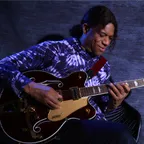
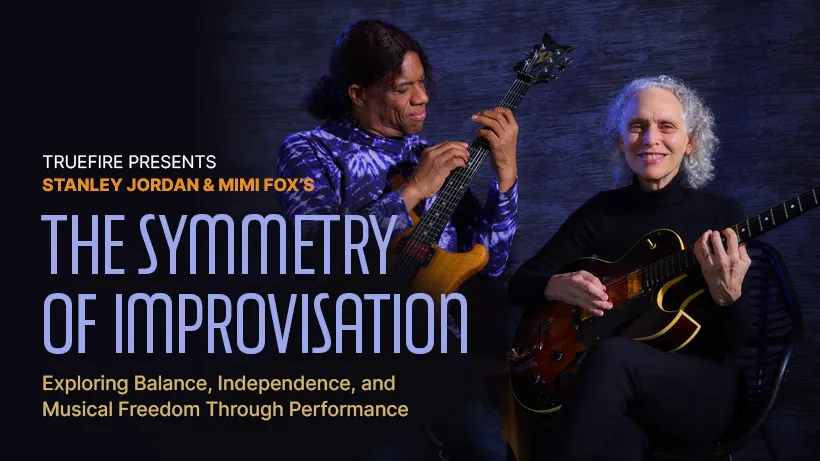
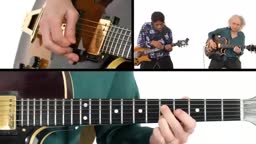
Stanley Jordan and Mimi Fox join forces in The Symmetry of Improvisation, one of TrueFire’s most distinctive jazz guitar courses, exploring improvisation not as a solo act, but as a living dialogue between musicians, instrument, and music itself.
"Improvisation isn't something you have to do alone. It's something that happens in relationship with the music, with the instrument, and with the people you're playing with."
This step-by-step guitar course opens with original performance etudes played together, designed to highlight balance, independence, and real-time interaction. Each performance becomes a study in listening, decision-making, and musical coexistence. Stanley and Mimi then unpack every piece, revealing the harmonic choices, hand interaction, and how touch, timing, and awareness shape the direction of a performance.
You’ll also explore the foundational concepts behind this kind of playing, including polyphonic thinking, two-hand independence, and improvising with multiple voices in mind. Just as importantly, you’ll see how two musicians respond to each other creatively, using contrast, symmetry, and shared awareness to open up new musical possibilities.
You’ll have all of TrueFire’s advanced learning tools at your finger tips to personalize your workspace and learn at your own pace.
You can loop, slow down, or speed up any section of a lesson. Plus, all of the tab and notation is synced to the videos for the optimal learning experience. You’ll also get tab and standard notation files to print out and Guitar Pro files as well.
Grab your guitar, and let’s explore The Symmetry of Improvisation with Stanley Jordan and Mimi Fox!
Hi Stanley Jordan And Mimi Fox here! Improvisation isn’t something you have to do alone. It’s something that happens in relationship with the music, with the instrument, and with the people you’re playing with. In this course, we explore improvisation through real musical conversations. We start with original performance etudes played together, designed to highlight balance, independence, and interaction in real time. Each performance becomes a study, not just of technique, but of listening, decision-making, and how multiple ideas can exist at once. Right after each performance, we unpack what actually happened, the choices behind the harmony, how the hands interact, and how touch, timing, and awareness shape the direction of the music. We also step back from the performances to explore the ideas that make this kind of playing possible, including polyphonic thinking, two-hand independence, and improvising with more than one voice in mind. And just as importantly, how two musicians respond to each other creatively, how contrast, symmetry, and shared awareness open up new possibilities. This isn’t about memorizing patterns or copying a style. It’s about developing a deeper musical awareness, learning how to listen more closely, how to balance freedom and structure, and how to let improvisation feel both intentional and alive. So grab your guitar, and let’s get started.
In this lesson we will learn about Stanley’s fourths tuning and how it opens up symmetry, voicings, and two-hand possibilities on the guitar.
In this lesson we will go over the basic idea behind this improvisation and how we use the scale as a springboard for musical conversation.
In this lesson we will hear the full duo performance and listen for how the two guitars interact in real time.
In this lesson we will focus on Stanley’s part and how he uses touch, symmetry, and independent hands inside the improvisation.
In this lesson we will focus on Mimi’s part and how she shapes the melody, rhythm, and phrasing inside the improvisation.
In this lesson we will break down the improvisation and talk about listening, space, symmetry, and responding in the moment.