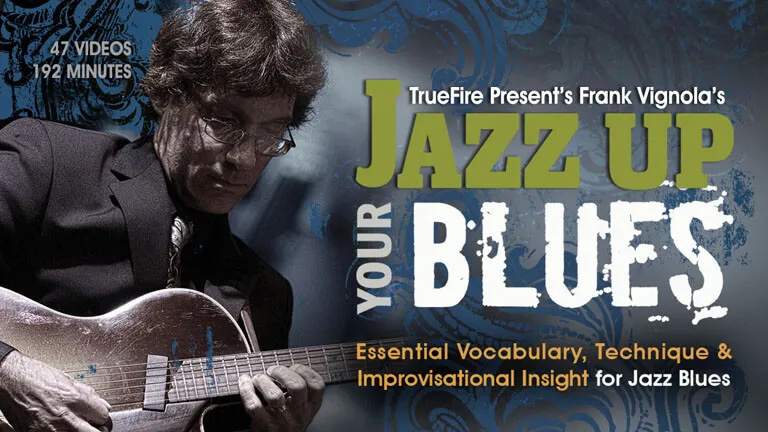
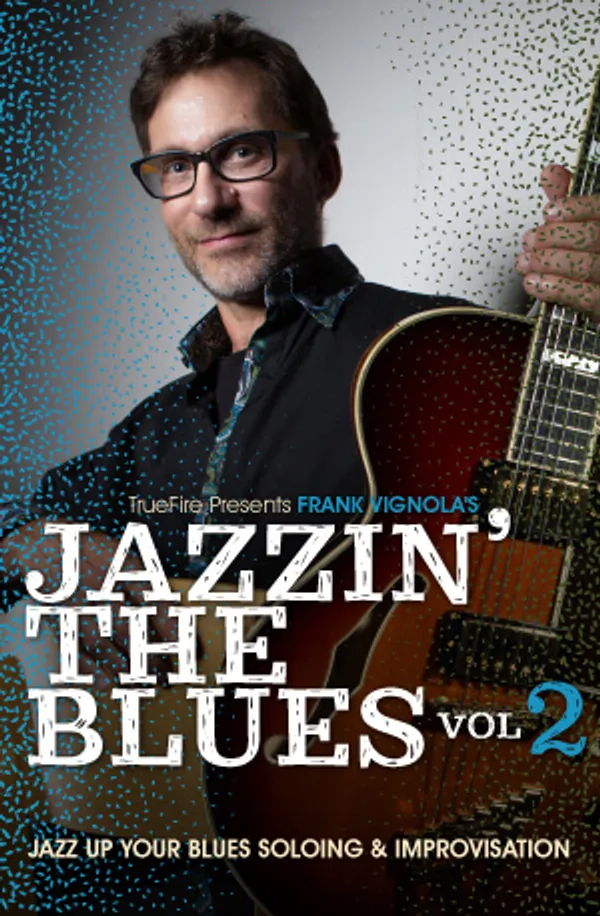
Jazzers, rockers, bluesmen, twangers, funksters, metal heads and polka players take note - this highly addictive new set of jazz blues guitar lessons from monster of the six-string, Frank Vignola, will inject such massive degrees of soul and groove into your improvisations that you'll likely not be able to put your instrument down for weeks on end. So, skip the following description, download the course immediately and bid your family and friends a loving fare thee well. You're gonna be happily busy for a while.
Still here? Fair enough. Here's more scoop and a little genealogy to mull over...
If you play any style of contemporary music from this century, the blues is genetically tied to it in one way or another be it progressions, scales, phrasing or just plain groove. We all share the same 12 notes in western music but there's something extraordinary about the way a great blues solo grabs your attention, turns your head and gets your feet moving. It's a primal thing.
When most of us were just coming up, we copped blues lines from our heroes of the Classic Rock era who in turn copped their lines from the crop of "authentic" blues giants like T-Bone, all of the Kings, Muddy, Bo Diddley, Lightnin' and dozens of other giants of the genre. For players, this form was relatively easy to learn with its basic I-IV-V progressions and rather limited vocabulary of phrases and techniques. Thus its popularity amongst young guitar players.
Meanwhile, another strain of the blues had its very own happening thing going on; Jump, West Coast and Jazz blues all of which stemmed from the jazz form. As you might guess from its title, Vignola's Jazz Up Your Blues pays homage to the latter.
Wes Montgomery, Kenny Burrell and George Benson are just three of many killer players who were blowing minds with jazzed up pentatonic lines back when most of us were just sparkles in our parents eyes. Similar to most jazz forms, this style is more sophisticated and thus more challenging to get a solid grip on but easily worth every minute in the shed getting there.
Frank's Jazz Up Your Blues will indeed get you there, and get you there fast. Plus, you'll have a ton of fun following Vignola's format for the course. No tedious theory to assimilate. No exercises to master. As with most of Frank Vignola's guitar lessons, you will play your way through the course and start blowing jazzed blues lines right from the very first lesson.
For those of you just returning from the Jupiter expedition, Frank is one of the most accomplished, multi-dimensional players walking the planet today. Monster player, composer and improviser, Frank plays proficiently in every genre, from jazz to bluegrass to acid rock and everything in between. Longtime protégé of Les Paul, Frank's played with everyone and his brother and has a pedigree a mile long. A quick Google will yield 71,300 other reasons why you might want to apprentice under Vignola.
"I've been blessed to have studied with so many great players over the years who taught me the ins and outs of playing the blues. Learning the blues is an essential foundation for becoming a great improviser in any style of music. I've wanted to do a jazzed blues course for a long time now to pay it all forward. Jazz Up Your Blues boils down the essence of what I've learned and I wanted to present the course in a dynamic and interactive fashion to get students up and running quickly. Once you get a jazzed blues line or two under your belt, you'll develop an insatiable appetite for this type of groove. You'll also start twisting and turning those lines into all of the styles you play."
Jazz Up Your Blues is comprised of 14 lesson sets where Frank first performs a solo over a practice rhythm track. Vignola deliberately constructed each solo to showcase essential jazz blues vocabulary and techniques. Frank then breaks it all down, move-by-move. You then work with the video, tab and notation to get it under your grip, and then perform it yourself over the track. The 14th lesson set features multi-chorus demonstrations of both comping and soloing, with emphasis on interacting with other band members when in an improvisational context (this set's worth the price of admission alone).
Jazz Up Your Blues Curriculum
1. Ode to Eric: Overview, performance, breakdown and playalong. 2. Funky Flourish: Overview, performance, breakdown and playalong. 3. Flat Nine Blues: Overview, performance, breakdown and playalong. 4. Fligaduh Blues: Overview, performance, breakdown and playalong. 5. Stutter Blues: Overview, performance, breakdown and playalong. 6. A Touch of Bop: Overview, performance, breakdown and playalong. 7. Sixth Sense: Overview, performance, breakdown and playalong. 8. Chord World: Overview, performance, breakdown and playalong. 9. Bad B's Blues: Overview, performance, breakdown and playalong. 10. Three Riff Blues: Overview, performance, breakdown and playalong. 11. Fast Track Blues: Overview, performance, breakdown and playalong. 12. Wes' Blues: Overview, performance, breakdown and playalong. 13. Tremolo Blues: Overview, performance, breakdown and playalong. 14. Comping & Soloing Series - Interacting with the band - Comping Example 1 - Soloing Example 1 - Soloing Example 2 - Comping Example 2 - Comping Example 3 - Soloing Example 3
Hands down, Jazz Up Your Blues is one of TrueFire's most engaging courses with as much sizzle as there is steak. If you've always wanted to nail this style of the blues, Frank gives you the hammer to do it with. Even if blues or jazz isn't your bag, the Jazz Up Your Blues guitar lessons will maximize your groove and help keep it there for years to come.
What you'll learn
Apply diminished scales and arpeggios to blues progressions
Learn to use target tones and chromatic approaches in blues context
Learn sophisticated rhythm guitar accompaniment
Understand the interactive relationship between soloist and accompanist
g or just plain groove. We all share the same 12 notes in western music but there's something extraordinary about the way a great blues solo grabs your attention, turns your head and gets your feet moving. It's a primal thing.
When most of us were just coming up, we copped blues lines from our heroes of the Classic Rock era who in turn copped their lines from the crop of "authentic" blues giants like T-Bone, all of the Kings, Muddy, Bo Diddley, Lightnin' and dozens of other giants of the genre. For players, this form was relatively easy to learn with it's basic I-IV-V progressions and rather limited vocabulary of phrases and techniques. Thus its popularity amongst young guitar players.
Meanwhile, another strain of the blues had its very own happening thing going on; Jump, West Coast and Jazz blues all of which stemmed from the Jazz form. As you might guess from its title, Vignola's Jazz Up Your Blues pays homage to the latter.
Wes Montgomery, Kenny Burrell and George Benson are just three of many killer players who were blowing minds with jazzed up pentatonic lines back when most of us were just sparkles in our parents eyes. Similar to most jazz forms, this style is more sophisticated and thus more challenging to get a solid grip on but easily worth every minute in the shed getting there.
Frank's Jazz Up Your Blues will indeed get you there, and get you there fast. Plus, you'll have a ton of fun following Vignola's format for the course. No tedious theory to assimilate. No exercises to master. As with most of Frank's courses, you will play your way through the course and start blowing jazzed blues lines right from the very first lesson.
For those of you just returning from the Jupiter expedition, Frank is one of the most accomplished, multi-dimensional players walking the planet today. Monster player, composer and improviser, Frank plays proficiently in every genre, from jazz to bluegrass to acid rock and everything in between. Longtime protégé of Les Paul, Frank's played with everyone and his brother and has a pedigree a mile long. A quick Google will yield 71,300 other reasons why you might want to apprentice under Vignola.
"I've been blessed to have studied with so many great players over the years who taught me the ins and outs of playing the blues. Learning the blues is an essential foundation for becoming a great improviser in any style of music. I’ve wanted to do a jazzed blues course for a long time now to pay it all forward. Jazz Up Your Blues boils down the essence of what I've learned and I wanted to present the course in a dynamic and interactive fashion to get students up and running quickly. Once you get a jazzed blues line or two under your belt, you'll develop an insatiable appetite for this type of groove. You'll also start twisting and turning those lines into all of the styles you play."
Jazz Up Your Blues is comprised of 14 lesson sets where Frank first performs a solo over a practice rhythm track. Vignola deliberately constructed each solo to showcase essential jazz blues vocabulary and techniques. Frank then breaks it all down, move-by-move. You then work with the video, tab and notation to get it under your grip, and then perform it yourself over the track. The 14th lesson set features multi-chorus demonstrations of both comping and soloing, with emphasis on interacting with other band members when in an improvisational context (this set's worth the price of admission alone).
Hands down, Jazz Up Your Blues is one of TrueFire's most engaging courses with as much sizzle as there is steak. If you've always wanted to nail this style of the blues, Frank gives you the hammer to do it with. Even if blues or jazz isn't your bag, Jazz Up Your Blues will maximize your groove and help keep it there for years to come.
This tune was inspired by a simple blues lick that comes from an Eric Clapton tune. It's amazing how one lick or musical line can sound so different over each chord change. It is also important that you are aware why it sounds the way it does by noticing which chord tones of each chord you are accenting. But even with all the theory aside you can have fun experimenting and changing up the lick to "make it your own". Consider the possibilities, get creative and have fun!
This tune was inspired by a simple blues lick that comes from an Eric Clapton tune. It's amazing how one lick or musical line can sound so different over each chord change. It is also important that you are aware why it sounds the way it does by noticing which chord tones of each chord you are accenting. But even with all the theory aside you can have fun experimenting and changing up the lick to "make it your own". Consider the possibilities, get creative and have fun!
We start by going over the chords. Remember that these are my choices for substitutions. You can choose your own substitutions. We then go over the melody starting with the main lick. Notice how the chord tones change when the chords change. It is a great practice to play the same lick over the different chords. As you see the chord tones change but the pentatonic scale stays the same creating tension and release and a very cool sound. Also take note of the neat little bend at the end of the solo. We use the chromatic scale to get from the sharp 9 to the root of the one chord. Use expression. Bends, vibrato and dynamics. You can use different notes with the same rhythm pattern to expand on this great lick. This is the way to create your own solos. Use the same riff moving the riff up chromatically with a pre determined ending note to finish your phrase.
You're jamming along playing your bluesy licks and want to add a little something to spice things up. Try adding a "flourish". A flourish is a fast musical idea that leads to a new chord change or new melodic idea. This tune has some great flourish ideas but don't stop there! As long as you have a starting and an end note you can develop your own flourishes. Don't forget to keep the expression in your playing.
A flourish is a fast musical idea that leads to a new chord change or new melodic idea. This tune has some great flourish ideas but don't stop there! As long as you have a starting and an end note you can develop your own flourishes. Don't forget to keep the expression in your playing.
Again we start by going over the chords. An important step every time. You must know the chords. We start with the sharp 9 and go down the pentatonic scale. Then we add the flourish. Practice this flourish idea slowly. Don't forget we have our target ending tone. Then a pull off. Pull offs are a great way to spice up your solos. On the E7 chord we use neighboring tones playing a note above and below the chord tones before playing the chord tone. Great Joe Pass style lick. Pentatonic is used over the Am7-D7 chords. Creates great tension before ending on the G chord.
Very informative.Professionally presented by Frank V!
R
Rycood
Verified buyer
05/24/20
Exactly the course I was looking for.
Great grooves here, covering many techniques and styles drawn from influential jazz/blues players. Great rhythm and lead content to help move away from tired progressions and the limitations of minor pentatonic scales. Frank is an amazing player with a wealth of knowledge and is one of the most effective instructors here.
B
boogie50
05/11/20
Better than fun in the sun.
Frank Vignola does a really nice job helping players take their blues playing skills to the next level. Frank has studied with some of the best, and now he imparts some of his great knowledge to us. This course will really help the intermediate player and will help anyone add great sounding lines to their playing vocabulary.
B
Bluesheavy15
12/22/19
Excellent Course for those trying to expand on the 12 Bar Blues
This course is certainly not for those you do not have the 12 bars blues down to a science. It would also help to know all the notes on the fretboard as well as the Major and Minor scales and the notes that make up the scale. Obviously knowing your pentatonic and blues scales is also important. This course takes you right into a blues progression using the jazz changes in a blues setting. Meaning using ii,V,I turnarounds and Diminished chords. In jazz you are not resting on chords for four measures so the chords as well as your solo needs to move. This course will explore these chord concepts while adding textures over these expanded and substituted chords. It still holds true to the blues roots so it’s not in-depth jazz or jazz fusion; however if you take these concepts in regards to soloing over a standard 12 bar blues you will have a fusion sounding blues. I took this course as I was looking for ways to color my sound with- in a standard 12 bar blues so a I,IV,V with out substitutes chords, diminished or ii,V,I turnarounds. Instead I would add these embellishments within the solo. The timing is critical and this course helped me to understand the timing as well as concepts to use in bridging these notes while not looking as if I’m changing scales with each note.