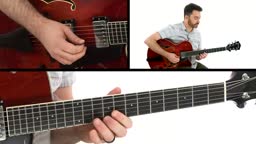
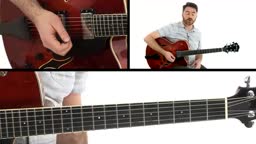
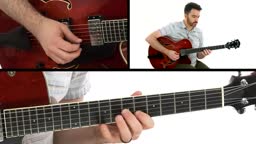
Bebop Blues, with its fast tempos, 12-bar structures, superimposed chords, and sophisticated improvisations, became a defining force in jazz during the 1940s. Embraced by guitarists like Charlie Christian, Wes Montgomery, and Barney Kessel, Bebop Blues became the vital dialect in the jazz language we know today. Mastering Bebop Blues is essential for any jazz guitarist; it builds the fundamental skills needed for improvisation, timing, and harmonic comprehension in the broader jazz idiom.
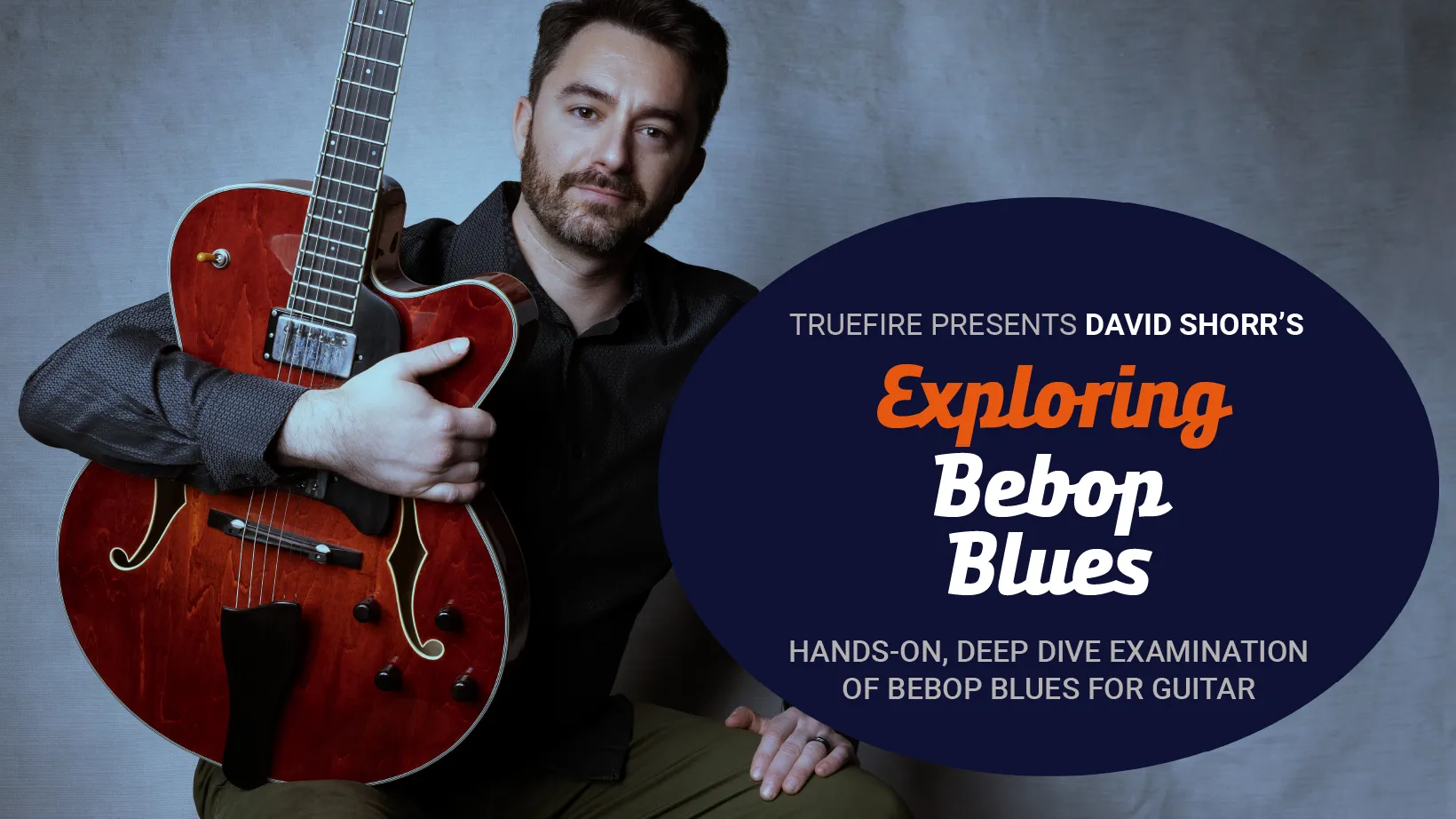
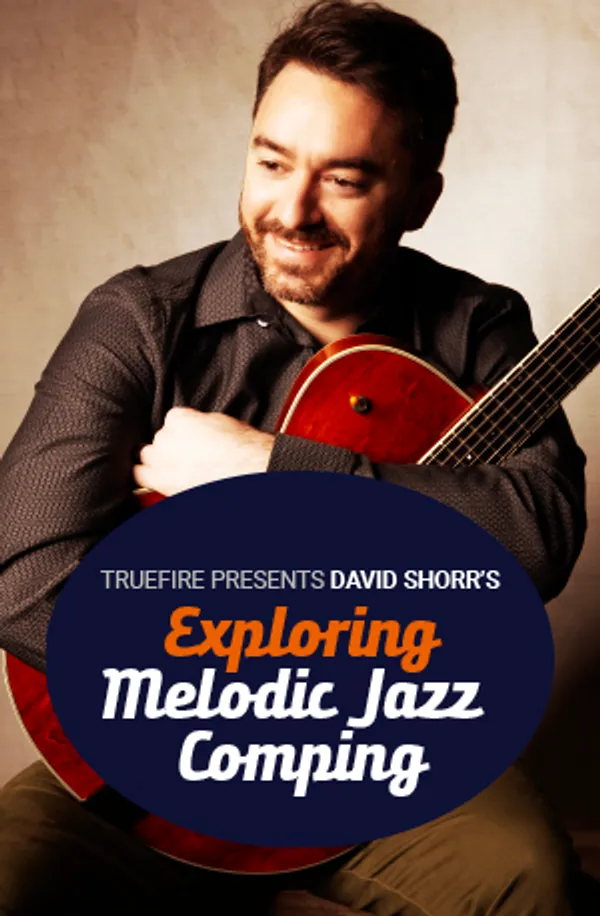
David Shorr’s ‘Exploring Bebop Blues’ focuses on the expressive language of Bebop Blues with a comprehensive, hands-on curriculum, including over 20 key concepts, harmonic approaches, and melodic devices that comprise the Bebop Blues language.
”I’ll explain and demonstrate an essential vocabulary of harmonic and melodic techniques and creative concepts. We’ll apply each over backing tracks for musical context. Using TrueFire’s learning tools, we’ll practice and play through ten etudes exploring different approaches for playing over commonly encountered bebop blues feels, tempos, and changes.
We’ll start with a typical jazz blues progression and work our way up to applying more expressive approaches for playing over more sophisticated changes like Bird Blues. As you play through all ten etudes, you’ll learn many essential and characteristic melodic lines and how to approach bebop’s many rhythmic complexities.”
KEY CONCEPTS INCLUDE: Playing Rhythmically Correct & Nailing Changes | Simplifying the Scale-Based Approach | Landing Notes of the Chord on the Beat | Follow the Scale Structure Exercise | Inversion Variations & Voice Leading | Linking Arpeggios with Scale Runs to Resolve | Using Diatonic Enclosures | Simplifying the Cycle Into Scales | Exploring Fingering & Position Options | Variations to Enhance Voice Leading | Fingering, Shifting & Position Options | Voice Leading for Harmonic Pathways | Extra Half Steps to Link & Resolve Lines | FIngers & Technical Considerations | Jazz Chromaticism: Borrowed Notes | Jazz Chromaticism: The Bebop Dom Scale | Jazz Chromaticism: The Barry Harris Concept | Jazz Chromaticism: Ways to Practice | Alternate Cycles | The Bird Blues.
You’ll have TrueFire’s interactive learning tools at your fingertips to customize your workspace and learn at your own pace.
The demonstrations and performances are tabbed, notated, and synced to the video lessons with controls for looping, slow motion, fretboard animation, and other tools designed to accelerate your progress.
You’ll also get the tab and standard notation files to print out, downloadable Guitar Pro files to edit, and backing tracks to practice and record with.
Grab your guitar, and let’s dig in with David Shorr!
What you'll learn
Apply nine different scales over a Bird Blues progression
Navigate diatonic harmony over blues progressions
Apply voice leading principles to melodic construction
Connect major scale knowledge to jazz improvisation
Hey there, I'm David Shorr. Exploring Bebop Blues focuses on the expressive language of bebop blues and how to apply a variety of creative, sophisticated approaches when soloing over bebop blues changes. We'll play and practice together over 10 bebop blues etudes. You'll learn many essential characteristic melodic lines and how to approach bebop's many rhythmic complexities. Each etude explores different approaches for playing over commonly encountered bebop blues feels, tempos, and changes. The course includes tab sync, notation, looping controls, and fretboard animations, so you can practice and learn at your own pace. If you're ready, grab your guitar, and let's get started.
Before we get into this course, there are a couple of things you should know. I'll take you through various scales and concepts for soloing over bebop blues, as well as an alternate cycle for the blues. If this is your first exposure to this style, it's important to be familiar with basic chord shapes, like shell voicings, which I'll briefly cover. A shell voicing is the minimum chordal information needed to play a 7th chord. On the guitar, that's the root, 7th, and 3rd. Off the E string, you get a shell chord for dominant, major, and minor chords. Off the A string, it's a similar structure for dominant, major, and minor. I'll also talk about extensions, like chords with a flat 9th or flat 13th. You should understand these extensions and how they relate to the central harmony of a chord. If you know how to play major scale patterns on the guitar neck, that'll be helpful, though not strictly necessary for this course.
In this section, we'll explore a scale-based approach to playing over the bebop blues. The core changes resemble a standard blues progression (I, IV, V), but with added elements like diminished chords and ii-V-I turnarounds. We start with B flat 7 to E flat, then move to a diminished chord before returning to B flat. We'll incorporate shell voicings and use simple one-octave scale shapes to ensure our lines accurately reflect the harmony. By focusing on nailing the right notes on the right beats, we'll capture the essence of bebop, making our lines fit seamlessly with the chord changes.
In this section, we'll explore a scale-based approach to playing over the bebop blues. The core changes resemble a standard blues progression (I, IV, V), but with added elements like diminished chords and ii-V-I turnarounds. We start with B flat 7 to E flat, then move to a diminished chord before returning to B flat. We'll incorporate shell voicings and use simple one-octave scale shapes to ensure our lines accurately reflect the harmony. By focusing on nailing the right notes on the right beats, we'll capture the essence of bebop, making our lines fit seamlessly with the chord changes.
In jazz blues, we introduce more changes than in standard blues, though the basic structure remains similar. In the key of B flat, we move from Bb7 to Eb7, incorporating diminished chords and ii-V progressions (F minor to Bb) to add harmonic depth. A common challenge for players new to jazz blues is the use of the 3-6 dominant 7 chords, which function within the key to create smooth transitions. The goal is to play solos that reflect these changes even without accompaniment, by placing chord tones (Bb, D, F, Ab) on strong beats (1 and 3) for rhythmic accuracy. This lesson will teach a scale-based approach, emphasizing how to effectively nail changes and make your lines sound harmonically solid, focusing on getting the right notes to land on the right beats.
When learning to play jazz, it's common to overthink chord scales, but a simplified approach works best. For jazz blues, we only need three scales: Bb7 (Eb major), Eb7 (Ab major), and F7 (Bb major). Knowing these scales in one octave is enough, as most jazz improvisation occurs within a single octave. Instead of focusing on each chord change, we focus on the overall movement of the chords, ensuring our lines land rhythmically on the right beats, especially strong beats like 1 and 3. This approach also simplifies tricky sections like the turnaround, reducing the need to play multiple scales over fast changes. By stripping down unnecessary scales and focusing on rhythmic accuracy, we can create more intuitive, horn-like lines while keeping the music grounded in the harmony.
In bebop jazz, it's essential to make chord tones land correctly on the beat to create authentic-sounding lines over the blues. Focusing on the core tones of a Bb7 chord—root, third, fifth, and flat seventh—without extensions simplifies the approach and ensures accuracy in outlining the harmony. For example, playing a Bb7 scale up to the seventh with eighth notes places the third on beat two, the fifth on beat three, and the flat seventh on beat four, clearly spelling out the chord. While not every line should follow this strict method, practicing it in various positions on the guitar helps solidify the connection between scales and chord tones across the fretboard.
Very clear explanation, very helpful for a novice bebop player
B
Bruno78
02/09/26
Bebop blues revealed
This is the ideal course if you want to add some bebop to your blues.
It's progressive, very clear, David Shorr takes the time to explain things to you and makes the approach to the style much less intimidating. Great course .
C
Carl
Verified buyer
11/29/25
Bebop Demystified
David takes his time to explain what is often times a very intimidating style of music, especially when played at fast tempos. I am looking forward to digging my heels further into this course. Bought his second course as well!