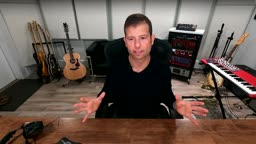
Join Vince DiPasquale, multi-platinum music producer, engineer, and co-founder of FaderPro, as he guides you on a deep dive into the science of equalization.
"In this course, we'll cover everything about equalizers and how to use them. We’ll start by discussing frequencies, the frequency spectrum, and how we hear sounds. We'll cover all the different types of EQs and the various parameters that you need to be aware of with each one of them
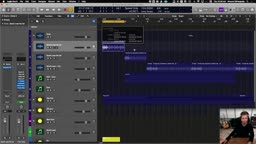
In the last section, we'll work on an actual project and look at examples of the types of EQ by going track-by-track. I’ll give you tips and techniques for how you might approach various situations with different types of sounds while working on your own music productions.
In addition to the various types of EQ and their parameters, we’ll also look at some software emulations of classic EQ hardware that are readily available to anyone on any budget.
Anyone at any level can get a lot out of this course. If you're more of a beginner or intermediate-level producer, this course is a deep dive into equalizers and will help shape and control your tracks, resulting in a more polished overall sound.
If you've been making music for a long time and are more of an advanced producer, this course will help fill in any gaps, reinforcing your knowledge and giving you new skills to apply, especially when it comes to some of the software emulations that we'll be looking at.
There's definitely a repeatable workflow when it comes to using equalizers to process the sounds in any project, and that's the workflow I will give you throughout this course."
Vince has worked with many incredible musicians, including Madonna, Nelly Furtado, Justin Timberlake, Mariah Carey, Missy Elliott, and Timbaland. He has released projects on major and independent labels, including Atlantic Records, Sony Music, Universal, Island Def Jam, Toolroom, and Subliminal.
Under the name Rebirth, his remix of Madonna’s smash hit “4 Minutes” (feat. Justin Timberlake) reached #1 on Billboard’s Hot Dance/Club Play chart. The single went on to earn double-platinum status. Vince has a deep history in electronic music, crafting many remixes and engineering some of dance music's biggest hits, including Lee Cabrera's "Shake It (Move a Little Closer).”
This course is part of the Science of Sound series, which goes deeper into important music production topics that you'll use repeatedly in your projects. Understanding the fundamentals behind concepts like delay, reverb, equalization, compression, and how we, as engineers and listeners, perceive sound will allow you to approach your productions with greater confidence, purpose, and know-how.
No Ph.D. is needed; our awesome educators explain the science-y parts in a way anyone can understand!
What you'll learn
Identify when to use transparent vs. colored EQ plugins
Understand a professional mixing workflow from individual tracks to master bus
Understand the science of sound, frequencies, and human perception of audio
Develop a systematic approach to EQ decisions in the mixing process
Develop ability to diagnose mix problems and determine where to apply fixes
Hi, I'm Vince DiPasquale, and I invite you to check out my new course on FaderPro. In this course, we'll delve into everything about equalizers and their usage. We'll begin by discussing frequencies, the frequency spectrum, and our perception of sounds. We'll explore various types of EQs and the essential parameters associated with each. Then, in the final section, we'll apply our knowledge to a real project. Here, we'll examine different EQs track by track, offering tips and techniques for handling diverse scenarios. You'll learn to navigate different sound types in your music productions. Besides the various EQ types and their parameters, we'll also examine software emulations of classic EQ hardware, accessible to anyone, regardless of budget. This course is beneficial for all skill levels. If you're a beginner or intermediate-level producer, it offers an in-depth understanding of equalizers, enhancing your ability to shape and control tracks for a more polished sound. Advanced producers will find value too, as the course reinforces existing knowledge and introduces new skills, particularly in software emulations. We'll focus on a repeatable workflow using equalizers to process sounds in any project, and I aim to share this effective workflow throughout the course.
This lesson series will explore the science of sound, various types of EQs, and their practical application in music production. We'll focus on building a strong foundational understanding applicable across different DAWs, and delve into both classic and modern EQ techniques to enhance your music production skills.
In this lesson we will explore the basics of EQ, focusing on the fundamentals of sound properties, specifically amplitude and frequency. We'll look at how sound travels and the science behind it, laying the groundwork for practical applications of EQ in music production.
In this lesson we will explore the audio spectrum, detailing the characteristics of different frequency ranges and how they impact the sound in music. We'll learn about the six frequency 'buckets', how certain ranges can negatively affect a mix, and the typical instruments associated with each frequency range. Understanding this spectrum is vital for effectively applying EQ techniques in music production.
In this lesson we will explore the audio spectrum, detailing the characteristics of different frequency ranges and how they impact the sound in music. We'll learn about the six frequency 'buckets', how certain ranges can negatively affect a mix, and the typical instruments associated with each frequency range. Understanding this spectrum is vital for effectively applying EQ techniques in music production.
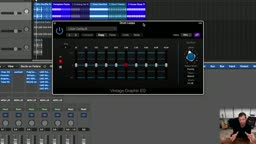
In this lesson we will explore semi-parametric EQs, particularly focusing on the vintage console EQ in Logic Pro and its emulation of the Neve 1073. We'll understand its features, limitations, and how it compares to fully parametric EQs. This knowledge is essential for effectively using EQ in music production, especially for achieving that classic vintage sound.
This lesson will explore the concept and application of shelving EQ in Logic's channel EQ. We will understand how to select frequencies, create a slope, and manage the Q factor to form a shelf. By using a practical drum loop example, we will see how shelving EQ can boost specific frequency ranges, providing a hands-on understanding of this EQ technique in music production.
Learning so much about sound production from each of the courses in this series. Great stuff!
C
Carlitos A.
12/22/23
Good the bad and the wrong key
Great job. It seem that I’ve been looking forever to find someone to explain this subject, any precise, clear, and easy to understand format. Working with different producers and engineers. I have a moderate idea what’s going on mixing and EQ that when I ask questions, I will get good information and descriptions what is going on Explains the topic will jump around so much that it becomes a big pile of patch chords and I’ll be confused by word salad and an Octomess. Thank you for sharing your no in and easy to understand format