
Guitar Lab: vi IV Moves
Intensive Examination of Rhythm and Lead Approaches For The vi IV Progression





Get this course and 1,000+ more with All Access
Try 7 days free. Cancel any time.
About this course
This course will examine one of the most common harmonic moves in pop and rock music: the vi IV chord progression. The entire course will focus on the theoretical key of D which yields a Bm to G chord vamp.
You will learn how to think vertically by utilizing arpeggios as a framework to articulate each chord change which will serve you in both your rhythm and lead guitar situations. The course information will then build on top of these arpeggios by presenting the modes for each chord.
You will be given guidelines for chord voicings and single note lines and will learn how to visualize information through various layouts on the fingerboard. You will also receive jam tracks with both a B pedal tone in the bass and a Bm to G bass line. These will be presented in a number of different rhythmic feels and tempos both with and without rhythm guitar.
You will learn how to think vertically by utilizing arpeggios as a framework to articulate each chord change which will serve you in both your rhythm and lead guitar situations. The course information will then build on top of these arpeggios by presenting the modes for each chord.
You will be given guidelines for chord voicings and single note lines and will learn how to visualize information through various layouts on the fingerboard. You will also receive jam tracks with both a B pedal tone in the bass and a Bm to G bass line. These will be presented in a number of different rhythmic feels and tempos both with and without rhythm guitar.
What you'll learn
- Apply three-note-per-string arpeggio layouts in improvisation
- Use chord tones as melodic targets over B minor and G chord changes
- Integrate various techniques (tapping, slides, bends) with arpeggio frameworks
- Create melodic lines by filling in scale tones between arpeggio notes
- Apply practice schemes to focus learning and avoid overwhelm
Release date: 03/30/2015 • 3h 56m runtime
Sample lessons
Pedal Tone Bass pt. 1
Two Note Voicings
Note Change In Top Voice
One Note Per String Arpeggios Pt. 4
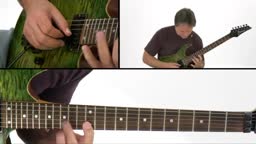
Note Change In Top Voice
Three Notes Per String Arpeggios Pt. 7
Note Change In Top Voice
Two One Layout Pt. 5
What's included
75 lessons • 74 charts • 1 Jam Tracks
This course will examine one of the most common harmonic moves in pop and rock music: the vi IV chord progression. The entire course will focus on the theoretical key of D which yields a Bm to G chord vamp. You will learn how to think vertically by utilizing arpeggios as a framework to articulate each chord change which will serve you in both your rhythm and lead guitar situations. The course information will then build on top of these arpeggios by presenting the modes for each chord. You will be given guidelines for chord voicings and single note lines and will learn how to visualize information through various layouts on the fingerboard. You will also receive jam tracks with both a B pedal tone in the bass and a Bm to G bass line. These will be presented in a number of different rhythmic feels and tempos both with and without rhythm guitar.
This lesson will explain the theory behind a vi IV progression. Chart number one reveals the major scales, diatonic harmony, and modes for all 15 keys.
A common sound in rock music is a pedal tone in the bass. This lesson will demonstrate a two voice rhythm guitar approach.
A common sound in rock music is a pedal tone in the bass. This lesson will demonstrate a three voice rhythm guitar approach by building on the previous example.
A common sound in rock music is a pedal tone in the bass. This lesson will demonstrate a four voice rhythm guitar approach by building on the previous example.
A common sound in rock music is a pedal tone in the bass. This lesson will demonstrate a five voice rhythm guitar approach by building on the previous example.
This lesson will focus on the arpeggios for each of the chords in this progression.
+ 68 more lessons
Reviews
No reviews yet
Complete this course and be the first to share your experience.
Stop searching. Start improving with All Access.
Try 14 days free. Cancel any time.
