





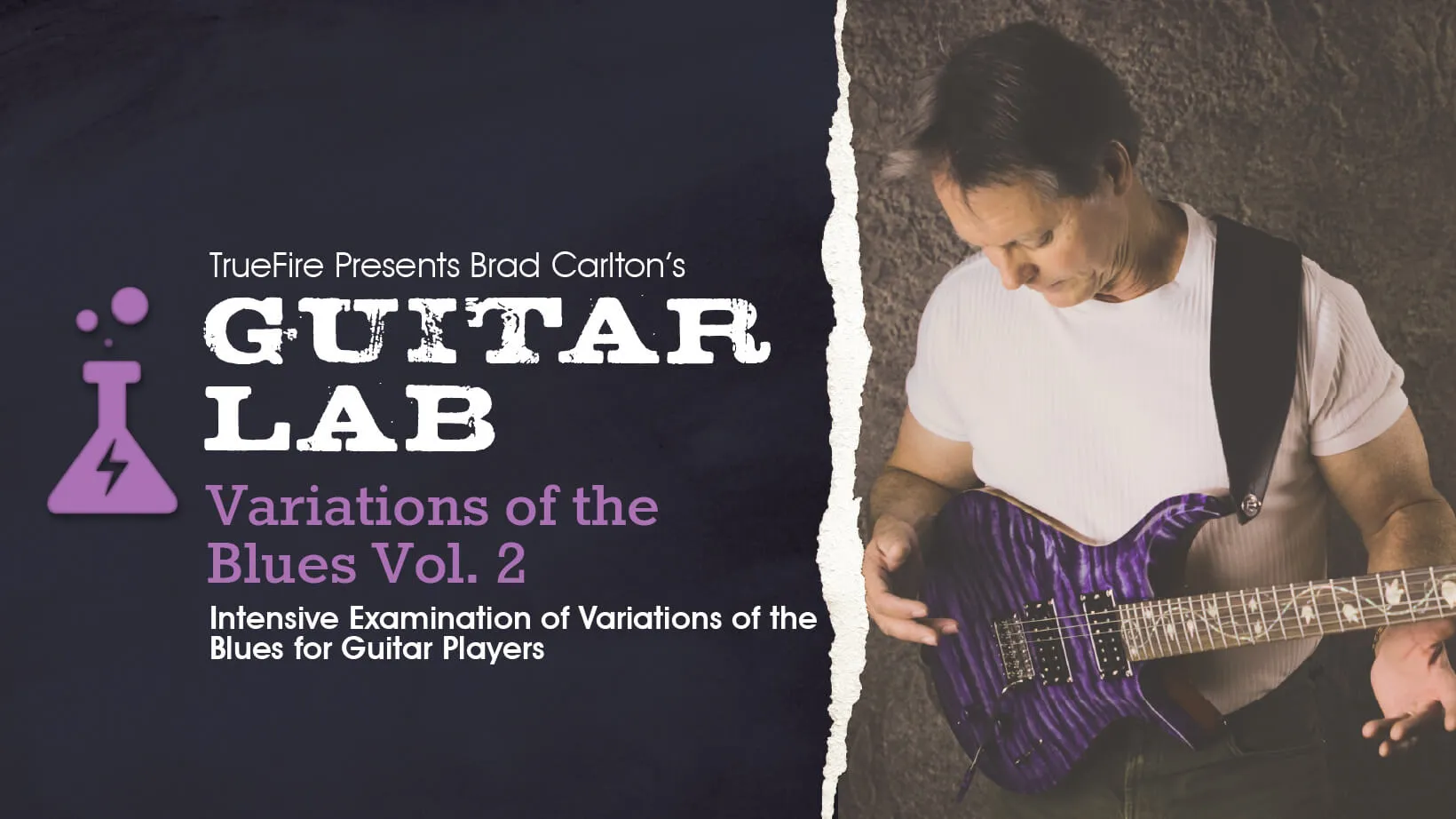

Guitar Lab: Variations Of The Blues Vol. 2

Intensive Examination of Blues Variations for Guitar Players

Marty FriedmanTommy EmmanuelSteve VaiEric GalesEric Johnson

Get this course and 1,000+ more with All Access

Try 14 days free. Cancel any time.

Purchase Individual Course for $5.00
Guitar Lab: Variations Of The Blues Vol. 2

About this course

Guitar Lab: Variations Of The Blues Vol. 2 is a comprehensive guide that aims to enhance your command over Blues variations. This program offers valuable technical insights to help you master the execution of these techniques, and provides an in-depth understanding of the theory behind these note groups. The primary focus is to equip you with the skills to create unique variations using rhythmic and melodic principles through dedicated practice.

What you'll learn

  • Apply mixed mode approach to create harmonic interest
  • Integrate tension and resolution in comping and soloing
  • Move chord structures through scales systematically
  • Comp with jazz-influenced harmony over blues progressions
  • Understand and apply chord scale theory
Release date: 08/01/2023 • 1h 33m runtime
Start Course
Sample lessons

What's included

17 lessons • 1 charts • 1 Jam Tracks

Variations Of The Blues Vol. 2
I'm Brad Carlton, and in this edition of "Variations Of The Blues" you're going to learn how to expand on basic blues moves: the five-six-flat seven, the 3-4-5. You're going to learn a lot of interesting structures, and we'll get into some jazz principles where you'll be using chordal harmony, contrary motion, and I will demonstrate how to comp. You'll move from inside traditional harmony to out and then back.

This will serve you well when you're comping and when you're soloing. You'll learn how to react and be able to record things on your own and set up scenarios where you can explore new harmonic and melodic avenues. So, grab your guitar and let's play some variations of the blues!
Variations Of The Blues Vol. 2
In this lesson, we'll focus on building chord voicings by rooting a fifth root to six and rooting a flat seven, using previous examples as a foundation. We'll also incorporate the 3 45 move on the third and second strings to create nicely voiced chords with a bluesy feel.Proper technique is essential for effective guitar playing. We'll discuss posture, hand positioning from the shoulder to the fingers, and how subtle adjustments can make a significant difference. The goal is efficiency, not just ease or difficulty. By practicing efficiently, even if it may not initially feel comfortable, you'll enhance your chord-playing abilities. Let's explore these techniques, experiment with variations, and add a touch of bluesy style to our chord progressions. 1, 2, 3, 4.
Variations Of The Blues Vol. 2
In this lesson we'll take a closer look at this chord progression. We'll use the same thirds on the third and second strings while focusing on the baseline on the sixth string. However, when playing with a bass player, we need to be aware of potential sonic clashes due to both instruments playing in the lower frequencies. This pattern works well for fingerstyle blues or solo playing, but with a bass player, we must be mindful of their part to avoid any conflicts in sound.Next, we'll delve into the chords in this progression, which are derived from the E Lydian mode, the fifth mode of the key of A. We'll begin with an E chord, representing the fifth chord in the key of A, followed by an F# minor chord. Next, we encounter the G# diminished chord, which interestingly acts as an E7 chord without its root. This is because the diminished triad can be thought of as a disguised five-seven chord.So, as we go through this chord progression, remember to consider the relationship between the chords and the bass notes, and let's explore how these diminished triads add a unique touch to our chord progressions in the key of A.
Variations Of The Blues Vol. 2
In this example, we mix modes to create a unique chord progression. Starting with Emixolydian, we play an E chord followed by an F# minor chord. Instead of moving to the G# diminished chord, we opt for G, giving it a mixed mode approach. However, playing the G over the bass creates a sonic clash. To enhance the sound, we add an E drone on top by fretting the G# note and leaving the other strings open to create an E chord. This progression offers a sophisticated touch and resembles a string or horn line. Experimenting with variations allows for additional creativity in the progression.
Variations Of The Blues Vol. 2
In this example, we're revisiting a previous chord progression, but this time, we'll add an E drone on top. To achieve this, we cannot use a barre chord because the first string needs to remain open. So, place your first finger on the G# note while keeping the other strings open, creating an E chord. The remaining fingers will naturally fall into place for the F# minor 7 chord. Then, we'll move up to the next part of the progression.To avoid squeaking when transitioning between chords, you can use your third and second fingers as guides. Lift your fingers lightly and practice moving between these positions smoothly. This technique is particularly helpful when playing on steel string acoustic guitars with thicker strings that can cause squeaks. To reduce the squeaks, watch your thumb position on the right hand. By slightly lifting your second finger before fretting the G# note, you can avoid any unwanted noise. Keep practicing and experiment with these chord variations to add depth and creativity to your playing.
Variations Of The Blues Vol. 2
This example is similar to a previous one, but instead of playing G sharps, we'll use G naturals, indicating we're in E minor. The chord progression starts with E minor, and the open G string gives us the flat third. We then move to F# minor seven and transition to G six since we have the G in the bass.When playing solo or thinking about the actual chords, we're not just focused on E minor, as the chords are E, F# minor, G, F# minor, creating a 2-3-4-3 progression in the key of D or E Dorian.Now, let's discuss some fingering options. Playing F# minor seven with fingers 2-3-4 can be comfortable, providing a guide with the third finger when moving to G six. However, you might also consider using a crossed fingering, which requires dropping the shoulder, bringing the elbow closer to the ribcage, and rotating the hand under the neck to clear the first string.Both fingerings have their merits, and it's essential to explore what feels comfortable and allows for smooth transitions between chords.
Variations Of The Blues Vol. 2
In this example, we have a straightforward chord progression with four voices in E, consisting of the root, root, third, and fifth. Then, we move to the F# minor seven chord, which can be formed by using the E minor shape but sliding it up to the second fret, creating an F# minor. To turn it into a minor seven, simply add the flatted seventh, which is a whole step below the root, giving it a more sophisticated sound.Next, we encounter the E7 chord, which comes from the D7 form but with the third in the bass. To transition smoothly, maintain the bar and avoid switching positions. This approach, originating from classical guitar, can offer interesting variations to your playing. Despite starting as a blues guitarist with no interest in fingerpicking or folk music, incorporating diverse techniques can lead to exciting musical possibilities.

+ 10 more lessons

Start Course

Reviews

1 result

Osokin

Verified buyer

11/10/23

Brad's Creative Blues Moves Part 2!

This is the second volume of Brad Carlton's thorough examination of different voicing and harmonic options that can be applied to blues forms. As is usual with Brad's teaching, the material can be challenging but is always hugely rewarding.


Stop searching. Start improving with All Access.

Try 14 days free. Cancel any time.