



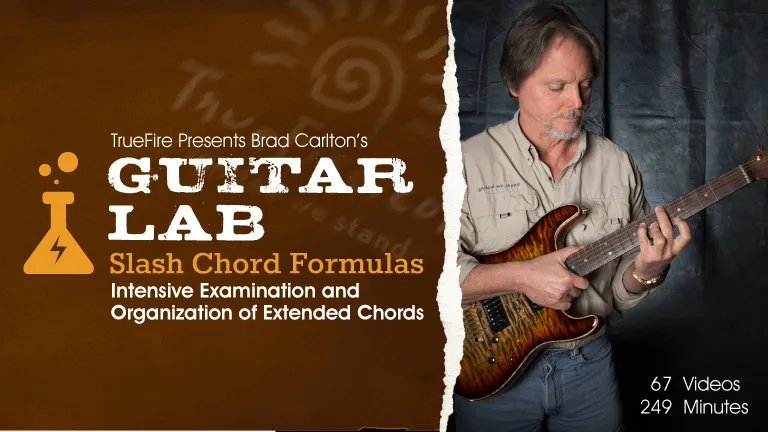
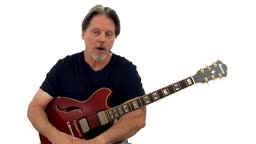
Guitar Lab: Slash Chord Formulas

Intensive examination and organization of extended chords

Marty FriedmanTommy EmmanuelSteve VaiEric GalesEric Johnson

Get this course and 1,000+ more with All Access

Try 14 days free. Cancel any time.

Purchase Individual Course for $5.00
Guitar Lab: Slash Chord Formulas

About this course

This course is designed to equip you with the theoretical knowledge, fingerboard visualization, and productive redundancy when building extended chords. I use the term productive redundancy to refer to the phenomenon that occurs in music where one piece of information can serve you in many different ways. When you're dealing with harmony this occurs quite frequently. You will learn how to utilize sus2, sus4, major, minor, augmented, and diminished chords as building blocks for more extended harmonies.

You will also learn how to visualize inversions of any chord along the string axis and also how to modify any chord to create other chord qualities. The principle of chord synonyms will be explained as well as the concept of "cross-thinking". In addition, the information in this course is not restricted to just rhythm guitar. You will be able to use all the chord voicings and arpeggios as a a framework when soloing.

What you'll learn

  • Use sus4 chords as static harmony rather than just resolution chords
  • Apply sus2 and sus4 voicings from previous learning to create 7sus4 sounds
  • Create rhythm guitar voicings using 7sus4 structures
  • Voice lead through 9th, sus4, and #11 chord variations
  • Learn to convert any dominant chord to sus4 by raising the 3rd to the 4th
Release date: 07/31/2015 • 4h 09m runtime
Start Course
Sample lessons
Chord Qualities and Inversions
Fingerboard Visualization
Imaj7 = iii/I
Imaj7 = iii/I
Cmaj7 = Em/C
Imaj13#11(no3, no5) = VIIm7/I
Cmaj13#11(no3, no5) = Bm7/C
Im13 = bIIImaj9#11/I
Cm13 = Ebmaj9#11/C

What's included

67 lessons • 66 charts • 1 Jam Tracks

Slash Chord Formulas
This course is designed to equip you with the theoretical knowledge, fingerboard visualization, and productive redundancy when building extended chords. I use the term productive redundancy to refer to the phenomenon that occurs in music where one piece of information can serve you in many different ways. When you're dealing with harmony this occurs quite frequently. You will learn how to utilize sus2, sus4, major, minor, augmented, and diminished chords as building blocks for more extended harmonies. You will also learn how to visualize inversions of any chord along the string axis and also how to modify any chord to create other chord qualities. The principle of chord synonyms will be explained as well as the concept of "cross-thinking". In addition, the information in this course is not restricted to just rhythm guitar. You will be able to use all the chord voicings and arpeggios as a a framework when soloing.
Chord Qualities and Inversions
The 3 charts that accompany this course are as follows: chart 1 is a chart of the major scales and all 15 keys and the modes that are generated from each scale degree, chart to is a list of chord formulas for the major, minor, and dominant chord families, and chart 3 is a list of enharmonic numeric analyses for all 12 notes of the chromatic scale.
Isus2 = V5/I
This lesson will demonstrate how a power chord can be used as a tool for establishing a sus2 tonality. I will demonstrate how this is very effective in creating a keyboard style rhythm guitar part.
Isus4 = IVsus2, Isus2 = Vsus4
The concept of chord synonyms is presented in this lesson. This simply means that a chord can have more than one name. This can be a useful tool when navigating through music.
I6 = vi/I, I6 = vi7
This lesson will demonstrate how to create a (maj)6 chord by playing a minor chord built off the 6th of the root of the chord. This upper structure component gives the desired sonority.
I6/9 = VI7sus4/I
In this lesson you will build on what you learn in the previous lesson by adding the 9 to the (maj)6 chord.
I6/9(no 5) = VIsus4/I, IIsus2/I
This lesson deals with a 6/9 chord but you will be omitting the 5.

+ 60 more lessons

Start Course

Reviews

2 results

Resojoe

10/29/18

Modern Sounds for Many Styles

I bought this course and am really glad I did. It not only works great with guitar but I’m trying to work out ideas from it on my Dobro. Ever wonder how certain guitarists get those modern chord sounds? Brad Carlton show it all in this course. I agree with sm5574 that this course is also great to listen to. At first it seems a little complex but Brad patiently guides you through it and after a while you’ll start to see how a simple triad over a bass note can give a rather complex harmony. Take your time to absorb the sounds for awhile before moving onto the next lesson because each lesson builds upon the previous one. I’m still working on this course and will be for some time as I grab my Realbook and begin to integrate these chord ideas into some songs.
sm5574

10/21/18

My favorite course to listen to!

This is my favorite course to just listen to. It's filled with all those modern sounds you hear in modern jazz and fusion, particularly in the catalog of Pat Metheny. Brad Carlton walks you through dozens of slash chords, shows different ways to play them and in what contexts they work best. If you want to add more modern sounds to your chord progressions, this is THE course to start with.

Stop searching. Start improving with All Access.

Try 14 days free. Cancel any time.