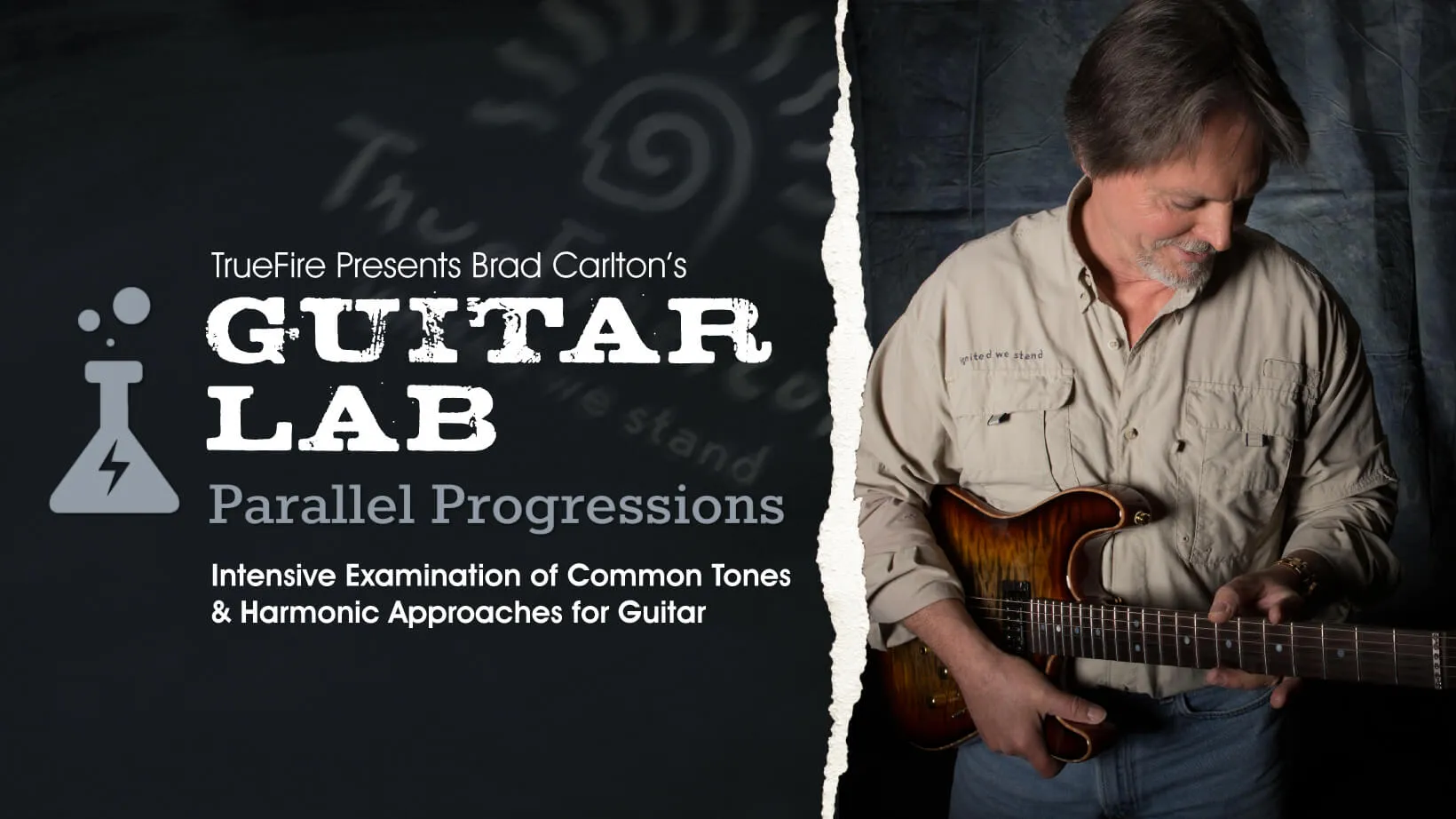
Guitar Lab: Parallel Progressions

Intensive Examination of Common Tones & Harmonic Approaches for Guitar

Marty FriedmanTommy EmmanuelSteve VaiEric GalesEric Johnson

Get this course and 1,000+ more with All Access

Try 14 days free. Cancel any time.

Purchase Individual Course for $5.00
Guitar Lab: Parallel Progressions

About this course

Hi, I'm Brad Carlton and welcome to Guitar Lab: Parallel Progressions. In this course, we'll define parallel progressions as two or more chords that share the same root in the base. We'll talk about the circle of fifths, it's purpose to show you that notes don't have to change when you go from one key to another. We'll also talk about what notes do change and focus on those.

Using guide tones, extensions, voicings, and rhythmic ideas in terms of melodic development and which register you play in will be important when playing over our Latin groove in this course. You'll learn a few things that will serve you not just in Latin jazz, but also in pop tunes and other types of progressions. This course will also help you understand the guitar in not grips but scale degrees. Alright, grab your guitar and let's play some parallel progressions!

What you'll learn

  • Apply guide tones and extensions to chord voicings
  • Apply circle of fifths knowledge to minimize note changes when modulating
  • Solo effectively over static bass lines using melodic development
  • Understand parallel progressions as chords sharing the same root in the bass
  • Calculate common tones when changing between keys
Release date: 10/01/2018 • 1h 34m runtime
Start Course
Sample lessons
The Circle of Fifths
Key Signatures

What's included

9 lessons • 8 charts • 1 Jam Tracks

Guitar Lab: Parallel Progressions
Hi, I'm Brad Carlton and welcome to Guitar Lab: Parallel Progressions. In this course, we'll define parallel progressions as two or more chords that share the same root in the base. We'll talk about the circle of fifths, it's purpose to show you that notes don't have to change when you go from one key to another. We'll also talk aout what notes do change and focus on those.

Using guide tones, extensions, voicings, and rhythmic ideas in terms of melodic development and which register you play in will be important when playing over our Latin groove in this course. You'll learn a few things that will serve you not just in Latin jazz, but also in pop tunes and other types of progressions. This course will also help you understand the guitar in not grips but scale degrees. Alright, grab your guitar and let's play some parallel progressions!
The Circle of Fifths
This lesson will explain the circle of fifths and it's similarity to an analog clock.
Modes and Their Parent Scales
Modes can be viewed as a major scale starting and ending on various scale degrees. This is an easy way to get the notes "under your fingers". It is then important to know the function of each note against the prevailing harmony. The formulas for the modes gives you this information.
Modal Harmonies
A very useful way to view any scale or mode is to use the chord that consists of the 1, 3, 5, and 7 as a skeletal framework. The remaining notes are the available extensions. These would be the 9(2), 11(4), and the 13(6).
Cmaj7 to Cm7
Our first parallel progression is a very common vamp consisting of a Cmaj7 moving to a Cm7. Our respective modes are Ionian and Dorian. The only notes that change are the guide tones. The 3 and the 7 of the Cmaj7 move to a b3 and a b7 for the Cm7.
Cmaj7 to Cm7
This lesson will continue with various ideas for playing over the Cmaj7 to Cm7 vamp.
Cmaj7 to C7
This pair of chords would be a common move to a IVmaj7 as the I7 is ithe V7 of the IVmaj7.

+ 2 more lessons

Start Course

Reviews

8 results

olivierhage

Verified buyer

09/14/25

Top!

This course is great, Brad clearly explains the utility of the cycle of fifth then directly guides you to put it all to practise. Most importantly, this course will many doors for you!
klog52

01/02/20

Toned in!

Nice lesson gave me a better understanding of the circle of fifths, scales, and modes. A very advanced lesson will need some music theory to fully understand what's being taught in this lesson. This lesson gives a better understanding of sharing more than one chord sharing the same base root. I was impressed by how easy Brad made the lesson so easy to follow along in each video. Enjoyed this course very interesting lessons!

LinguaFranka

Verified buyer

11/14/19

Interesting but not engaging

There is a great deal of (mostly) useful talking but not as much playing as I would have liked.

nigge99

Verified buyer

11/04/19

good ideas!

didn't know much about prallel progession ... interesting course and absolutely fun to use ... good stuff ;-)

VladZu

Verified buyer

10/30/19

It's ok

You won't be disappointed, but you won't be thrilled, either

Stop searching. Start improving with All Access.

Try 14 days free. Cancel any time.