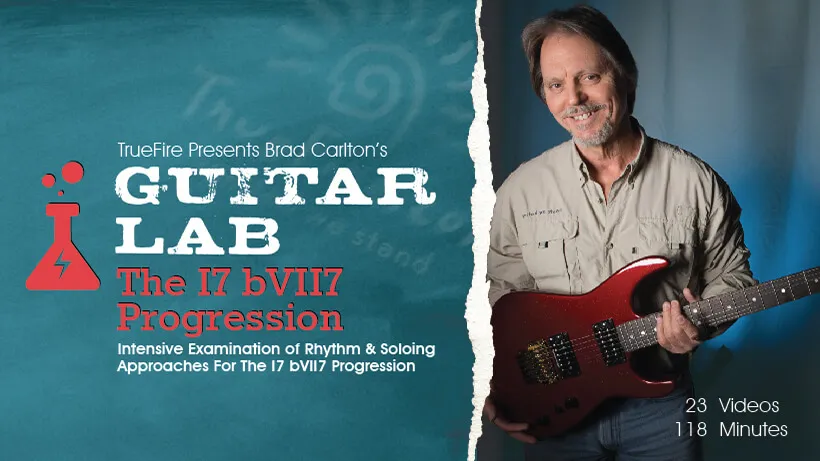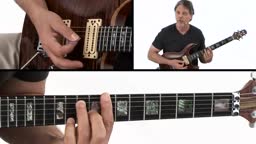

Guitar Lab: The I7 bVII7 Progression

Intensive Examination of Rhythm & Soloing Approaches For The I7 bVII7 Progression

Marty FriedmanTommy EmmanuelSteve VaiEric GalesEric Johnson

Get this course and 1,000+ more with All Access

Try 14 days free. Cancel any time.

Purchase Individual Course for $5.00
Guitar Lab: The I7 bVII7 Progression

About this course

Welcome to this edition of Guitar Lab focusing on The I7 bVII7 Progression. This course will examine various harmonic and melodic approaches over the I7 bVII7 progression. This sequence of two dominant chords a whole step apart is a common building block which is used in many different styles of music. Grab your guitar and let's get started!

What you'll learn

  • Navigate pentatonic scale across chord changes
  • Improvise using chord tones
  • Improvise musically across chord progressions
  • Practice melodic variation
  • Learn dominant 9th arpeggio technique
Release date: 09/01/2016 • 1h 58m runtime
Start Course
Sample lessons
Chord Voicings
Chord Voicings
5th/6th String Root Forms
Harmonic Analysis
Harmonic Analysis
Scale Options
The Safety Net Approach
Chord Voicing Shapes
Building Arpeggio Forms
Chord Reference

What's included

23 lessons • 22 charts • 2 Jam Tracks

The I7 bVII7 Progression
Hi, I'm Brad Carlton and welcome to this edition of Guitar Lab focusing on The I7 bVII7 Progression. This course will examine various harmonic and melodic approaches over the I7 bVII7 progression. This sequence of two dominant chords a whole step apart is a common building block which is used in many different styles of music. Grab your guitar and let's get started!
Chord Voicings
We'll use 6th and 5th string rooted chord forms throughout this course to accommodate the whole step bass line.
Harmonic Analysis
When dealing with unaltered dominant chords, there are two heptatonic scales which generate the various available harmonies. The Mixolydian mode, which is mode V of the major scale, and the Lydian b7, which is mode IV of the melodic minor scale. The formula for the Mixolydian is 1-2-3-4-5-6-b7 and the Lydian b7 formula is 1-2-3-#4-5-6-b7.
The Safety Net Approach
Any chord voicing involves a layout of one note-per-string on the fingerboard. It's important that you see these chord tones as available melody notes which can serve you as a "safety net" when soloing over a progression.
Building Arpeggio Forms
After you're able to see the chord tones that make up a chord voicing, you can build a complete chord arpeggio in the same position by playing the note that correspond to the numeric formula of the chord.
Using Common Tones
In this lesson, we'll cover the importance of knowing the common tones which occur when playing over the I7 bVII7 progression.
Pentatonic Approach
This lesson will examine the use of the C minor pentatonic scale over both chords.

+ 16 more lessons

Start Course

Reviews

1 result

Norbert99

07/24/19

Great course !

Clearly explained and a whole bunch of ideas to go further ! Highly recommended !!!
Stop searching. Start improving with All Access.

Try 14 days free. Cancel any time.