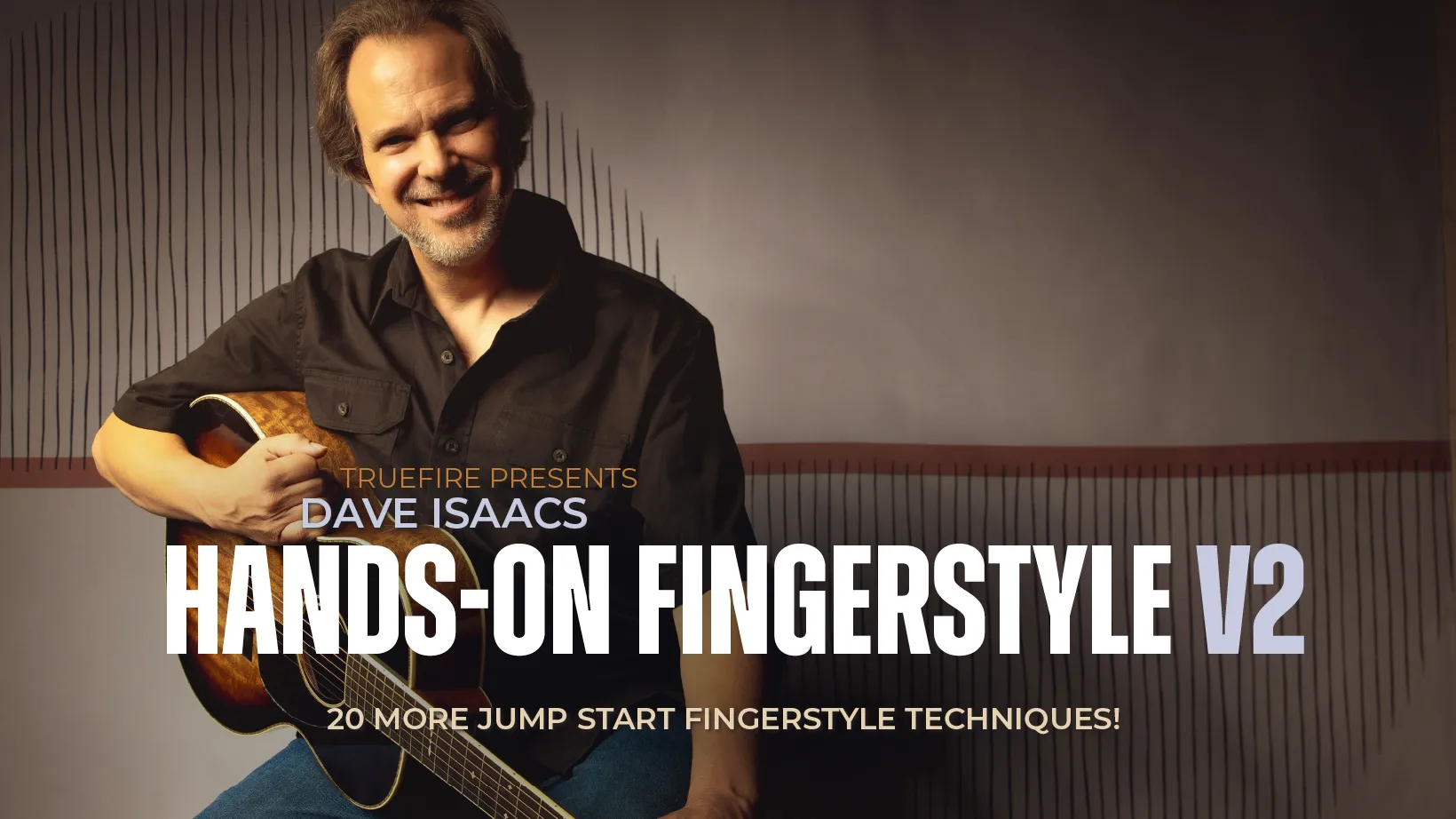

Hands-on Fingerstyle, Vol. 2

20 MORE Jump Start Fingerstyle Techniques!

Marty FriedmanTommy EmmanuelSteve VaiEric GalesEric Johnson

Get this course and 1,000+ more with All Access

Try 14 days free. Cancel any time.

Purchase Individual Course for $19.99
Hands-on Fingerstyle, Vol. 2

About this course

In the first volume of Hands-On Fingerstyle, Dave Isaacs introduced you to his highly popular "jump start" method for learning fingerstyle guitar. He also overcame any doubts you may have had about your ability to learn the technique by following his intuitive "bite-size" lesson path.

Here in Dave's second edition, you’ll build on the fundamentals that you learned in the first volume. Following his "jump start" approach, Dave will guide you through another 20 bite-size lessons where you will learn more fingerstyle techniques such as arpeggio patterns, independent melody and bass, and percussion.

”In the first edition, we discovered the fundamental techniques involved in playing fingerstyle. Here in the second edition, we're going to build on those fundamentals and touch on some specific techniques that will take you further up your fingerstyle learning path.

I’ve designed these step-by-step collections of 20 bite-sized lessons to accelerate your continued exploration of the world of fingerstyle. Working with TrueFire's suite of cutting-edge learning tools like synchronized tab, looping, and slow-mo, you can learn at your own pace. Remember, learning an instrument is an ongoing process.

It's about expressing yourself and finding joy in the experience. So grab your guitar, and let's get your hands on fingerstyle!”


Like the first volume, following the order of the 20 “bite-size” lessons is one of the secret ingredients of Dave’s method. You’ll practice and play through the following lessons in this order: Open String Roll Warm-up, Thumb & Finger Alternation, Rest and Free Stroke Scales, Block Chord Study in C, Melody and Bass, Arpeggio Study in F, Block Chord Study in D, Melodic Picking in D, Scale Study in D, Intro to Counterpoint, Triads Over a Drone Bass, Block Chord Shuffle in E, E Blues Study , The Thumb Slap, Arpeggio Study in D Minor, D Minor Blues Study, Up The Neck in A Minor, Rhythmic Comping, Syncopated Rag, and Thumb & Finger Brush Study.

You’ll have TrueFire’s interactive learning tools at your fingertips to personalize your workspace and learn at your own pace.

The demonstrations and performances are tabbed, notated, and synced to videos with controls for looping, slow motion, fretboard animation, and many other tools designed to accelerate the learning process.

You’ll also get tab and standard notation files to print out and downloadable Guitar Pro files to practice with as well if desired.

Grab your guitar, and let’s get ‘hands-on’ again with Dave Isaacs!

What you'll learn

  • Play triad voicings in multiple positions up the neck
  • Create implied melody through dynamic emphasis
  • Apply drone bass concept with changing harmony above
  • Awareness of techniques to be covered: arpeggios, independent melody/bass, percussion
  • Understanding the scope and structure of the Hands-On Fingerstyle Vol. 2 course
Release date: 03/28/2024 • 2h 30m runtime
Start Course
Sample lessons
Arpeggio Study in F
Arpeggio Study in F
Demonstration
Melodic Picking in D
Demonstration
E Blues Study
E Blues Study
Demonstration

What's included

22 lessons • 20 charts

Hands-On Fingerstyle, Vol. 2
Hi, I'm Dave Isaacs, and welcome to this second edition of Hands-On Fingerstyle. In the first edition, we discovered the fundamental techniques involved in playing fingerstyle. Here in the second edition, we're going to build on those fundamentals and touch on some specific techniques, like arpeggio patterns, independent melody and bass, and percussion.

I've designed this step-by-step collection of 20 bite-sized lessons to accelerate your continued exploration of the world of fingerstyle. Working with TrueFire's suite of cutting-edge learning tools like synchronized tab, looping, and slow-mo, you can learn at your own pace. Remember, learning an instrument is an ongoing process.

It's about expressing yourself and finding joy in the experience. So grab your guitar, and let's get your hands on fingerstyle!
Open String Roll Warm-up
We're diving into a tuning-in exercise to sharpen our fingerstyle playing, focusing on the placement and accuracy of our picking hand – that's thumb, index, middle, and ring, or in classical terms, P, I, M, and A. I emphasize the importance of awareness in our hand positioning, advocating for a 'neutral hand position' which is just a relaxed stance, as if you're about to shake hands. This natural posture translates directly to how we approach the strings, ensuring our fingers are nicely arched and our thumb is relaxed, pointing towards the index finger's outer pad.

We'll start simple, working through the strings with P I M A in sequence, emphasizing preparation and accuracy before adding more complexity. This exercise isn't just about hitting the notes but about being mindful of where each string is before you even play it, allowing for a smoother transition between notes. It’s an exercise designed to refine your focus and improve your familiarity with your instrument, adjusting as necessary for different string sets to maintain a clean sound.

This is about finding that sweet spot where your hand and your guitar work best together, adjusting the guitar neck's angle and your hand’s motion for optimal play. I encourage you to take it slow, focus on clarity and precision, and remember, warming up and tuning in are crucial parts of practice that set the tone for focused and effective sessions. Developing a routine around this can significantly enhance your playing skills.
Thumb & Finger Alternation
Diving into an exercise that hones in on alternating between the thumb and fingers, which you'll find is a backbone to countless song accompaniments, we're keeping it straight to the point while leaning into the natural mechanics of our hand. This dance between the thumb pushing down and the fingers pulling up isn't just about those digits; it involves the whole arm, ensuring we avoid any stiffness by not relying solely on our fingers. This motion, where the thumb rolls outward and the fingers inward, mirrors a brushing action rather than plucking, shaping the way we approach the strings.

Holding down an E minor chord, we run through a simple pattern of thumb and finger movements across the strings, showcasing this technique across various chords like A minor and G, and even a B7 over an F# base. It’s a clear reminder of how our hand naturally positions over the strings, with the thumb freely navigating while the fingers may require slight arm movements for string transitions. The key takeaway? Always think ahead, preparing your fingers for their next move to ensure a smooth, surprise-free performance. It's all about paying attention to the details, whether you're navigating through chord changes or planning your next note, keeping your practice intentional and your playing sharp.
Rest & Free Stroke Scales
In this series, we're diving into various fingerstyle guitar techniques, spanning from folk and blues to contemporary singer-songwriter and classical styles. We're starting with something fundamental yet crucial: a scale in rest strokes. While it might not be the go-to for those mainly playing accompaniments, mastering scale passages and rest strokes is vital for true control over fingerstyle guitar playing. It's all about even sound production across the neck, whether you're on bass or treble strings, open or fretted notes.

We're using a C major scale to illustrate this, emphasizing the importance of familiarizing yourself with different positions on the fretboard. This not only enhances your fret hand's efficiency but also ties into understanding how scales and chords relate, improving your overall guitar geography. Especially with rest strokes, you'll notice the necessity for slightly different hand positions when tackling the thicker, wound bass strings compared to the treble strings. This exercise isn't just about hitting the right notes but about paying close attention to the motion of your picking hand and maintaining a smooth transition between strings and frets. It's a comprehensive approach that fine-tunes your technique, ensuring you're mindful of every aspect of playing as you navigate up the neck.
Block Chord Study in C
We're diving into the nuanced world of playing simple chords, breaking them down not as block shapes but as collections of individual voices or parts, each with its own direction. This mindset shift means the fingers we choose for picking aren't just about string order but are driven by the music itself, making our thumb the bass player and our other fingers responsible for melody and a middle voice. Whether it's using P I M or P I A, the idea is to match our finger choice to the chord's needs, ensuring each note sits right where it should. This approach not only helps us get comfortable with the physical aspect of playing but also deepens our musical understanding, allowing us to hear the distinct voices within chords. And it's this blend of technical skill and musical insight that elevates our playing from just hitting the right notes to truly making music that resonates.
Melody and Bass
We're diving deeper into our melody exercise, which showcases a blend of bass and melody parts, much like a pianist managing both treble and bass ranges. When playing fingerstyle guitar, your thumb acts as the bass player, while your other fingers handle the melody, creating a rich, full sound. This approach might seem complex with its combination of simple chords and specific finger placements—like using your thumb for bass notes and fingers for melody, or the strategic use of pinches and finger releases to transition between chords. Despite the detailed instructions on finger movements and chord transitions, the goal is to achieve a smooth flow of music. Moreover, the technique of resting fingers on the guitar is highlighted as a personal preference that aids in stability and spatial awareness, as long as it doesn't restrict movement. This freedom allows for a more intuitive and fluid playstyle, emphasizing the importance of being comfortable and adaptable in your technique.
Arpeggio Study in F
In this lesson we're exploring another common accompaniment pattern in this lesson, specifically a six-note roll in the key of F, which includes a mix of familiar and possibly new chord shapes. Starting with a four-string version of the F chord, we discuss the flexibility of hand positioning for effective barre covering, emphasizing personal comfort over strict adherence to form. We then delve into a minimal bar B flat chord, highlighting the importance of minimal hand pressure and efficient finger placement to avoid unnecessary strain. Transitioning through chords, like B flat major to minor, and introducing an F with a C bass, we aim for a seamless sound that blends these chords smoothly. The right hand's six-note roll pattern, a carryover from previous lessons, emphasizes a fluid motion that incorporates the entire arm, contrasting a rigid approach with one that leverages the natural weight and roll of the hand for a more dynamic performance. This technique not only enhances the exercise's musicality by adding emphasis to every third note but also encourages a harmonious interaction between the mechanics of playing and the musical context, ensuring a fluid and expressive execution.

+ 15 more lessons

Start Course

Reviews

3 results

Denis L.

01/31/25

have no words

10 stars
Mark A.

07/20/24

Great second instalment

For anyone who's done vol. 1, this is more of the same: Dave slowly saying "p", "p _i_", "m" while breaking down the seemingly impossible into doable chunks. It's great. Not necessarily much more difficult that part 1, just using different techniques.Minor gripes: I'd like the pdfs to be better formatted (bars are often unnecessarily wide, so you can't see the whole piece on one page), fingerings in the pdfs don't always correspond to the videos, and the pieces are all pretty short (for pedagogical rather than performance purposes, understandably).

PJ

03/29/24

Fingerstyle heaven...

Great follow-up to Lev1, far more challenging. Halfway through and I am really enjoying, it made me revisit some of the other many fingerstyle courses on here. I like Dave's approach, quite straight and a excellent mixture of technical skills and body/finger awareness. I'll have to check out his JamPlay courses... Thanks Dave, and I am looking forward to more material in the future.

Stop searching. Start improving with All Access.

Try 14 days free. Cancel any time.