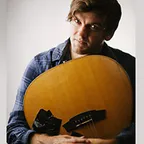
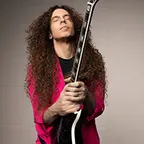
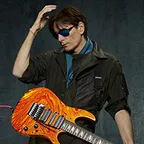
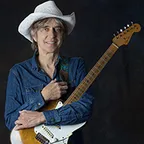
Michael Hedges, Preston Reed, Tommy Emmanuel, Kaki King, Don Alder, Erik Mongrain, Phil Keaggy, Doyle Dykes, Andy McKee and so many other modern masters of fingerstyle guitar enhance their performances with an impressive palette of percussive techniques.
Unlike traditional fingerstyle, percussive techniques are difficult to accurately notate and impossible to teach all of the nuances strictly by books, audio instruction or sheet music. Players learn these techniques through observation, emulation and truckload of practice. Ultimately, the technique manifests itself under your fingertips.
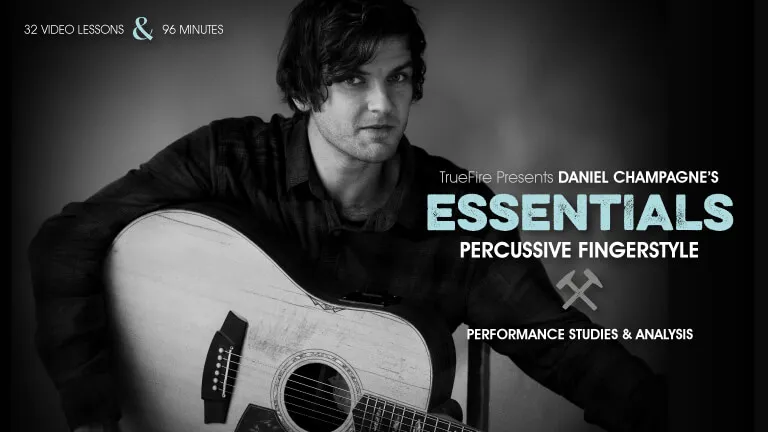
We’re proud to welcome Daniel Champagne to the TrueFire family! An avid student and practitioner of percussive techniques, Daniel is a rising star in the new generation of fingerstyle artists.
“Festival goers flocked in the thousands towards the main stage to witness the young musical phenomenon from Australia dish out an absolute show-stopper at the evening’s end.”
Fortunately for we students of fingerstyle, Daniel is also a passionate teacher who happily reveals his hard-earned knowledge bank of percussive techniques here in this Essentials edition of Percussive Fingerstyle. He also generously includes a few tasty fingerstyle etudes requiring no percussion.
“Percussive fingerstyle is an approach to guitar that combines some more experimental techniques with traditional fingerstyle playing. In this edition of essentials, we'll jump right into the playing, learning the fundamental elements of this style including body percussion, two hand tapping and a variety of open tunings.”
Daniel organized the course into a series of 10 percussive fingerstyle etudes, each focused on a specific technique and application of that technique.
#1 - Percussive Groove: “We’re looking at three different percussive sounds here. 1) A kick drum made with your palm on the face above the sound hole. 2) A snare sound made with you open hand on the bottom side of the guitar. 3) A hi-hat slap with the left hand against your strings while muted. Count yourself in, start out slowly and build it up. Never hit it too hard because guitars DO break.”
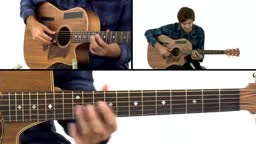
#2 - Two Hand Tap: “This exercise focuses on two hand tapping & legato techniques which involve both hands being able to play melody notes across the fretboard by themselves. We are only playing the 1st and 6th strings to give you a basic idea, but do try looking at this pattern as a starting point and play around/add things to it as you go!”
#3 - Nightingale Intro: “Here’s a piece that combines both the percussive and two hand tapping techniques along with a more traditional guitar style. The tuning for this song is CGDGBD. Learn each section slowly before you try piecing it together at full speed and make sure you let those harmonics ring out as loud as possible.”
#4 - Same Enemy Riff: “This piece is in the same tuning of CGDGBD and puts both the percussive and two hand tapping techniques into a more steady groove based around three chord rooted on the 5th string and the second finger constantly hammering on and pulling off the B string. Try to start out simply playing the chord, then add the legato playing and finally, add the percussive rhythm with your right hand.”
#5 - Acland Street Intro: “This is more of a straight up fingerpicking piece. It's played in standard tuning (EADGBE) and is based on the following chord pattern: C, G, Am, F x 2. Dm, G, C, (passing B). Am, (passing G) Dm, G, C, (passing B) Am, (passing G) F, G. Try picking through the chord pattern first and humming the melody in your head. Break it down piece by piece and start off slowly then build speed gradually.”
#6 - Lily Instrumental Section: “This piece is in 3/4 or 6/8 time (which ever way you count it) and is played in drop D tuning (DADGBE). As with "Acland Street," try playing through the chord progression, or at least the base line before you add the melody on top.”
#7 - Pendulum A Section: “This piece is tuned to an open Em chord, EGDBGBE and it stays in this key for the whole time with no changes as such. Try to separate the two parts to start with, work on just the left hand playing the fretted notes at first and then add the right hand percussive groove when you're ready.”
#8 - Chase The Sky Intro: “This one's a little bit tougher. It relies almost solely on harmonics between the 12th, 7th and 5th frets so it's always good to work on the light touch you need to let them really ring out on each fret and string.”
#9 - Mystery Train: “Here's a fingerpicking piece in CGEbGCEb tuning. It's using the alternative thumb picking pattern between the 6th and 4th string, and the main melody is played with the second and third fingers on the 1st and 3rd strings. There is quite a complicated run down at the end so try playing this separately and slowly before bringing it up to the speed of the whole piece.“
#10 - Tap The Red Cane II: “Here is a new tuning for you, open D (DADF#AD). This piece is played completely through the two hand tapping technique so remember to make your 'pull-offs' and 'hammer-ons' dramatic to keep the power and the volume flowing throughout. This isn't an easy song for anyone to play, so take it slow and spend some time trying to get it all clean and even.”
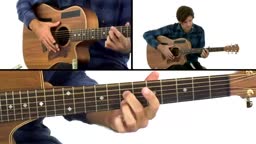
Daniel overviews the etude and then performs the piece and demonstrates the percussive techniques in play. The performance is followed by a detailed breakdown. All of the performances are tabbed and notated. You’ll also get Guitar Pro files so that you can loop and/or slow any section down as you work through each of the etudes.
Grab your guitar and let’s manifest your percussive prowess!
What you'll learn
Create embellishments within a chord progression framework
Play a complete fingerstyle arrangement with melody and bass
Combine traditional fingerstyle with experimental techniques
Coordinate thumb picking bass pattern while adding melodic notes
Understand the fundamentals of percussive fingerstyle guitar
Hi I'm Daniel Champagne and welcome to Essentials: Percussive Fingerstyle.
Percussive fingerstyle is an approach to guitar that combines some more experimental techniques with traditional fingerstyle playing.
In this edition of essentials, we'll jump right into the playing, learning the fundamental elements of this style including body percussion, two hand tapping, and a variety of open tunings.
We'll work through 10 essential percussive fingerstyle pieces. For example, we’ll start with a simple groove evoking the sounds of a drum set on your guitar…
Then we'll work on an approachable two-hand tapping piece to help you get acquainted with the different elements of that technique.
We'll explore our first open tuning in a piece called "Nightingale" that incorporates both body percussion and tapping…
After that we'll work on a funky hip-hop groove…
"Acland Street" takes us back to a more traditional fingerstyle approach in the key of C…
We'll work on a drop-D 6/8 piece with a strong melody and a moving bassline…
"Pendulum" uses an interesting version of open-E minor tuning and an intricately layered groove…
We'll also work on a piece constructed almost solely of harmonics and percussive embellishments…
"Mystery Train" incorporates a strong right hand pattern and left hand legato…
And finally, a challenging piece in open D with an intricate melody formed by variations of the two-hand tapping technique...
I'll perform each piece and then break it down for you, pointing out all the techniques you need to know AND of course you'll also have all the standard notation and tab to work with as well.
So grab your guitar and lets get started!
We are looking at three different percussive sounds here...
1) A kick drum made with your palm on the face above the sound hole.
2) A snare sound made with you open hand on the bottom side of the guitar.
3) A hi-hat slap with the left hand against your strings while muted
Count yourself in, start out slowly and build it up. Never hit it too hard because guitars DO break.
We are looking at three different percussive sounds here...
1) A kick drum made with your palm on the face above the sound hole.
2) A snare sound made with you open hand on the bottom side of the guitar.
3) A hi-hat slap with the left hand against your strings while muted
Count yourself in, start out slowly and build it up. Never hit it too hard because guitars DO break.
We are looking at three different percussive sounds here...
1) A kick drum made with your palm on the face above the sound hole.
2) A snare sound made with you open hand on the bottom side of the guitar.
3) A hi-hat slap with the left hand against your strings while muted
Count yourself in, start out slowly and build it up. Never hit it too hard because guitars DO break.
This exercise focuses on two hand tapping & legato techniques which involve both hands being able to play melody notes across the fretboard by themselves. We are only playing the 1st and 6th strings to give you a basic idea, but do try looking at this pattern as a starting point and play around/add things to it as you go!
This exercise focuses on two hand tapping & legato techniques which involve both hands being able to play melody notes across the fretboard by themselves. We are only playing the 1st and 6th strings to give you a basic idea, but do try looking at this pattern as a starting point and play around/add things to it as you go!
This exercise focuses on two hand tapping & legato techniques which involve both hands being able to play melody notes across the fretboard by themselves. We are only playing the 1st and 6th strings to give you a basic idea, but do try looking at this pattern as a starting point and play around/add things to it as you go!
Great course, I love the style. This will take my playing down new path.
A
alessiamartis
06/28/20
Love it!
I've always loved this percussive playing and tried to learn many times, but with this course, I learn a song in the first 10 minutes! It's a challenging course, and it'll teach you some great and specific techniques. Every part it's well explained, broke down and made it easy to understand and internalize.
U
unicorn248
Verified buyer
04/26/20
Percussive Guitar
This is a difficult thing to do. Must go very slowly in order to get the hands to even approach doing what they are being asked to do. What a challenging course.
T
timo101
Verified buyer
04/26/20
Learn a lot!
Great course for learning modern fingerstyle guitar!