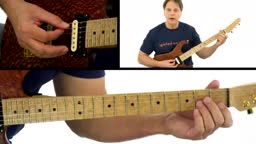
Pedal tones are a very effective harmonic device, especially practical for guitarists who can use open strings as pedal tones. In this first volume of Chord Studies: Pedal Tones, you'll explore a series of innovative applications for pedal tones and learn how they are constructed for optimal musical impact.
About the Chord Studies Series
If Forest Gump’s shrimp-loving Bubba played guitar, his take on chords might go something like this, ”You can strum ‘em, fingerpick ‘em, arpeggiate ‘em, mute ‘em, alternate tune ‘em, voice lead ‘em. Dey’s uh, barre chords, altered chords, extended chords, moveable chords, cluster chords, slash chords, inversions, triads, diads. There’s jazz chords, power chords, blues chords, cowboy chords, block chords, open chords…”
Bubba would be right — there’s a wide and wonderful world of chords for we guitarists to explore. But what’s the best way to do that? Chord dictionaries might be handy references but there’s no context (and really, when’s the last time you looked at one of those?).
Theory and harmony instructionals are filled with chord construction strategies and applications and we highly recommend digging as deep into the science of chords as your left brain will allow you.
However, learning new chords, progressions, applications and right-hand techniques in a musical context (songs, etudes, jamming with other players, etc.) is the most popular approach and that is the educational premise behind Brad’s Carlton’s Chord Studies course seres.
Each edition of Chord Studies features 15 play-along and jammable chord studies, which are focused on a particular chord type, chord progression or chord application. While Brad does touch on rhythmic qualities, this is not a rhythm guitar course — these studies are specifically designed to significantly expand your chord know-how and vocabulary.
Brad covers a range of styles, levels , chord types and progressions across 10 editions: CAGED Chords, Jazz Blues Progressions, Open String Chords, Rock and Pop Progressions, Slow Blues Progressions, Evolving Blues, Evolving Triads, Slash Chords, Power Chords and Beginner Chords.
Each of the 15 Studies within an edition includes an overview from Brad followed by a performance and play-along of the chord study over a rhythm track. Chord grid charts and a chord lead sheet accompanies each study. Plus, you’ll get all of the practice rhythm tracks to work with on your own.
Reference the chord charts to become familiar with the voicings and their fingerings, and then use the lead sheet to play-along with Brad’s video performance. Try different rhythmic patterns over the supplied rhythm tracks and then take it all to your own playlist of songs and jam tracks.
What you'll learn
Execute a 6-4 progression using power chords
Apply partial chord voicings in heavy distorted contexts
Control string selection to avoid unwanted notes
Recognize and apply chord inversions with extended harmony
Understand the harmonic function of a 6-4 progression in the key of C
Pedal tones are a very effective harmonic device, especially practical for guitarists who can use open strings as pedal tones. In this first volume of Chord Studies: Pedal Tones, you'll explore a series of innovative applications for pedal tones and learn how they are constructed for optimal musical impact.
Pedal tones are a very effective harmonic device, especially practical for guitarists who can use open strings as pedal tones. In this first volume of Chord Studies: Pedal Tones, you'll explore a series of innovative applications for pedal tones and learn how they are constructed for optimal musical impact.
This pack of progressions involves pedal tones in the bass, meaning that the same note stays in the bass. Example 1 is a vi-IV progression in the key of C. Be careful on the first chord that you only strum through the third string. If you accidentally sound the second string, it'll give you an A major. Notice how A is our pedal tone here.
This pack of progressions involves pedal tones in the bass, meaning that the same note stays in the bass. Example 1 is a vi-IV progression in the key of C. Be careful on the first chord that you only strum through the third string. If you accidentally sound the second string, it'll give you an A major. Notice how A is our pedal tone here.
This progression is a vi-IV in the key of C. The chords are Am to F, but we're pedaling the A in the bass. This works out because A is the root in Am and the third of the F chord. We start with our standard Am chord, and then move from E to F on the fourth string as well as an octave higher on the E string.
This progression is a vi-IV in the key of C. The chords are Am to F, but we're pedaling the A in the bass. This works out because A is the root in Am and the third of the F chord. We start with our standard Am chord, and then move from E to F on the fourth string as well as an octave higher on the E string.
This is a vi-IV progression in the key of C; our chords are Am and F and we're keeping A in the bass. When moving from the A5 to the F/A, all you have to do is move up one position and come down with your third finger. For the Am, you're going to barre the first, second, and third strings with your fourth finger. Our last chord is a little different, an F chord using the D form out of the CAGED system. Notice how it looks like your standard D chord, just moved up.
This is not a glamorous course, meaning, this is not a Shredders course. No flash, not pyrotechnics here... but this really opened my song writing up giving me some fresh insights. Funny how you know something but have long forgotten how cool something is?
Guess this broke me out of a rut songwriting wise. I Love this course. The deeper you get into guitar, the more you realize just how important broadening your tonal pallet is to be fresh and evolving. Brad is an awesome teacher.
I enjoyed this, and almost immediately inspired me to work this into my song writing.
K
klog52
12/26/19
Awsome
Chords , chords , chords what a great lesson, so many ways to play chords in different styles, takes you to a new level of understanding chords and to play in different applications and progressions. Break downs of the chords in different styles were very easy to follow along with the chord diagrams provided showing the left-hand fingerings. Very nice jam tracks to practice with after finishing the lessons. This lesson will make a very nice addition to everones collection.
J
James B.
10/08/18
Useful Course
This course was useful for chord voicings and finger stretching/strengthening as the intended purpose. I really appreciate the bite size lessons, which repeat the same chords in different positions/inversions. It helps to absorb and internalize the theory behind the one note change between two different chords.
Brad's instruction is succinct, clear, and to the point. Sometimes for a theory newbie like me a little more explanation of the theory and notes would help to acclimatize me better; my practice and study time is less abundant than I would like.
The course is definitely worth it.