gdgxm9fnfn
Verified buyer
08/03/23
Muy recomendable el curso !! Te proporciona buenas herramientas para que puedas avanzar un poco más en este estilo!!




Get this course and 1,000+ more with All Access
Try 7 days free. Cancel any time.
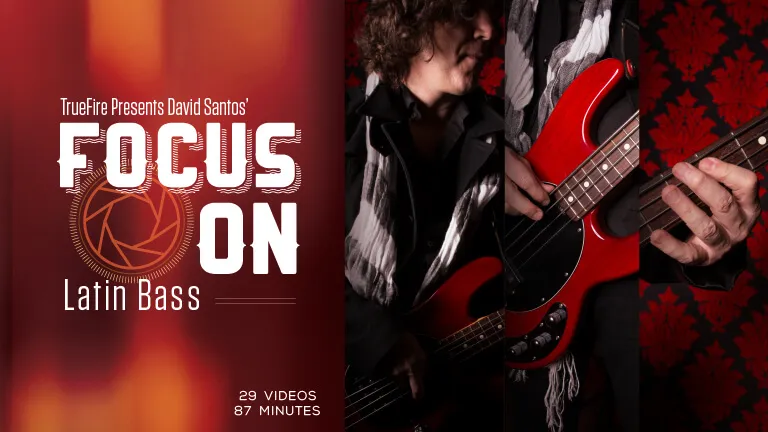
About this course
What you'll learn
29 lessons • 14 charts • 4 Jam Tracks
This course has been carefully designed, not only to give you a strong foundation in Latin Bass playing, but to give you a lifetime's worth of knowledge that you'll actually use as you go out and play with other people. Take this knowledge and make it "your own."
After you've gone through the entire course chronologically, I urge you to navigate between the different sections at your own pace and in your own way in order to internalize it. Design your own method of studying this information so that you will retain it and integrate it with your own playing style. Add it to your developing concept of bass playing and make it a part of your musical life. Focus on the sections that you find the most interesting and the most helpful. Repetition is key! Most importantly, go out and use this information in real playing situations with real live musicians whenever possible. Play often and always play with confidence!
Latin bass styles are extremely varied. There are many regions from where Latin bass has evolved and continues to evolve. I believe the study of Latin bass should begin with African and Cuban music and continue with research into Salsa Music as well as Latin Jazz, which originated in New York City.
History of Latin Bass and bass players to listen to:
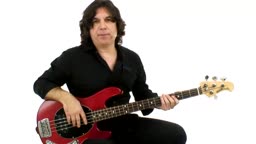
I play Music Man "Stingray" basses with DR Flatwound strings and Hartke bass amps, which allows me to simulate an acoustic bass or an Ampeg Baby Bass sound. Many Latin bass players use the aforementioned Ampeg Baby Bass, which is an electric upright bass. A South American Company named Sendel makes a version of an electric upright bass that is commonly used as well. Some Latin bass players play a traditional acoustic bass also referred to as a double bass, upright bass, or acoustic bass, while many Latin bass players opt to play modern electric bass guitars.
In this section there will be 10 specific studies that, when combined, will give you an understanding of how to play Latin Bass.
The chords in many of the following lessons are A minor, D minor, and E major (or E7). In any minor key, the three primary chords are the one minor, the four minor and the five major or five dominant seventh. There are 8 notes or "degrees" in the A harmonic minor scale. The 8th note of the scale is the same as the 1st note except for the fact that it is an octave higher. The 1st and 8th notes are referred to as the tonic, so A is the tonic of the A harmonic scale! The notes in the A harmonic minor scale are A B C D E F G# and the octave A, also referred to by "degree" as: 1,2,3,4,5,6,7 and 8 or A is the first degree, B is the 2nd degree etc...
The one chord, A minor, is built from the 1st note of the scale by skipping every other note of the scale. The chord D minor is built from the 4th note of the scale, D, by skipping every other note of the scale, and the chord E major (or E7) is built from the 5th note of the scale, or the 5th "degree" of the scale by skipping every other note. Therefore the notes in an A minor chord are A, C and E. The notes in a D minor Chord are D, F and A. The notes in an E major chord are E, G# and B, and the notes in an E7 chord are E, G#, B and D.
An arpeggio is a group of notes within a chord which are played one after the other, either going up (ascending) or going down (descending). An arpeggio is sometimes referred to as a broken chord. Executing an arpeggio requires the bass player to play the notes of the chord individually in order to differentiate them. The notes in the arpeggio all belong to that particular chord. The chord may be a simple chord which might consist of the 1st, 3rd, and 5th notes or "degrees" of the scale, or it may extend further into a more complex arpeggio consisting of the 1st, 3rd, 5th, 7th, or even the 9th, 11th or 13th degrees of the scale.
The simple chord is called a triad. Starting on the first note of the C scale (or tonic), and building an arpeggio from that first scale degree, an arpeggio of this three note type of chord, or triad, would be C, E, and G. It is arrived at by skipping every other note of the C major scale. It can also be referred to as 1, 3, and 5 of the C major scale, for the first, third and fifth degrees of the scale. This also holds true for all minor chords and their respective scales.
+ 22 more lessons
5 results
gdgxm9fnfn
Verified buyer
08/03/23
Muy recomendable el curso !! Te proporciona buenas herramientas para que puedas avanzar un poco más en este estilo!!
Osokin
Verified buyer
04/10/22
A Really Great Introduction To Latin Bass!
David Santos and TrueFire have put together a really great course on Latin Bass. In addition to some really nice playing examples in different grooves such as Bolero and Bomba (which are then 'broken down' and explained) many key concepts are explained and demonstrated. There is even a section on the history of the music and some of the key players, as well as some advice on tone and gear.
Alessandro
07/19/21
Comprehensive Introduction to Latin Bass
This course is a comprehensive introduction to the world of Latin bass playing and history. The examples are easy to understand but I wish the instructor used the metronome or click when he illustrates the rhythmic concepts. In any case, it was interesting and it is the first course I complete here on TrueFire. I will go back to it often to really absorb the infos.
Efrencho's M.
02/20/19
Latino Punch!
I always wanted to know some formulas of Latin music, and this course opened a range of possibilities, really very easy to understand, the audio is perfect, easy to digest, it really is an experience to learn on the site.
PSchwander
Verified buyer
01/18/19
Great Course
This is an excellent introduction to Latin bass. It contains a great introduction to the key players, as well as gear, and all the theory and practice for digging into Latin bass.
Try 14 days free. Cancel any time.