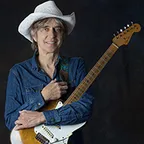
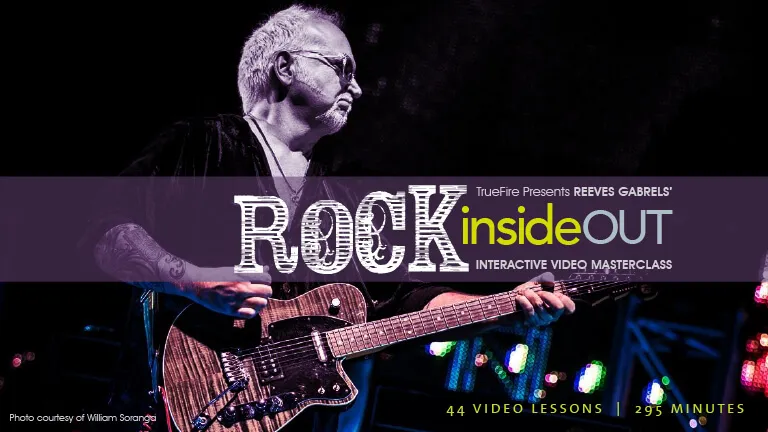
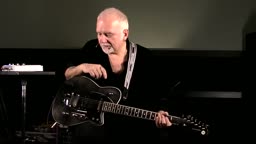
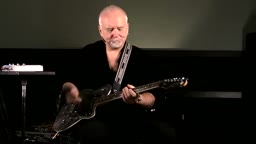
We’ve been majorly tuned in to Reeves Gabrels for a very long time and its an honor to welcome Reeves to the TrueFire family with this Rock Inside Out course, which we filmed in Nashville at SRI’s rehearsal studios and at the Bourbon Street Blues & Boogie Bar.
Called "one of the most daring rock-guitar improvisers since Jimi Hendrix,” Reeves Gabrels is widely recognized for his guitar virtuosity, versatility and uncanny ability to "explore sonic extremes with a great, adaptive intuition for what each song needs most.”
Currently a member of Cure, Reeves is best known for his work with David Bowie between 1987 and 1999. He’s performed, recorded and collaborated creatively with top artists worldwide and is widely respected by his peer guitarists and musicians.
Fortunately for we students of guitar, Reeves is also a gifted educator who is passionate about sharing his insight and creative approaches. Throughout the series of video lessons within Rock Inside Out, Reeves covers a scope of topics ranging from right and left-hand techniques to harmonic approaches for improvisation to gear and effects applications.
He’s also generously allowed us to share seven bonus performances from one of his live sets at Bourbon Street, which we include to demonstrate how all of Reeves fretboard strategies, effects applications and creative approaches sound when practiced for a lifetime and applied in a live performance setting. Sit back and enjoy these bonus gems!
Reeves organized the course into three sections. In the first section, he drills down on a variety of concepts and techniques that fuel his own signature sound: Top Strings: Voicings In Fourths, The Hendrix 6/9 Chord, Bottom Strings: Fourths, Fingering Options: Fourths, Vibrato Technique, The Whammy Bar, Pentatonic Approaches, Diminished Approach, Sonic Shapes, Speed Picking, Ionian Superimposition, Lydian Superimposition, Mixolydian Superimposition, Major Pentatonic, Aeolian Superimposition, Dorian Superimposition, Phrygian Superimposition, Minor Pentatonic, Whammy Bar Slides, Rhythm Guitar Approach, and Playing A Supportive Role.
NOTE! The video lesson on Speed Picking is worth the price of admission alone. Reeves demonstrates his “circle picking” technique, which powers his own speed picking prowess, and may very well be the answer that you’ve been seeking to power yours.
The next section covers his gear, but its far more than just a gear demo. Reeves is a master at painting with the kaleidoscope of sonic colors he creates with his rig. To the best of our knowledge, this is the first time that Reeves has explained the whats, whys and hows of his rig — you will walk away with serious insight for how to creatively tweak and apply your own effects.
Reeves walks you through: Tone & Gear Considerations, Wah-Wah Pedal, Multi-wave Distortion, Octave Fuzz, Univibe Pedal, Kaoss Pad, Signature Guitars, Blackstar 200 Watt, 2nd Pedal Board and the Vibrator (yes, that ‘vibrator’). Reeves then demonstrates the application of these effects across two impressive Loop Improvisations.
The third and final section features the aforementioned bonus performances referenced above: Bright Lights Big City, Problem, Nothing Left To Say, Wish You Were Here, Comeback and Messin' With The Kid. These performances illustrate how Reeves puts all the moving parts together in an engaging performance — put your guitar down and enjoy the show.
Other than the bonus performances, all of the key examples are tabbed and notated for your practice, reference and study purposes. You’ll also get Guitar Pro files so that you can loop and/or slow any section down as you work through the lessons.
Get Inside Out with Reeves Gabrels — your sonic palette will thank you for it!
What you'll learn
Master pressure control techniques for varying vibrato speed and character
Observe song structure with verses, chorus, and guitar solo
Study phrasing and dynamics in a full song context
Explore unconventional sound sources for creative guitar textures
Develop muting skills for controlling sustained mechanical tones
This collection of video lessons covers a variety of the techniques and creative approaches that I use frequently in my playing. We’ll cover topics such as Modal Superimposition, Sonic Shapes, Whammy Bar Techniques and Voicing in Fourths. We’re also going to explore, and expand on, some topics that you’re likely already familiar with such as the pentatonic blues scale; I’ll show you a whole new way of looking at it—using it as a base to take your playing from the ‘inside’ to the ‘outside’ as the title of this course implies. We’ll also examine circle picking and I’ll show you the root of where it comes from.
We’ll break down my gear and look at a few of the pedal boards that I use and I’ll show you how I dial in certain sounds.
I’ve included several performances to illustrate how to apply all of the principal techniques and approaches that we work on in the course.
So grab your guitar and lets dig in!
I like to use voicings in fourths for comping and soloing. I started using them because I was tired of using power chords and fourths worked better with distortion.
The overtones in distortion can often clash with power chords but fourths make distortion sound more consonant because there isn’t a 3rd being played. We’ll look at how to use voicings in fourths on the top strings and illustrate the differences in tone that they can create.
What led me to using voicings in fourths was the overlap between them and Hendrix’s playing. Hendrix would use the 6/9 chord in improvisational settings to get out of a solo and get back to the top of a verse. I also use the chord, without the root, to leave room for the other instruments.
In addition to using voicings in fourths on the top strings, we can apply the same technique to the bottom strings. This technique is useful if you’re playing in unison with another guitar player or a bass player. Using voicings in fourths on the bottom strings lets you follow along while making the lines more harmonically interesting.
When playing voicings in fourths, there are really only two fingerings that I use. We’ll look at ways to integrate these simple fingerings in many different situations, including chromatically and while comping in order to create motion and rhythmic interest.
Vibrato is my favorite way to embellish a note. In this lesson, we’ll look at several different types of vibrato and what they can do for your playing. Changing certain characteristics of the vibrato such as speed, hand position, tension, and others can help you identify with a certain vibrato and develop your own fingerprint.
The most common way to embellish a note is to use the whammy bar. Although easy to use in excess, it can get us closest to emulating other instruments like saxophone and horns, or even the human voice on guitar.
The whammy bar allows us to get both in front and behind the note by making it be both sharp or flat.
In this lesson, we’ll examine different whammy bar techniques such as trailing off notes, coming up to notes, microtones, and strumming.
We’ll also discuss the importance of finding the right set-up to optimize the amount of vibrato you can get from your whammy bar.
An Awesome Course - By One of the Great Musical Explorers
First, I have been a long fan of David Bowie's music. One reason is the caliber of musicians he picked to work with. They were always cutting edge. Reeves is one of those guys. I recently found an article from the 80s in Guitar World Magazine with David and Reeves, and I could see at that point when they were working together what David saw in Reeves as a musician collaborator. David said he let (and expected) Reeves to run wild. They were deep into experimental music at the time.
Well, in this course, we get to see how an innovative experimenter thinks and approaches his craft. FIrst Reeves clearly has awesome conventional chops and a understanding of music theory; which he readily shares. But he also shows you how he fits musical part's into his approach that at first glance would not seem to work, but they do. He also demonstrates technques that are so awesome, like the fake slide guitar with his vibrato. Using a vibrator in Ebow like fashion. And he gets really deep into his gear, something us "gear heads" always appreciate. He shows two of his pedal boards and demostrates how he uses the pedals.
Toward the end, he has several live performances with his band where he is the lead singer and guitarist.
Reeves comes off as not rehearsed in what he talks about. Its like setting in front of him doing a clinic. No teleprompter delivery. Very real. He's thinking about what he is trying to convey as he talks.
While this course may not be for everyone, I believe that there are a lot of folks out there that will find useful insight for the rock approach. This is one I go back to regularly. He is very entertaining; as well as a good teacher. One those guys that would be fun to talk about the old times with.
M
mattstutts2
10/03/18
Interesting
This is pretty unique look at playing theory from a very individualized artist. Reeves talks a lot about how he approaches music and works his way through pentatonic and modal playing. But the real insight here is his discussion on his gear, particularly his pedalboard. Reeves literally goes through all of the pedals he uses on his board and talks about why he picked that particular box, how he likes to set each effect, etc. You don't get that kind of insight from most instructors. So, really, there's more here that you'll just listen to rather than exercises to go through but it's still very interesting.