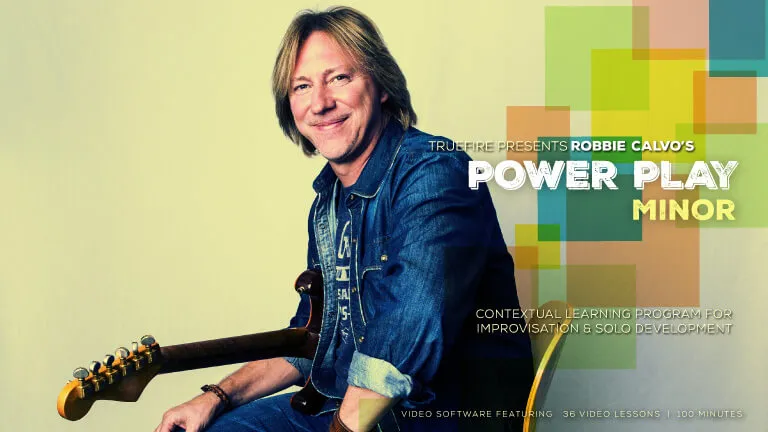
Any musician that does it really well will tell you there’s only one way to develop your improvisational skills — learn the theoretical fundamentals and then practice improvising, over a variety of changes, in a variety of keys and feels, as frequently as possible.
If you already have a grip on the fundamentals, and are fortunate enough to be able to jam live with other musicians several times a week, your improvisation chops will grow very quickly. But if you need a little help with the fundamentals, and don’t have the chance to play out as much as you’d like to, then Robbie Calvo’s Power Play Series will get there just as quick (maybe even a little quicker!).
Robbie’s Power Play Series is a contextual hands-on learning system focused solely on the development of improvisational skills. No tedious theory or boring exercise to struggle through — you will play and improvise your way through the entire series.
Robbie’s 6-minute improvisation workouts are the core learning tools of the series. Each workout features a rhythm track with a series of 8-bar progressions that change key four times throughout the workout,. The progressions and keys loop four times to net approximately six minutes of non-stop soloing and improvisation.
The Workouts are organized by tonalities (Minor Pentatonic, Dorian and Phrygian) and for each tonality, Robbie gives you a Road Map to follow which includes chord progression breakdowns, applicable scale shapes and patterns, fretboard navigation tips, “sweet note” resolutions, phrasing insight and a variety of other improvisational tips.
“I’ve designed the Power Play Series to emulate the real world experience of playing in a variety of keys and tonalities, across a variety of chord progressions. When jamming and improvising, you really never know what tune or progression might be called out, or even what to do over that progression. My 6-minute workouts will be challenging at first but after just a few practice sessions with them, the student will be amazed just how comfortable and creative they’ve become playing in multiple keys and feels all over the fretboard — on the fly!”
The Power Play Series consists of three modules..
Power Play: Major focuses on 3 Major Scale Types for improvisation - The Major Pentatonic Scale - The Major Scale (Ionian Mode) - The Lydian Scale. You'll learn to apply and improvise with all 5 of your Major Pentatonic scale forms, 7 Major scale forms and 7 Lydian scale forms across the entire fingerboard.
Power Play: Minor focuses on 4 Minor Scale Types for Improvisation - The Minor Pentatonic Scale - The Dorian Mode - The Phrygian Mode - The Aeolian Mode (Natural Minor). You’ll learn to apply and improvise with all 5 of your Minor Pentatonic scale forms, 7 Dorian, Phrygian and Aeolian scale forms across the entire fingerboard.
Power Play: Dominant focuses on 3 Scale Applications for Dominant chord progressions - The Major Pentatonic - The Blues Scale - The Mixolydian Mode. You'll learn to apply and improvise with all 5 of your Major Pentatonic Scale forms, 5 Blues Scale forms and 7 Mixolydian Scale forms across the entire fingerboard.
All of Robbie’s improvisation performance examples, across the entire series of modules, are tabbed and notated for your reference purposes. Plus, you’ll get all of the rhythm tracks to work with on your own as you learn to craft your own original improvisations.
Grab your guitar and Power Play!
What you'll learn
Navigate Aeolian scale shapes in 5th position across four different keys
Understand Aeolian mode as the 6th mode of the major scale
Understanding the role of each component in the signal path
Learning about gear choices that contribute to professional tone
Gaining insight into professional recording setup for guitar
Welcome to Power Play - Minor Edition. You are about to embark on one of the most powerful solo development learning programs available. Whether you are just starting out learning your scale shapes or are a seasoned pro, Power Play will challenge you to the fullest every time. Power Play Minor is the application of the minor pentatonic, Dorian mode, Phrygian mode and the Aeolian natural minor mode over 4 custom designed minor tonality chord progressions.
Each 8 bar chord progression will change key 4 times and then repeat for a total of 4 cycles. These are not exercises, they are solo sections that you improvise using designated scale types and patterns. You'll be applying all 5 of your minor pentatonic scale forms, 7 Dorian, Phrygian and Aeolian scale forms across the entire fingerboard. I've set up some specific challenges for you to try as well - playing in position over the 4 key changes, shifting position after one complete cycle of changes and using the entire fretboard to improvise each 8 bar solo section. I challenge you to Power Play Minor and the following improvisational workouts.
What Is Power Play? Power Play is the ultimate chop builder and solo crafting method for guitarists. These soloing workouts are not exercises, you'll be crafting and improvising solos through a series of 8 bar progressions that change key four times. The series of four key changes will loop 4 times to give you approximately 6 minutes of focused soloing. Sound easy? We'll see.:-)
I've crafted each track to work specifically with the scale type I suggest you work with in each section, however in true fashion each track will also serve as a foundation for the other scales in the course so that you can change it up if you'd like to.
You should strive to phrase and pace each of the 8 bar solos as if they were real solos. You'll need to end each solo with a resolution point (Sweet Note) and be conscious of the key change that is coming next. If you can phrase the end of your solo to flow into the next key that would be really cool too.
I want you to become the ultimate improviser so let's take a look at how to maximize the potential of this course. How to Use Power Play I'm going to make some suggestions on how you work through this course but it will be up to you to be honest about what level you are at. If you are just starting to learn all of your scale shapes for each scale type you may want to play through the entire length of the track in one position so that you can become really familiar with the shapes in only one place on the neck. Once you are comfortable in that position, move into the next fretboard location and play through the entire track using the shapes for each key found at that location. Please be aware that this process may take months depending on how much you get to play.
I want you to improvise each 8 bar section as if it were a real solo. Think about the beginning, middle and crescendo to each 8 bar solo. Phrasing, dynamics and pace are all important aspects to remember as you improvise your solos.
After each full track playing session - TAKE A BREAK AND RE-FOCUS - THIS IS REALLY IMPORTANT!
Assignments 1. Play through the entire length of the track in one fretboard location changing scale pattern shape to accommodate the key that is playing. This is going to strengthen your knowledge of the four scale shapes found at that location. This process may take several weeks. Stick with it until you really know those shapes and can create interesting solos.
2. Play through the entire track and its looped four key changes in the next fretboard location to the previous one you've been working in. This means that each scale shape will be different for each of the four keys! Continue applying this process with all of your scale patterns across the fretboard until you've got all of the scale patterns under your fingers, in your mind and breathing from your soul.
3. Improvise through one complete cycle of the four key changes in one fretboard location. Shift into the next fretboard location and improvise using those shapes over the next sequence of four 8 bar key changes. Shift again into the next position on the next sequence of 4 key changes. At the end of that sequence shift again into the next fretboard location. By the end of the track you should have played in four consecutive fretboard locations. As an extra assignment you could ascend through your shapes for one complete track cycle and descend through your shapes on the next complete track cycle.
4. This is where it all comes together and you will see your chops expand across the horizon of all of your scale shapes. Improvise using the entire fretboard if you so wish, crafting your 8 bar solos. Shift into the next key at the location your last solo ended if possible. You don't have to do this but it would be really powerful if you could.
That's how Power Play works. The benefits of working through this program
Learning/solidifying all of your scale types and shapes over a minor tonality and chord progressions using the minor pentatonic scale, Dorian, Phrygian and Aeolian modes. Internalizing how an 8 bar section of music sounds and feels. Learning how to craft a solo with a beginning, middle and crescendo using pace, dynamics and taste within 8 measures of music. The ability to improvise through key changes in position and using the freedom to improvise using the entire fretboard to craft your solos.
In this first section we are going to be improvising using all five minor pentatonic shapes. We'll be applying those 5 shapes over a minor chord progression that changes key 4 times. The sequence of 4 key changes will loop for a total of four times. The idea is to solidify your knowledge of each of those shapes in position on the fretboard and to use them freely across the fretboard without restriction. The challenges are to be able to do that through a series of continuous key changes, and to craft 8 bar solos that have cool phrasing, Sweet Notes and a beginning, middle and crescendo as well.
Each chord progression example presented in Power Play Minor edition consists of one chord progression that has been transposed into 4 different keys. Each key lasts for the duration of 8 bars. In this first example you are going to be playing over these 4 keys in sequence - F#mi - Ami - Cmi - Ebmi. yes, Ebminor, come on now, there has to be some hard ones! This sequence of key changes will repeat 4 times. Don't think that's long enough? Well, this sequence played 4 times will be approximately 6 minutes. That's 6 minutes of intensely focused solo creation in 4 different keys 4 times over. Now that’s what I call an improv workout!
Check out the chord chart and my breakdown of the chord progression to see what is actually happening in the harmony. It's not necessary to learn the chord progression but if you are curious and want to take your studies a little further, go ahead, it's a nice little vamp you can jam with your friends at another time.
In the first performance demonstration you will see and hear me improvise over all four keys, in position using only the minor pentatonic scale. Watch closely as you listen to each 8 bar section and count the bars if you need to. You'll notice that I use a new shape for each of the four keys. You’ll want to craft your lines for each 8 bar section using pace, dynamics and crescendos. If you can target the Sweet Notes that would be really incredible!
Let's take a look at my first performance and get you into your first Power Play Minor workout.
In this first solo sample you are listening to me play the minor pentatonic scale in position over 4 different key changes. Each of those keys lasted for 8 bars. The idea being that you improvise an 8 bar solo in each key using one pattern for each key change without shifting. Why? Because this is going to strengthen your knowledge of those scale shapes and your chops within each shape, in position and make you compose/phrase your solos in 8 bar sections. I hope you enjoyed my 4 solos over this cool minor groove, now it’s your turn. Get yourself ready to focus completely for the next 6 minutes.
Your first exercise is to play your minor pentatonic scale shapes in position over the first sequence of chord changes. 8 measures each of F#mi - Ami - Cmi - Ebmi respectively.
Improvise a solo for each key staying in position on the fretboard. The sequence will repeat four times. This should be ample time for you to explore the four shapes in the position you choose to work in first.
Take a break and then prepare yourself to play in the next fretboard position. You can call this position 2 or solo workout 2 if you’d like. These will all be new shapes for each new key. Now play through the complete sequence of changes again in your new fretboard location.
Your assignment is to repeat the process moving through all five positions of the minor pentatonic scale shapes in position each time. An extra challenge for those of you who can play all of your minor pentatonic scale shapes - shift to the next location on the fretboard after one sequence of four key changes. This means by the end of the full track you'll have played in four different fretboard locations! That’s quite a workout!
Robby is a great teacher.
In this course you can use the right notes in the right context. congratulations
D
douglove1000
Verified buyer
04/05/21
Minority report
Courses from the PowerPlay series are designed to increase your autonomy and let your creativity flow by giving you all the necessary material and framework (major, minor, etc...). As always with Mister Calvo, there is a lot of licks to copy and integrate to your own music. You must have the basis (scales, licks, some improvisation skills) to really take advantage of this course.
M
morningfield
Verified buyer
11/18/20
Thanks !!
J
Jeffochka
10/30/18
No Minor Accomplishment
I love the teacher’s easygoing style. You get a lot of content and absolutely no fluff; the teacher stays on subject and keeps the lessons bite-size so you are able to learn as much as possible in a short amount of time and you are able to keep adding layers of knowledge with each new lesson. Great teacher and great material! Robbie Calvo is unbelievable and his courses all blow me away. He makes theory so accessible while keeping it practical and fun! Great stuff on the application of the minor scale.