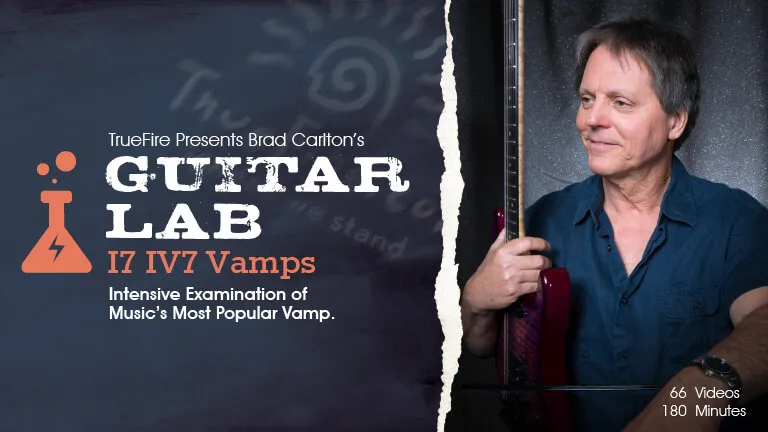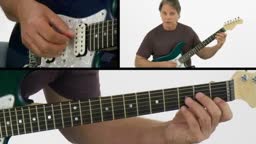

Guitar Lab: I7 to IV7 Vamps

Learn all the tools necessary to play a I7 IV7 progression

Marty FriedmanTommy EmmanuelSteve VaiEric GalesEric Johnson

Get this course and 1,000+ more with All Access

Try 14 days free. Cancel any time.

Purchase Individual Course for $5.00
Guitar Lab: I7 to IV7 Vamps

About this course

This course is designed to equip you with the tools necessary to play a I7 IV7 progression. You will be supplied with three jam tracks all of which support this progression in the street key of C. These jam tracks are in a drum/bass format. They are all in a shuffle feel. You will learn the theory that applies to dominant family chords with special emphasis on the guide tones. You will learn how to build chord voicings that connect the C7 and F7 chords in a very musical fashion by applying voice leading on each string of each chord. You will also learn how to extend these chords thus establishing a jazzier sound. The application of the C blues scale over both chords is another sound that will be presented.

What you'll learn

  • Apply voice leading principles to jazz chord progressions
  • Create simple melodies using notes from chord voicings
  • Identify chord tone functions (root, 3rd, b7) in each voicing
  • Recognize and use common tones between chord changes
  • Understand how each voice moves between the two chord voicings
Release date: 11/19/2014 • 3h 00m runtime
Start Course
Sample lessons
C7 F9: Pt 1
C7 F9: Pt 1
C7 F7 Vamp Chord Voicings
C7 F7 C7 F9
C7 F7 C7 F9
C7 F7 Vamp Chord Voicings
C7 F7: Pt 1
C7 F7: Pt 1
C7 F7 Vamp Chord Voicings
C7 F9: Pt 4
C7 F9: Pt 4
C7 F7 Vamp Chord Voicings

What's included

66 lessons • 65 charts • 1 Jam Tracks

Guitar Lab: I7 IV7 Vamps
This course is designed to equip you with the tools necessary to play a I7 IV7 progression. You will be supplied with three jam tracks all of which support this progression in the street key of C. These jam tracks are in a drum/bass format. They are all in a shuffle feel. You will learn the theory that applies to dominant family chords with special emphasis on the guide tones. You will learn how to build chord voicings that connect the C7 and F7 chords in a very musical fashion by applying voice leading on each string of each chord. You will also learn how to extend these chords thus establishing a jazzier sound. The application of the C blues scale over both chords is another sound that will be presented.
Chord / Scale Theory
Chart 1 is a master chart of the major scales and their modes. In the key of C. C is scale degree I and F is scale degree IV. In major scale theory the only place that a dominant seventh chord is build is on the fifth step the scale. This means that when you play C7 chord, the key of the moment would be F major. You will be playing the V chord in the key of F which would utilize mode V which would is C mixolydian. Chart number two shows the C mixolydian mode with the guide tones highlighted in red. This same theory that has just been presented would apply to the F7 in your progression. The F7 would be the V chord in the key of Bb major (see chart 1). So from a theoretical standpoint, when you change chords you change keys. To summarize this theory, the C7 is the V chord in the key of F and the F7 is the V chord in the key of Bb. Therefore your modes are C mixolydian and F mixolydian. Chart number two shows how the notes function in each of these modes. The C blues scale is also presented in terms of scale degrees. Chart number three is very important because it explains how each note that you play over the I7 chord will change meaning when played over the IV7 chord. Diagrams one through six display this information in the lower area of the fingerboard.
Bass Line
This lesson focuses on the bassline of these two chords in your jam tracks. Make sure you can hear these bass notes and play along with them. Example 1 shows this bassline in tablature and standard notation.
Guide Tone / Root Structures: Pt 1
Example 2 shows the guide tones on the third and fourth strings for each of these two chords and also the bassline. Practice playing against the jam tracks with root/guide tone structures and also with just the guide tones.
Guide Tone / Root Structures: Pt 2
Example 3 shows the guide tones on the second and third strings for each of these two chords and also the bassline. Practice playing against the jam tracks with root/guide tone structures and also with just the guide tones.
1st Voice Common Tone: Pt 1
Example 4 builds on top of example to buy utilizing a common voice on the second string for both chords. This top voice is the root of the C7 chord in the fifth of the F7 chord.
1st Voice Common Tone: Pt 2
Example 5 uses the same structures as in the previous example but the top voice is an E flat. This note is the sharp nine of the C7 and the flat seven of the F7.

+ 59 more lessons

Start Course

Reviews

2 results

sindibad

09/03/19

Guitar Lab: I7 to IV7 Vamps

It is a very important tool for working arpeggios, always in great pedagogical quality.

tonylaurent

Verified buyer

09/01/19

Brad Carlton's Guitar Lab: I7 to IV7 Vamps

Get Dr Carlton's railway tracks to theory and dominant chords based on guide tones. This course will give you shuffle jam tracks and point you to mastery of essentail blues.

Stop searching. Start improving with All Access.

Try 14 days free. Cancel any time.