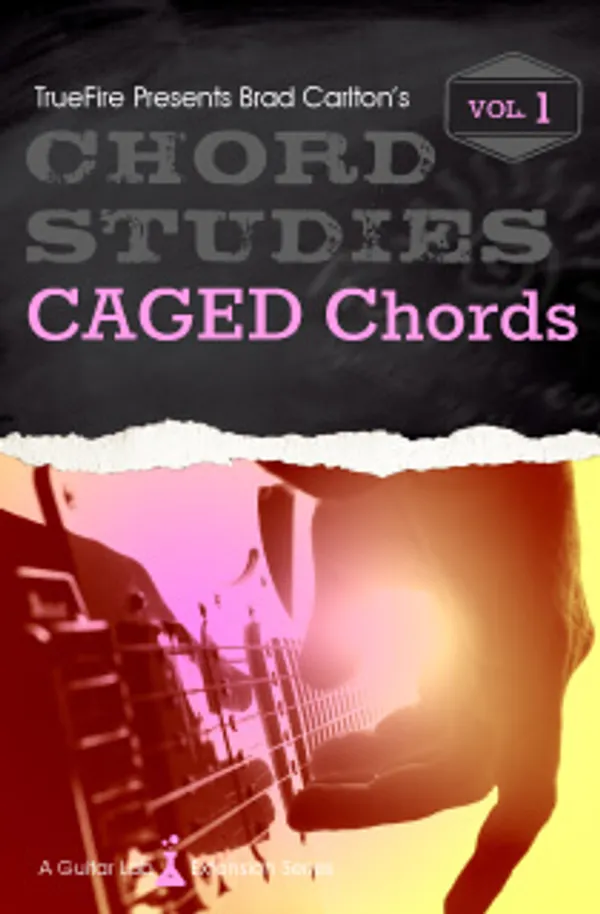
Blues progressions can be simple or very sophisticated. Either way they’ll sound great IF you voice the chords properly and alter the changes and structures correctly. And that’s exactly what you’ll be doing after you’ve these voicings and alterations to your blues comping bag.
About the Chord Studies Series
If Forest Gump’s shrimp-loving Bubba played guitar, his take on chords might go something like this, ”You can strum ‘em, fingerpick ‘em, arpeggiate ‘em, mute ‘em, alternate tune ‘em, voice lead ‘em. Dey’s uh, barre chords, altered chords, extended chords, moveable chords, cluster chords, slash chords, inversions, triads, diads. There’s jazz chords, power chords, blues chords, cowboy chords, block chords, open chords…”
Bubba would be right — there’s a wide and wonderful world of chords for we guitarists to explore. But what’s the best way to do that? Chord dictionaries might be handy references but there’s no context (and really, when’s the last time you looked at one of those?).
Theory and harmony instructionals are filled with chord construction strategies and applications and we highly recommend digging as deep into the science of chords as your left brain will allow you.
However, learning new chords, progressions, applications and right-hand techniques in a musical context (songs, etudes, jamming with other players, etc.) is the most popular approach and that is the educational premise behind Brad’s Carlton’s Chord Studies course seres.
Each edition of Chord Studies features 15 play-along and jammable chord studies, which are focused on a particular chord type, chord progression or chord application. While Brad does touch on rhythmic qualities, this is not a rhythm guitar course — these studies are specifically designed to significantly expand your chord know-how and vocabulary.
Brad covers a range of styles, levels , chord types and progressions across 10 editions: CAGED Chords, Jazz Blues Progressions, Open String Chords, Rock and Pop Progressions, Slow Blues Progressions, Evolving Blues, Evolving Triads, Slash Chords, Power Chords and Beginner Chords.
Each of the 15 Studies within an edition includes an overview from Brad followed by a performance and play-along of the chord study over a rhythm track. Chord grid charts and a chord lead sheet accompanies each study. Plus, you’ll get all of the practice rhythm tracks to work with on your own.
Reference the chord charts to become familiar with the voicings and their fingerings, and then use the lead sheet to play-along with Brad’s video performance. Try different rhythmic patterns over the supplied rhythm tracks and then take it all to your own playlist of songs and jam tracks.
What you'll learn
Execute smooth voice leading between 7th chords in a blues progression
Perform hyper-extension technique for extended voicings
Apply voice leading principles in turnarounds
Apply barre technique for hand stability even when not strictly necessary
Understand how chord voices move melodically between changes
Hi this is Brad Carlton. Welcome to this Guitar Lab edition focused on Evolving Blues Progressions. Each individual edition of this Guitar Lab series features 15 studies focused on a particular application of chords. I designed this series to provide you with unlimited creative options for crafting interesting and compelling rhythm guitar parts. interesting and compelling rhythm guitar parts. Across the series we'll explore essential and exotic chord voicings, all number of different blues progressions but they are all either 12 bar blues progressions or eight bar blues progressions. I'll break down and demonstrate the chord tracks in a variety of styles using chord progressions commonly encountered in that style. You'll also get chord diagrams that will clearly give you the left hand fingerings and you'll get the jam tracks for you to work with on your own.So, get your guitar and let's make some music.
You're going to be studying a number of different blues progressions, but they're all either twelve bar blues progressions or eight bar blues progressions. Our last three in this group will be eight bar blues progressions. Now in a standard 12-bar blues the basic form would just use three different chords. A I VII, IV VII, and V VII. We're going to be in the key of A, so that means that you have A VII, D VII, and E VII. We'll start with a very simple form that doesn't have a whole lot of chordal activity, meaning you're not changing chords very frequently. Then we'll gradually build in with substitutions that come from the jazz vocabulary. And you'll also learn a lot of different voicings. Voicings that include a bass note, so if you're by yourself you'd hear it, but also voicings that delete the bass note, so if you're in a jazzy situation or you've got a bass player that's walking you won't get in their way. I'll be talking about pivot and guide fingers. Prepared guide fingers. All kind of techniques like double stops, where you're hyper extending a finger to capture two adjacent strings in the same fret and you'll also learn a lot of things about dampening and how to keep things clean. So, let's have some fun, start simple, get a little more complex.
This progression starts out with A7, and adds the G note on the first string for a little extra flavor in bar 4, but other than that it is just a good straight ahead 12 bar blues in A.
This progression starts out with A7, and adds the G note on the first string for a little extra flavor in bar 4, but other than that it is just a good straight ahead 12 bar blues in A.
When you have a "quick change" in a blues, it means that in measure 2 it goes to the IV chord. Which in this case, since we are in the key of A, is the D7. In this version we have also added the V7 chord in measure 12, which is a great way to make a progression want to start over, because a V chord always wants to resolve back to I.
When you have a "quick change" in a blues, it means that in measure 2 it goes to the IV chord. Which in this case, since we are in the key of A, is the D7. In this version we have also added the V7 chord in measure 12, which is a great way to make a progression want to start over, because a V chord always wants to resolve back to I.
Here we add the D#dim7 chord in the second half of measure 2 and in measure 6. You will hear this helps you "step" into the next chord.That is one of the important concepts in becoming a great chord master - being able to use one chord to get you to the next!