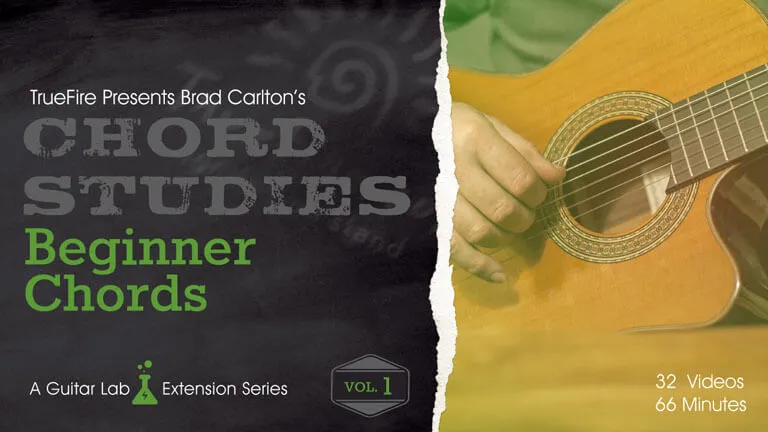
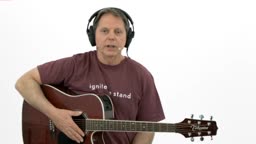
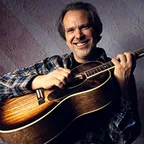
These 15 beginner studies are focused on helping you learn how to change chords smoothly without missing a beat -- an essential skill for any guitar player. You’ll also learn to work with the E, C, F, G, A, D, E minor, A minor and other common chords that you’ll need to play hundreds of your favorite songs.
About the Chord Studies Series
If Forest Gump’s shrimp-loving Bubba played guitar, his take on chords might go something like this, ”You can strum ‘em, fingerpick ‘em, arpeggiate ‘em, mute ‘em, alternate tune ‘em, voice lead ‘em. Dey’s uh, barre chords, altered chords, extended chords, moveable chords, cluster chords, slash chords, inversions, triads, diads. There’s jazz chords, power chords, blues chords, cowboy chords, block chords, open chords…”
Bubba would be right — there’s a wide and wonderful world of chords for we guitarists to explore. But what’s the best way to do that? Chord dictionaries might be handy references but there’s no context (and really, when’s the last time you looked at one of those?).
Theory and harmony instructionals are filled with chord construction strategies and applications and we highly recommend digging as deep into the science of chords as your left brain will allow you.
However, learning new chords, progressions, applications and right-hand techniques in a musical context (songs, etudes, jamming with other players, etc.) is the most popular approach and that is the educational premise behind Brad’s Carlton’s Chord Studies course seres.
Each edition of Chord Studies features 15 play-along and jammable chord studies, which are focused on a particular chord type, chord progression or chord application. While Brad does touch on rhythmic qualities, this is not a rhythm guitar course — these studies are specifically designed to significantly expand your chord know-how and vocabulary.
Brad covers a range of styles, levels , chord types and progressions across 10 editions: CAGED Chords, Jazz Blues Progressions, Open String Chords, Rock and Pop Progressions, Slow Blues Progressions, Evolving Blues, Evolving Triads, Slash Chords, Power Chords and Beginner Chords.
Each of the 15 Studies within an edition includes an overview from Brad followed by a performance and play-along of the chord study over a rhythm track. Chord grid charts and a chord lead sheet accompanies each study. Plus, you’ll get all of the practice rhythm tracks to work with on your own.
Reference the chord charts to become familiar with the voicings and their fingerings, and then use the lead sheet to play-along with Brad’s video performance. Try different rhythmic patterns over the supplied rhythm tracks and then take it all to your own playlist of songs and jam tracks.
What you'll learn
Use muting technique to practice chord transitions
Control which strings are strummed for each chord
Eliminate string squeaks during chord changes
Maintain finger contact with strings during transitions
Understand proper hand rotation between chord shapes
Hi this is Brad Carlton. Welcome to this Guitar Lab edition of Beginner Chord Studies. Each individual edition in this guitar lab series features 15 studies focused on a particular application of chords. I designed this series to provide you with unlimited creative options for crafting interesting and compelling rhythm guitar parts. Across the series we'll explore essential and exotic chord voicings, all-purpose substitutions, creative approaches, and performance techniques. We'll also include a few bar chords, but you can get a lot of technical tips about how to keep from hitting too many strings. How to keep string noise down and also how to efficiently change form one chord to another. You'll learn about pivot fingers, guide fingers. You'll also learn how to observe what you're doing with your wrist and your thumb, so you can get your chords clear with minimal effort. I'll break down and demonstrate the chord studies over rhythm tracks in a variety of styles using chord progressions commonly encountered in that style. You'll also get chord diagrams that'll clearly give you the left-hand fingerings. And you'll get the jam tracks for you to work with on your own. So get your guitar and let's make some music.
We're going to talk about how to change chords down in open position. All of your basic forms that you learn when you're first getting started on the guitar. We'll also include a few bar chords, but you're going to get a lot of technical tips about how to keep from hitting too many strings, how to keep string noise down, and also how to efficiently change from one chord to another. You'll learn about pivot fingers, guide fingers. You'll also learn how to observe what you're doing with your wrist and your thumb, so you can get your chords cleared with minimal effort.
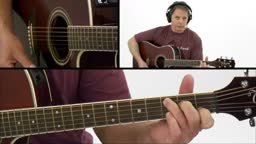
In this example you'll be playing two chords: a C for one measure and an A Minor for one measure. Start by playing whole notes, or holding the chord for four beats on each chord, and then once you have become comfortable with the change between chords, you can start to mix in some more picking hand patterns and rhythmic variation. As far as the fingering is concerned, these two chords exhibit a very important fingering principle called "pivot fingers". That means that the same finger stays in the same fret on the same string when you change chords. Your first and second fingers in this example will work as pivot fingers. Don't worry if they shift slightly in the fret, but try not to remove them from their respective strings.
In this example you'll be playing two chords: a C for one measure and an A Minor for one measure. Start by playing whole notes, or holding the chord for four beats on each chord, and then once you have become comfortable with the change between chords, you can start to mix in some more picking hand patterns and rhythmic variation. As far as the fingering is concerned, these two chords exhibit a very important fingering principle called "pivot fingers". That means that the same finger stays in the same fret on the same string when you change chords. Your first and second fingers in this example will work as pivot fingers. Don't worry if they shift slightly in the fret, but try not to remove them from their respective strings.
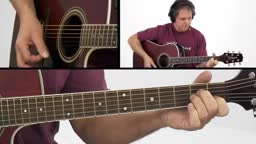
Here's an example that uses a common progression of two chords: a G and an E Minor. Each chord should be played for four beats. In this example, it's very important that you maintain your second finger in contact with the fifth string in the second fret when you change chords. This is another example of using a "pivot finger" like we used in the last example.
Here's an example that uses a common progression of two chords: a G and an E Minor. Each chord should be played for four beats. In this example, it's very important that you maintain your second finger in contact with the fifth string in the second fret when you change chords. This is another example of using a "pivot finger" like we used in the last example.
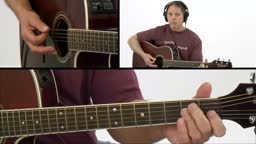
This is an example of a great sounding change: E Minor to B7. Each chord in this example should be played for four beats. Your second finger will be a pivot here, which means you do not lose contact with the fifth string when you change chords. Practice it with playing only whole notes until you are comfortable with the change, and then try adding in some rhythmic variation.
I’ve already gone through beginner courses like Justin Guitar and TrueFire, but I feel that this course has helped me play more accurately and beautifully. It’s probably not aimed at complete beginners, but I think it’s an excellent course for people like me who can already play piano and understand music theory, and who find the usual beginner courses unsatisfying. Unlike many intro courses that make odd compromises, this one actually teaches beginners important points—like muting techniques—that are often overlooked, which is really appreciated.
O
obbig
Verified buyer
01/05/25
Follow the instructions, not the instructor!
This is a great course for those wanting to learn how to play chords efficiently whilst learning the chords themselves. It might not be everyone's cup of tea, but learning how to finger two chords and changing between them with minimal movement each lesson sounds/feels a lot more musical as you learn than strumming a single chord in a playalong for two minutes lol.
Speaking of that don't make the mistake others did whilst going through this course. This course is about beginner chord shapes and moving between chords in an efficient manner - that is the part the student is instructed to learn. The extra arpeggios and flourish Brad throws in is not tabbed for a reason, it's there to make the lesson more musical to listen to. The basics can feel boring at times but to play well they are important to learn, so having an instructor throw some flavour into the mix as you concentrate on your part is most welcome.
S
Stefan447
02/13/24
Glad I took a step back
I'm really happy I took a step back and did this basic chord training! I've learned a lot of fundamental tricks to make chord changes easier that I otherwise would have missed. This teacher is excellent.
S
Shivxs
Verified buyer
12/23/23
Older Beginner
I do mean older. I like having the videos with the lessons. My guitar teacher turned me on to this site and the teaching has been awesome. I have purchase several programs and have never been disappointed with the contents.
R
RobertBarros
Verified buyer
12/08/23
Viewpoint from a Novice Player
I have embarked on a self-teaching journey using platforms like YouTube, Instagram, and TikTok. Throughout this experience, I've observed a notable absence of guidance on where to start or even if there is a specific starting point. One common pitfall I've encountered in self-teaching is putting the proverbial horse before the cart.
Take, for example, a particular instructor whose class received negative reviews from individuals complaining about the absence of a demonstrated strumming pattern. Despite this criticism, I observed that the instructor, when playing along, employed a sophisticated yet straightforward strumming pattern. The crux of the class, however, revolves around transitioning between chords rather than emphasizing the strumming technique. I contend that instructors, not just the one in question, should prioritize this approach to enhance the class's appeal and enjoyment factor. It also fosters a sense of aspiration, instilling a desire in learners to replicate the skill.
Here's my advice: adhere to the primary instructions provided. In my own experience, after dedicating an hour to practice, I successfully replicated the instructor's strumming pattern through attentive listening. This underscores the effectiveness of focusing on core concepts before delving into intricate details, ultimately fostering a more rewarding and productive learning experience.