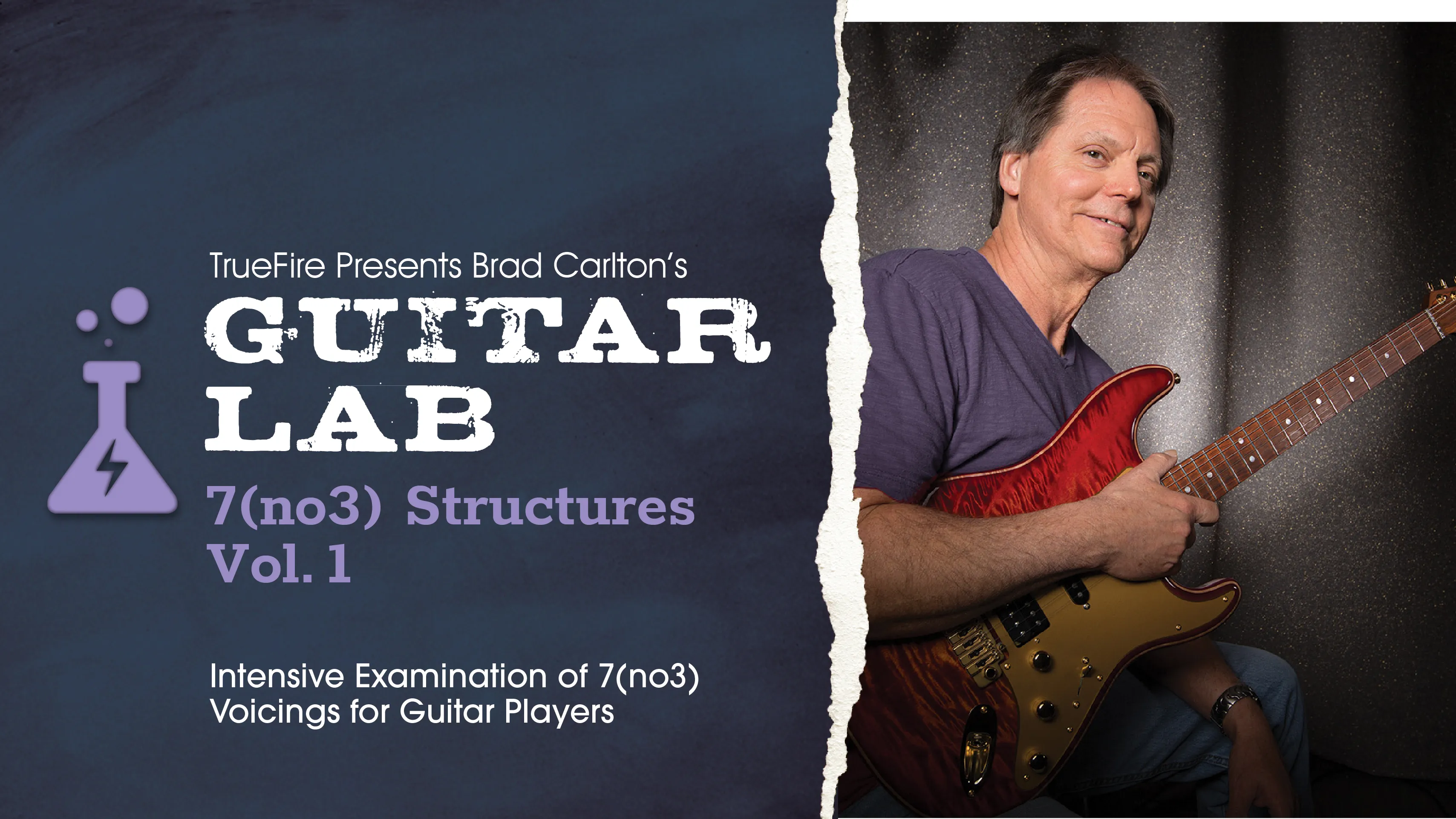
7(no3) Structures Vol. 1 takes a deep dive into one of Brad Carlton’s most practical and flexible guitar concepts: the 7(no3) voicing. Built from the flat seven, root, and five, this lean three-note structure leaves out the third, creating an ambiguous sound that works beautifully in both dominant and minor settings. That makes it an ideal tool for comping, jamming, and building musical ideas that stay open, colorful, and highly adaptable.
Brad breaks down how these structures connect to the larger 12-note chromatic system, showing you how to understand them as movable fretboard concepts rather than isolated chord grips. You’ll learn how to visualize the voicings across multiple string sets, work through their inversions, connect them to familiar chord forms, and use nearby tones to create bluesy movement, chord melody, and expressive embellishments.
Along the way, the course strengthens much more than just your chord vocabulary. You’ll sharpen your theory, improve your fretboard awareness, develop better fingerings, and train your ears to hear how small note changes create major shifts in color and function. By the end of the course, you’ll have a powerful new way to comp, solo, and explore the guitar with more freedom and confidence. So grab your guitar, open up the fretboard, and let’s dig into 7(no3) structures.
Hi, I am Brad Carlton, and we’re going to talk today about a 7 0 3 structure. As the name implies, it does not define whether it’s dominant or a minor seven. You’re going to learn how to see this information on the fretboard, because I’ll show you how to move patterns around so that, systematically, you can see the duplication that exists on our fretboard. You’re also going to learn how to jam all by yourself by using these structures and applying different modes, because this structure is a subset of many different scales. So grab your guitar, and let’s do a 7 0 3 structure study.
In this lesson we will cover the big-picture idea behind the 7 no 3 structure and why it is such a useful tool on the guitar. We will talk about how all music comes from the 12-note chromatic scale, why this voicing is ambiguous without the third, and how that lets it work in both dominant and minor situations. We will also begin connecting this structure to familiar chord shapes so it feels practical right away.
In this lesson we will learn how to start using the 7 no 3 structure on the top three strings and hear how it functions over a bass note. We will look at the basic shape, understand it as flat seven, one, and five, and begin exploring how even just three notes can create strong musical ideas. We will also start adding simple movement around the shape so you can hear blues color, tension, and release.
In this lesson we will cover how to build more music out of the 7 no 3 structure by adding nearby notes and simple embellishments. We will work with ideas like the flat five, four, flat three, and nine, and hear how those notes change the sound while still staying connected to the original voicing. This is where the structure starts to feel more like chord melody and less like just a static grip.
In this lesson we will learn how to invert the 7 no 3 structure and begin seeing all of its positions on the top string set. We will go through the inversions step by step, talk about what an inversion really is, and learn why the top note matters so much to the overall sound. We will also explore fingering options so you can move more smoothly and start using these voicings musically instead of mechanically.
In this lesson we will cover how to move the 7 no 3 structures from the top three strings down to the next string group. We will use the tuning of the guitar to understand how the shapes duplicate across the fretboard, and we will deal with the small adjustment caused by the tuning difference between the third and second strings. This helps you stop thinking of shapes as isolated grips and start seeing how the whole instrument connects.
In this lesson we will learn how to use these duplicated shapes on the second, third, and fourth strings for jamming, phrasing, and tonal variety. We will compare the same voicings in different places on the neck, hear how the tone changes, and start building simple melodic ideas across the string set. We will also begin applying modes like Dorian, Aeolian, and Mixolydian so the structure becomes a real improvising tool.
Another great lesson by Brad Carlton who in my opinion is one of the best instructors on Truefire. This lesson really opens up alot of possibilities for comping and improvising. Im looking forward to the next volume. Thanks again for these lessons!
F
Flip
03/02/26
a curious chord
This is a chord structure that serves as a great anchor for many concepts. It's ambiguous quality means you have the freedom to see it from different perspectives, which is great when you're connecting information (shapes and structures from CAGED, tonal qualities, ect) from an analytical standpoint, as well as just having the freedom to use it musically and improvising. As usual Brad is a wonderful teacher and every lesson is packed with wisdom you can apply to nearly everything you play.