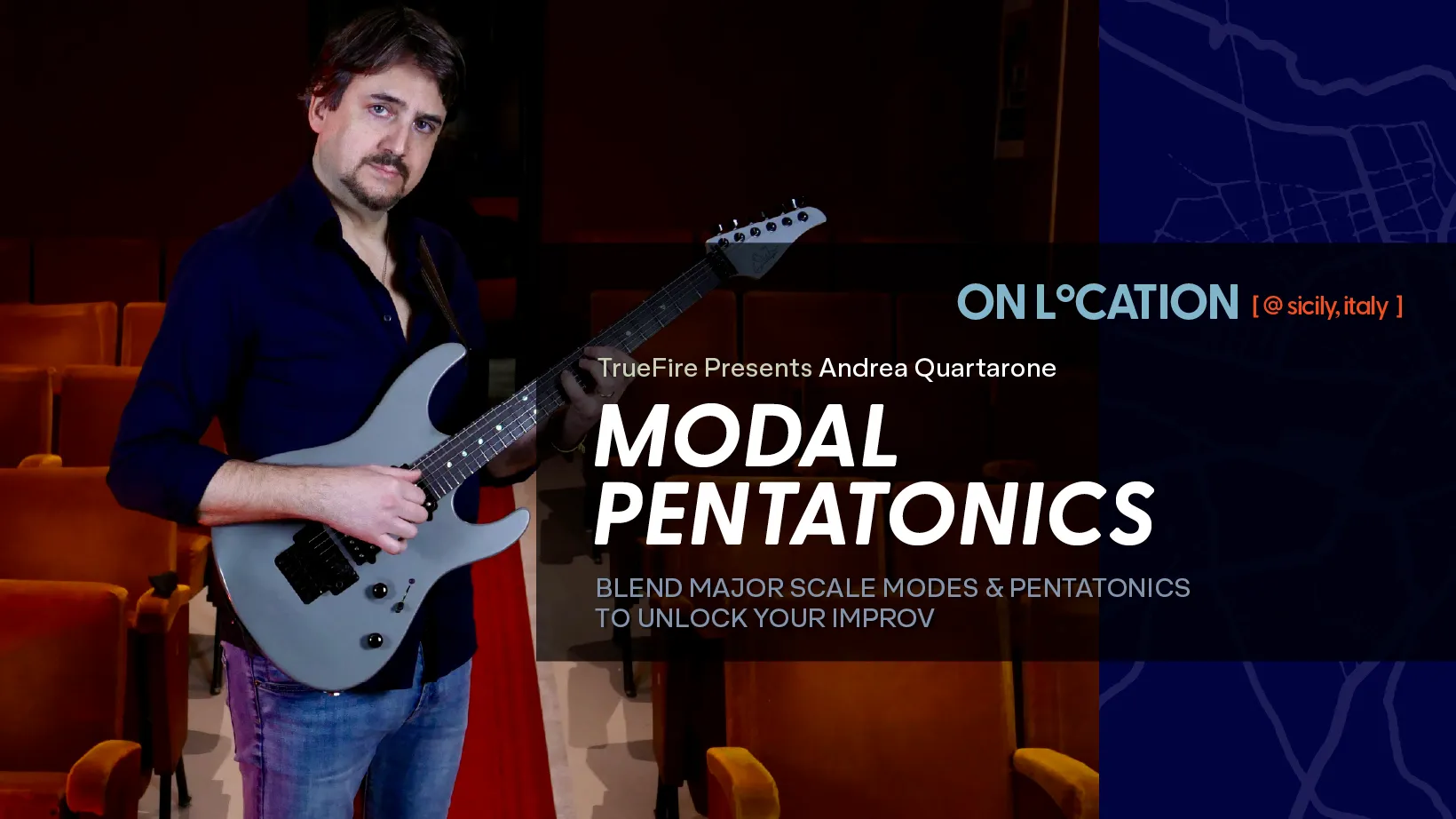
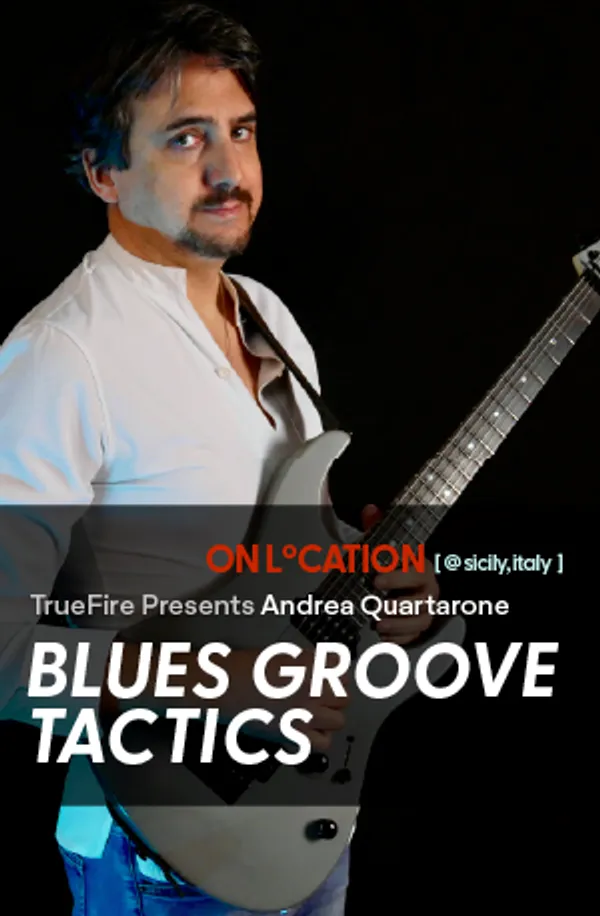
On Location: Modal Pentatonics

Blend Major Scale Modes & Pentatonics to Unlock Your Improv

Marty FriedmanTommy EmmanuelSteve VaiEric GalesEric Johnson

Get this course and 1,000+ more with All Access

Try 14 days free. Cancel any time.

Purchase Individual Course for $19.99
On Location: Modal Pentatonics

About this course

The pentatonic scale is one of the most universal tools in a guitarist’s vocabulary, but it doesn’t have to sound predictable. By weaving in modal colors and new interval choices, you can completely reshape how your solos feel, flow, and connect harmonically.

In On Location: Modal Pentatonics, Andrea Quartarone shares his modern framework for expanding the pentatonic sound into a full modal system. Filmed on location in Italy, this course will help you discover how to blend familiar shapes with fresh modal flavors to create lines that sing with depth and sophistication.

“We’ll cover the Modal Pentatonic System, mode-specific pentatonic scales, and creative ways to connect these ideas across the fretboard,” says Andrea. “By the end of this course, you’ll have the tools to expand your improvisation and take your solos to new heights.”

You’ll explore:

  • Modal Pentatonic System structure and fretboard visualization
  • Ionian, Lydian, and Dorian applications for melodic freedom
  • Aeolian and Mixolydian phrasing ideas for expressive leads
  • Phrygian, Locrian, and Altered pentatonic colors for modern tone
  • Creative ways to connect modal shapes across the neck
  • Performance studies to apply every idea musically
With TrueFire’s learning tools including synced tab, slow-mo, looping, and fretboard animations, you’ll have everything you need to practice, explore, and master these sounds at your own pace.

So grab your guitar and let’s dig in with Andrea Quartarone!


What you'll learn

  • Apply tritone substitution concepts melodically
  • Use the b5 pentatonic technique over altered dominants
  • Superimpose pentatonic scales over altered dominant chords
  • Connect multiple ii-V-I progressions across different keys
  • Learning about portable vs full-featured modeling options
Release date: 11/20/2025 • 1h 48m runtime
Start Course
Sample lessons
Mixolydian Pentatonic
Demonstration
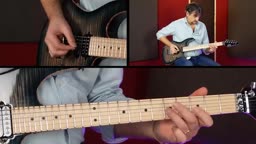
Song 3: Mixolydian Brave Hit
Performance
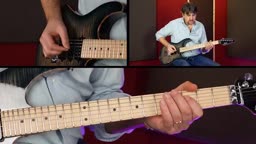
Song 3: Mixolydian Brave Hit
Breakdown

What's included

21 lessons • 12 charts • 5 Jam Tracks

On Location: Modal Pentatonics
You already know pentatonic scales, but what if you could unlock an entirely new world of sounds by combining them with major scale modes? Hey, I'm Andrea Quartarone, and in On Location: Modal Pentatonics, we’re going beyond the usual pentatonic shapes and exploring a fresh approach to improvisation. I’ll show you how to build and apply modal pentatonic sounds, mixing Ionian, Dorian, Mixolydian, and even altered pentatonics into your playing.

You’ll learn how to break free from predictable patterns, outline chord changes more effectively, and craft solos that sound rich and expressive. We’ll cover the modal pentatonic system, mode-specific pentatonic scales, and creative ways to connect these ideas across the fretboard. By the end of this course, you’ll have the tools to expand your improvisation and take your solos to new heights.

Grab your guitar, and let’s get started.
How to Work With This Course
We already know our pentatonic scales, but in this course we’re taking them somewhere new by combining them with major scale modes to unlock a whole new palette of sounds. We’ll explore how to mix Ionian, Dorian, Mixolydian, and even altered pentatonics to break free from predictable patterns and flow more naturally through chord changes. Together, we’ll dig into the modal pentatonic system, learn mode-specific shapes, and find creative ways to connect these ideas across the fretboard. By the end, we’ll have a fresh, expressive approach to improvisation and the tools to take our solos to a new level. We’ll start things off with a performance and then break it all down step by step.
Modal Pentatonic System
Musical language works just like spoken language—we build it by learning new words, ideas, and sounds until they naturally become part of how we express ourselves. In this section, we’ll focus on how to really understand and apply the modal pentatonic system so our improvisation feels connected and expressive. We’ll look at the theory behind it, get comfortable playing pentatonic scales all over the fretboard in every key, and train our ears to recognize different modal colors like Ionian, Dorian, and Mixolydian. We’ll also practice over single-chord vamps to internalize each sound and see how the harmony and scales interact. The goal is to move beyond just playing shapes—to start hearing, feeling, and speaking the language of modal pentatonics fluently. We’ll start things off with a performance and then break it all down step by step.
Ionian And Lydian Pentatonic
When we talk about modal playing, it’s easy to think we have to rely only on full modes—but we can actually capture those same modal colors using arpeggios and pentatonic scales too. In this course, we’ll explore how modes, arpeggios, and pentatonics each create their own melodic and dynamic character while sharing the same harmonic foundation. Our focus will be on applying pentatonic scales in a modal context, learning how to use them to outline chords like major 7s or 9s and evoke sounds like Lydian or Mixolydian just by shifting our pentatonic choices. We’ll go through each mode step by step, with practical examples and simple tips that help us confidently use modal pentatonics over any chord in any key. We’ll start things off with a performance and then break it all down step by step.
Song 1: Ionian and Lydian Perspectives
Now that we’ve learned how to use pentatonic scales to bring out rich modal colors and expand our soloing vocabulary, let’s jump into a performance followed by a breakdown.
Song 1: Ionian and Lydian Perspectives
Now that we’ve learned how to use pentatonic scales to bring out rich modal colors and expand our soloing vocabulary, let’s jump into a performance followed by a breakdown.
Dorian and Aeolian Pentatonic
In this lesson, we’re exploring the subtle but powerful differences between Aeolian and Dorian sounds—and how to bring those colors out using pentatonic scales. We’ll see how small shifts, like moving from a minor sixth to a major sixth, can completely change the mood of a solo, taking us from the darker Aeolian feel to the brighter, more open Dorian sound. We’ll learn how to visualize these relationships across the fretboard, think in intervals like perfect fourths and minor sixths, and apply them over real chord progressions so we can choose the right flavor for any musical moment. We’ll kick things off with a performance, then break it all down in detail.

+ 14 more lessons

Start Course

Reviews

3 results

Israel W.

05/06/26

Not interested.

I don’t know why people think that a lesson is the time to shred. But it’s not. I’m very interested in modal pentatonics but I have no interest in learning from someone who doesn’t know how to slow down and demonstrate properly.

Baccetti

Verified buyer

12/12/25

OK

arpeggio5

Verified buyer

12/05/25

Excellent video he’s a little hard to understand but gives very good video

He explains himself good samples, good player

Stop searching. Start improving with All Access.

Try 14 days free. Cancel any time.